
On this page
Start your online academy today. 14 days free.
Start free trialAn online academy is your own school on the internet: one place, under your name, where students find your courses, pay, learn and come back for the next batch. It is bigger than a single course and more yours than a channel or a marketplace page.
Maybe you teach SSC maths in Hindi and your YouTube channel is growing. Maybe you run a NEET batch from a rented room in Kota or Patna, or you teach spoken English and yoga to working adults over Zoom. In each case students already trust you. What is missing is a proper home for that trust: a place that collects fees, gives access, holds your notes and tests, and carries your brand.
That home is what people mean by an online academy. This guide explains the meaning, the parts, the types (with Indian examples), how it works from sign-up to first sale, what it costs, and how to tell if you are ready. If you already know you want one, our step-by-step guide to starting an online academy is the next read.
Key takeaways
- An online academy is an educator's own branded school online: a website (ideally on your own domain) and app where students buy courses, learn and stay enrolled.
- It is not the same as a course, a channel or an LMS. A course is one product, a channel is a free audience, a marketplace page is rented space, and an LMS is the software engine inside an academy.
- Seven parts make one academy: website on your domain, courses (video, PDF, tests), live classes, payments, a student app, student data and marketing tools.
- Six common types in India: exam-prep (NEET, JEE, SSC, UPSC), skill (spoken English, yoga, music, coding), school tuition, cohort or bootcamp, membership, and an offline institute going online.
- The running costs are predictable: a platform plan, any fee on sales, a domain, payment-gateway charges and GST. Add them up before you launch.
- Start with one course you already teach well, then add batches, tests and live classes as students arrive.
What is an online academy?
An online academy is an educator's or institute's own school on the internet: a branded website and app where students discover courses, pay, and learn through recorded lessons, PDF notes, tests and live classes. Unlike a single course, it holds many courses, batches and students under one name, and keeps them coming back.
Put simply, the academy is the business and the courses are what it sells. A student does not join "Chapter 4 video". They join your academy, for a NEET 2027 batch, and then buy your test series and a crash course before the exam.
Three things separate an online academy from other ways of teaching online:
- One brand. Students see your name, logo and web address, not a platform's.
- Many products. Courses, test series, notes, live batches and memberships live side by side.
- A relationship that lasts. Students log in again and again, and you know who they are.
Online academy meaning in Hindi and everyday use
In everyday Indian usage, "online academy" overlaps with "online coaching", "online institute" and "online classes". In Hindi you will hear it called an online coaching centre or online shiksha sansthan. The idea is the same: a teacher or institute that runs its classes, notes, tests and fees online instead of (or as well as) in a classroom.
The word "academy" matters, though. It signals something more permanent than a one-off course: a place with a name, a syllabus, a calendar and a community of students.
Online academy vs online course, YouTube channel and marketplace
An online course is one product; an online academy is the whole school that sells many products under your brand. A YouTube channel builds a free audience, and a marketplace listing puts your course in someone else's shop. An academy is where those audiences end up paying you directly.
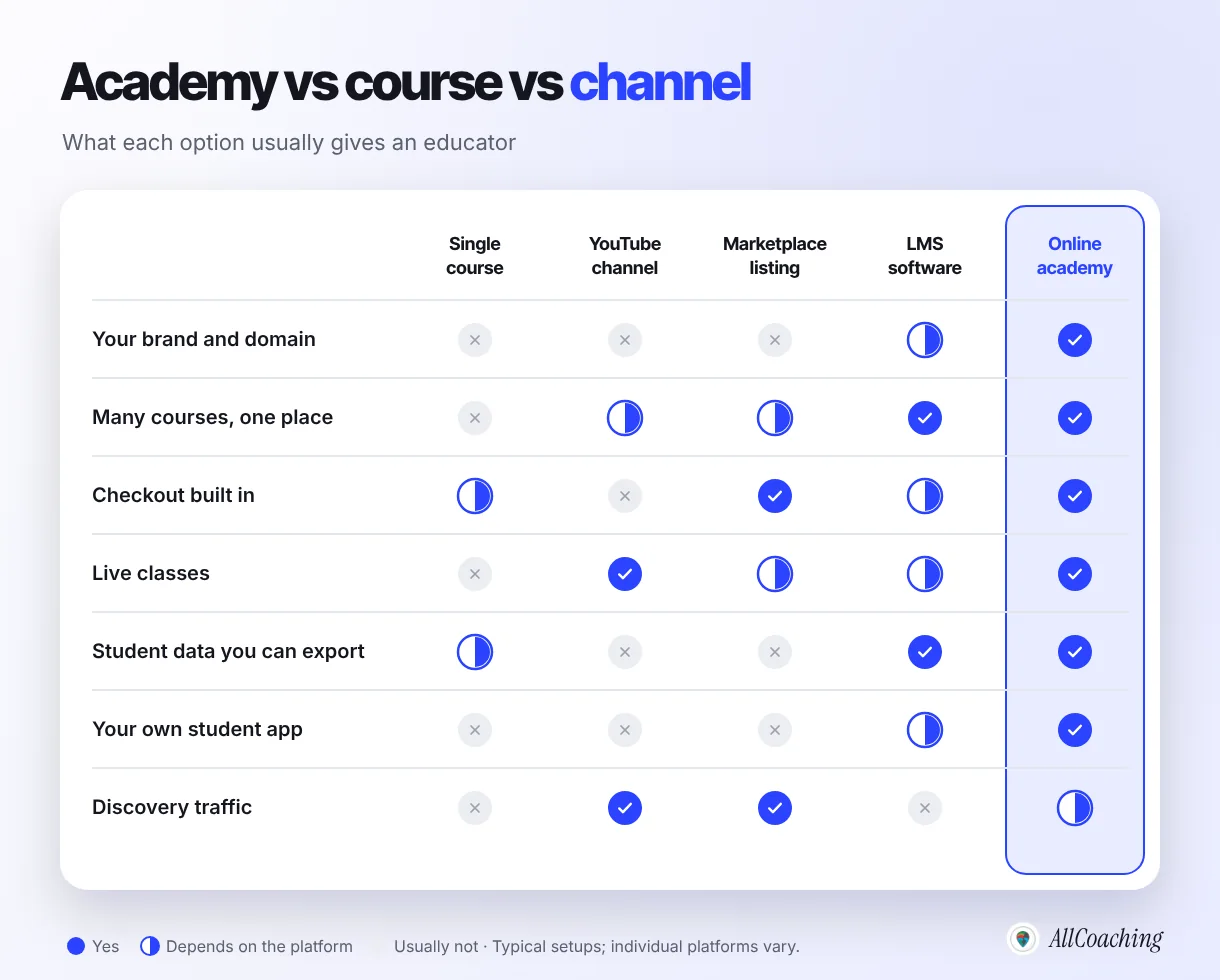
Online academy vs online course
A single online course is a set of lessons on one topic, such as "SSC CGL Quant in Hindi". It can be sold as a link, a Google Drive folder or a page on a course platform. That works for a first experiment.
An academy starts to matter when you have more than one thing to sell, or more than one batch a year. It keeps every course, every student and every payment in one place, so a student who finished your Quant course can buy your mock-test series in two taps.
Online academy vs YouTube channel
YouTube is excellent for being found. It is not built for paid learning: there is no syllabus order, no test series, no fee collection for a batch and no way to see which student watched what. Most successful educators in India use YouTube as the front door and an academy as the classroom. Our guide on how to sell courses online in India shows how to move viewers from free videos to a paid course.
Online academy vs marketplace listing (Udemy or Unacademy style)
On a large marketplace, your course is one listing among thousands. The platform owns the student relationship, sets much of the pricing and branding, and the student remembers the platform more than you. In return, you may get discovery. In your own academy, the student relationship, the price and the brand are yours. If you are weighing the two, read own app or marketplace: three paths compared.
Question educators ask
Can I run an online academy and still sell on YouTube or a marketplace?
Yes, and many educators do. Free YouTube lessons and social posts bring students in; the academy is where they pay, learn and stay. The key is that the paid relationship sits on a website and app with your name on it.
Online academy vs LMS: what is the difference?
An LMS (learning management system) is the software that delivers and tracks learning; an online academy is the complete business built around it. Every online academy needs an LMS inside it, but an LMS on its own is not an academy.
Wikipedia describes a learning management system as "a software application for the administration, documentation, tracking, reporting, automation, and delivery of educational courses, training programs, materials, or learning and development programs".1 That covers lessons, tests and progress. It does not, by itself, cover the things that make students find you, trust you and pay you.
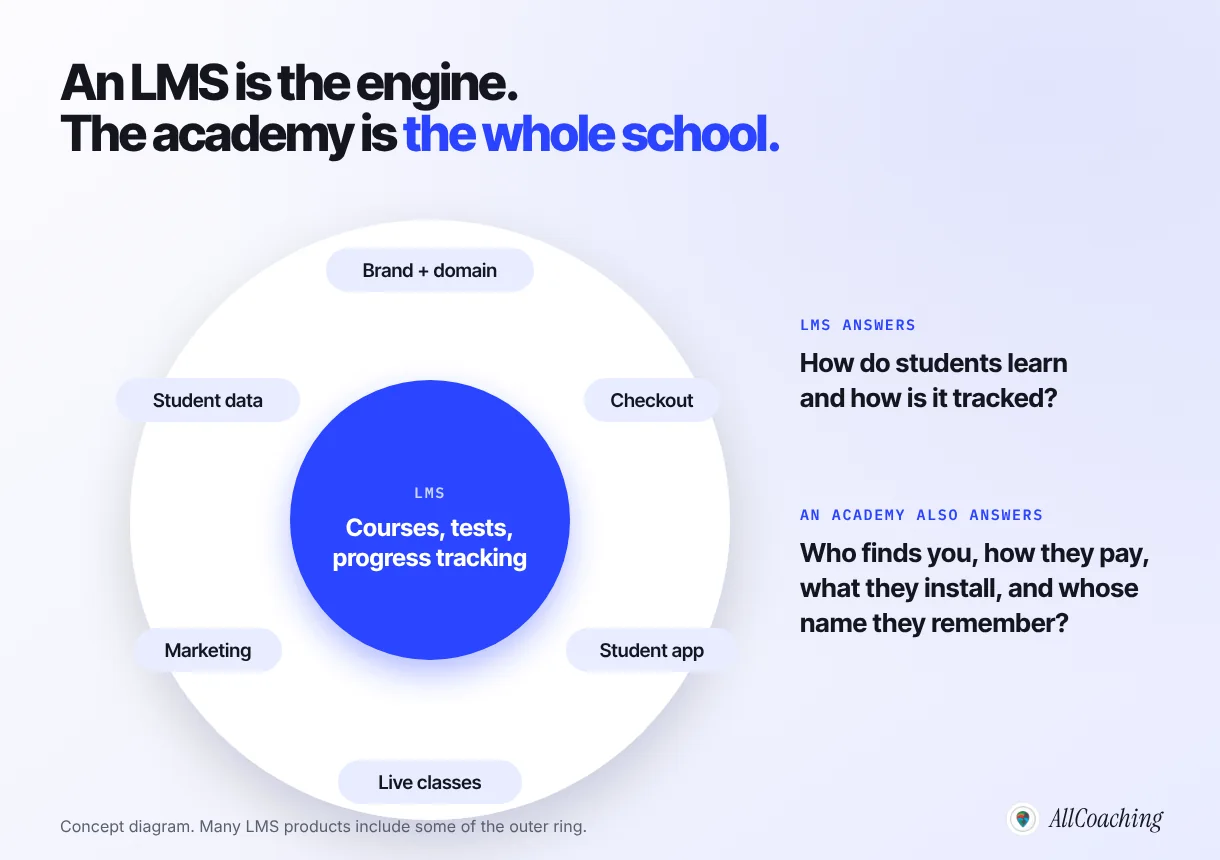
| Question | LMS alone | Online academy |
|---|---|---|
| How are lessons and tests delivered? | Yes, its core job | Yes, through the LMS inside it |
| Whose name and web address do students see? | Depends on the product | Yours, on your own domain |
| How do students pay? | Often a separate add-on | Checkout built in, access given on payment |
| What do students install? | Often a generic app or none | Your own branded app |
| How do new students find you? | Not its job | Website pages, SEO and ad tracking |
This is why the phrase "build your own LMS" has become shorthand for "build your own academy". Educators do not want software to manage; they want a school that runs. For a side-by-side look at the software options, see the best LMS for coaching institutes in India.
The parts of an online academy
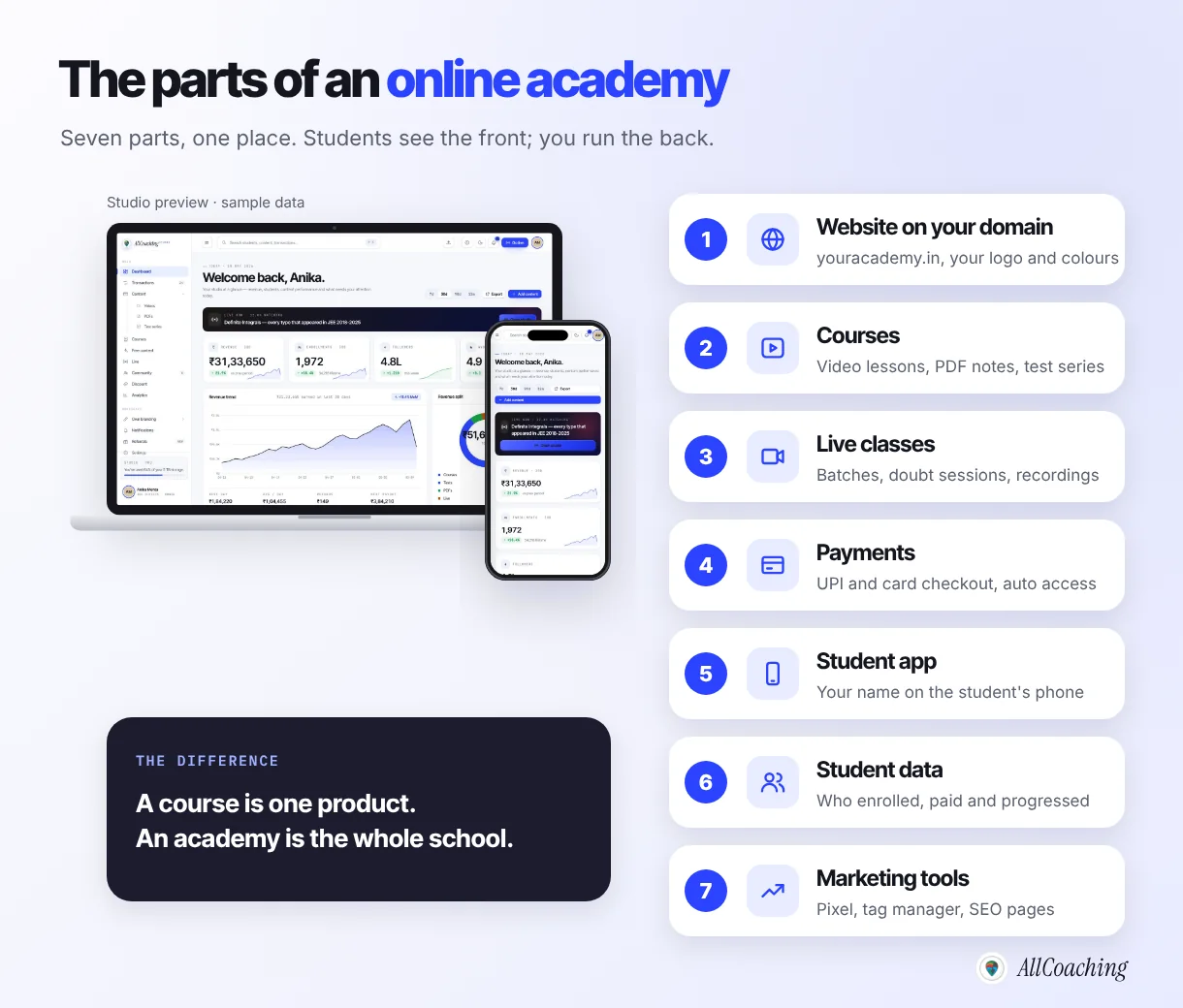
A complete online academy has seven parts: a website on your own domain, courses, live classes, payments, a student app, student data and marketing tools. You can start without some of them, but students notice when one is missing.
1. A website on your own domain
Your academy's address, such as youracademy.in, is the one link you share everywhere: YouTube descriptions, Instagram bio, WhatsApp groups and posters. A domain in your name keeps that address yours even if you change tools later. Our guide to an LMS with a custom domain explains how connecting one works.
2. Courses: video, PDF notes and tests
Most Indian academies sell a mix: recorded video lessons in syllabus order, downloadable PDF notes and formula sheets, and test series with timed mocks and solutions. Exam-prep students in particular expect previous-year questions and full-length mocks.
3. Live classes
Live batches, doubt-clearing sessions and revision marathons keep students accountable. They can run on YouTube Live, Zoom or a live room inside the academy, with recordings added to the course afterwards. See how to conduct live classes on mobile apps for the practical setup.
4. Payments
Students pay by UPI or card at checkout, and access opens automatically. No screenshots of payment on WhatsApp, no manual adding to groups. If you are choosing a gateway, compare charges in our guide to the best UPI payment gateway for online courses.
5. A student app
Indian students learn mostly on phones. TRAI reported 1,114.17 million internet subscribers in India at the end of June 2026, of whom 1,066.43 million were wireless subscribers (checked October 2026).3 An app with your name on the student's home screen is a daily reminder of your academy.
6. Student data
Who enrolled, who paid, who finished Chapter 6 and who has not logged in for two weeks. This record is what lets you follow up, run a re-enrolment offer, or move platforms without losing anyone. Make sure you can export it.
7. Marketing tools
Pages that can rank on Google, plus tracking such as Meta Pixel and Google Tag Manager so your ads and posts can be measured. Our online academy SEO guide for beginners covers the search side in detail.
Types of online academy (with examples from India)
Most online academies in India fall into six types: exam-prep, skill, school tuition, cohort or bootcamp, membership, and an offline institute going online. Many educators combine two, such as an exam-prep academy with a membership for current affairs.
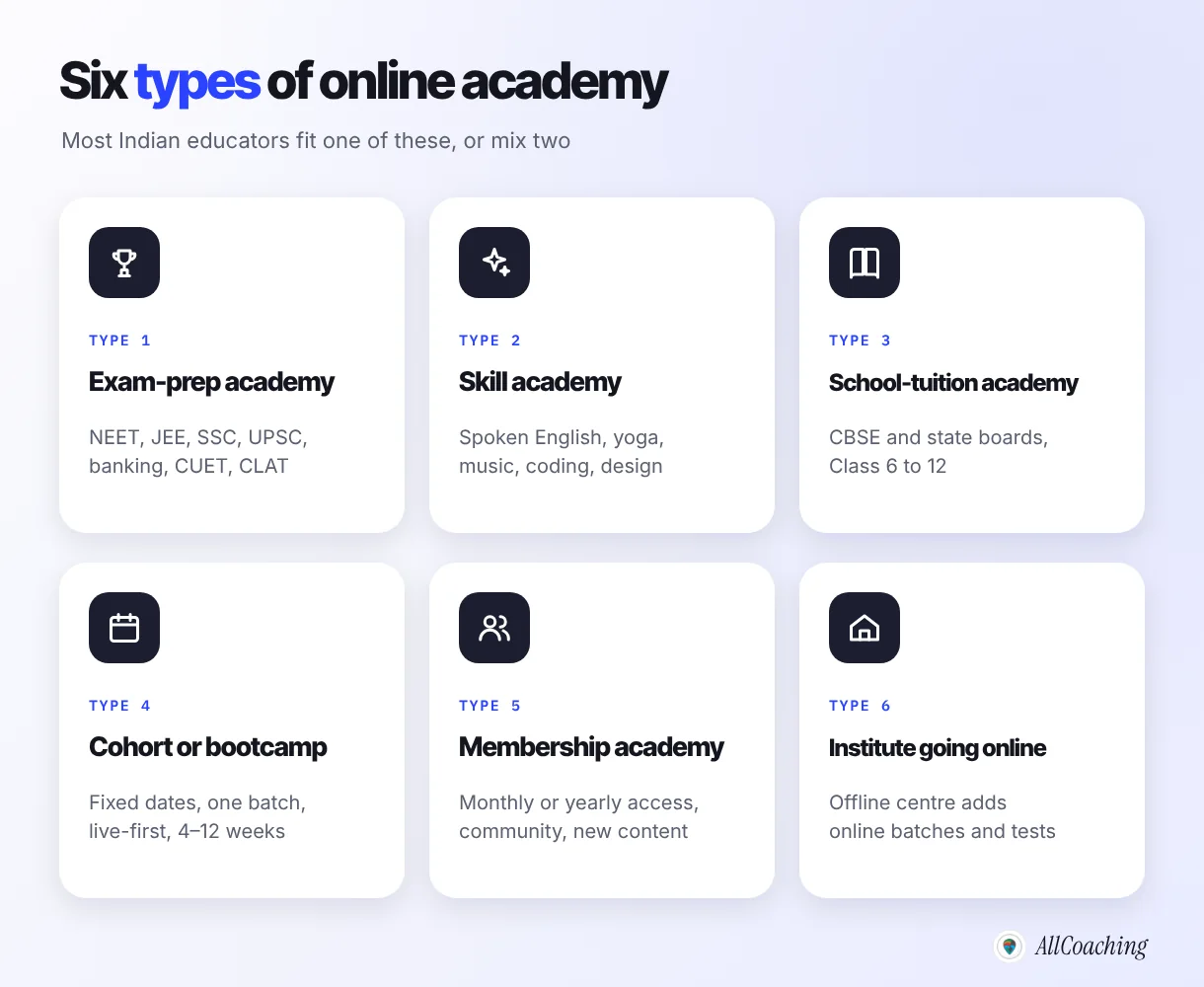
1. Exam-prep academy
Built around a competitive exam and its calendar: NEET, JEE, SSC CGL, banking PO, UPSC, state PSC, CUET or CLAT. The products are full courses, subject-wise batches, test series and crash courses timed to the exam. Hindi and regional-medium academies are a large share of this type. Example: a physics teacher in Lucknow running a NEET 2027 batch in Hinglish, with weekly tests. Our guide for NEET educators goes deeper.
2. Skill academy
Teaches a skill rather than a syllabus: spoken English, yoga, Carnatic or Hindustani music, guitar, coding, digital marketing, design, vastu or the Vedas. Students are often working adults, and they buy on outcomes ("speak confidently in interviews"). Example: a spoken-English trainer selling a 60-day course and weekly live speaking practice. See our guide for spoken English teachers.
3. School-tuition academy
Follows CBSE, ICSE or state-board syllabi for Classes 6 to 12. Parents are often the buyers, so clear schedules, test results and progress reports matter. Example: a maths tutor teaching Class 10 board batches online after school hours.
4. Cohort or bootcamp academy
Runs fixed-date batches, usually live-first, for a set number of weeks. Everyone starts and finishes together. It suits intensive programmes such as a 6-week interview-preparation bootcamp or a 30-day UPSC answer-writing challenge.
5. Membership academy
Students pay for ongoing access rather than a single course: monthly current affairs for UPSC, a yoga practice library, or a music riyaz community with new lessons each week. Income is steadier, but you must keep adding content.
6. Institute going online
An established offline coaching centre that adds online batches, recorded backups of classroom lectures and online test series. It keeps its local reputation and reaches students in other cities. Our guide to moving offline coaching online covers the switch.
How does an online academy work?
An online academy works like an online shop for teaching: you set it up once, add courses, share one link, and the platform handles payments, student access, the app and hosting each time someone enrols. Your daily work stays teaching.
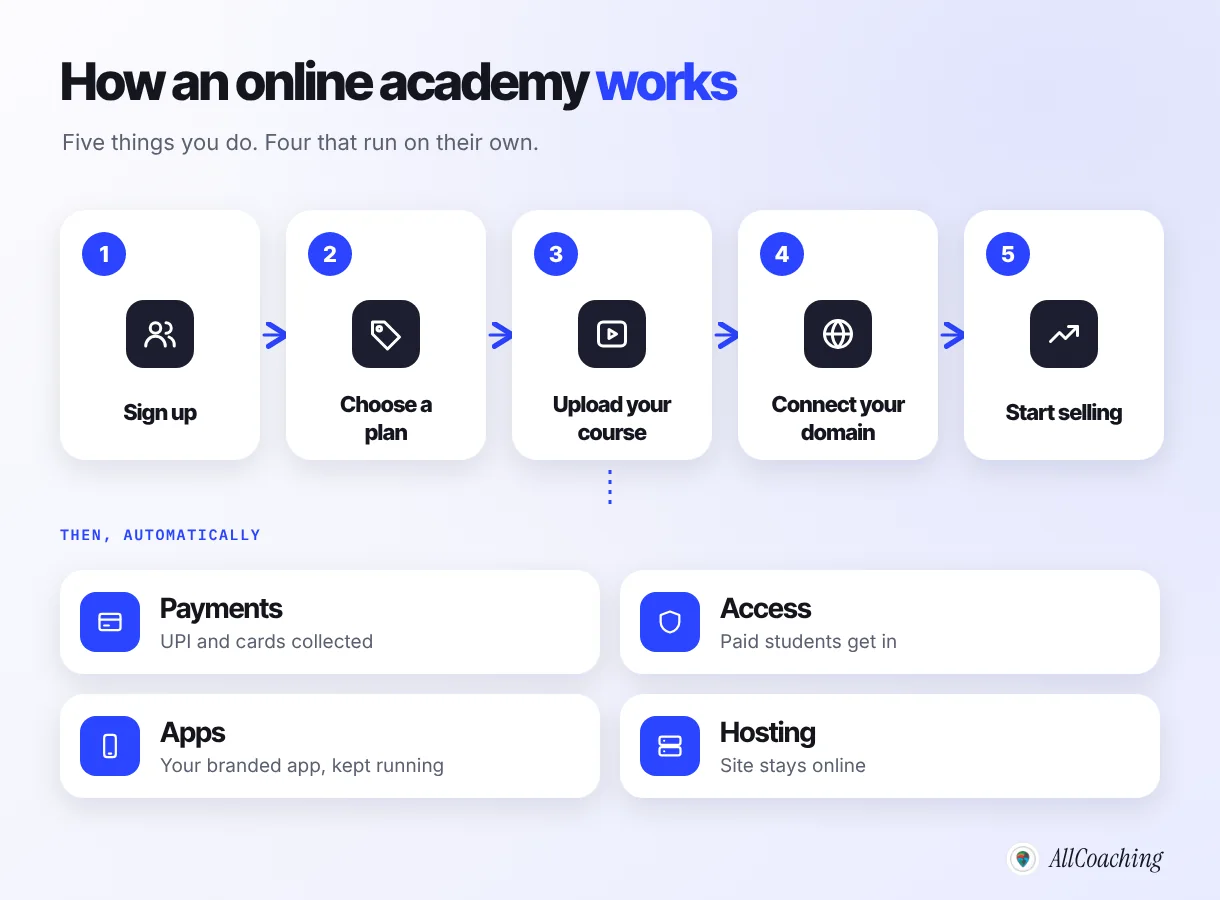
What you do
- Sign up on an academy platform and name your academy.
- Choose a plan that fits your stage and expected sales.
- Upload your course: videos, PDFs and tests, in syllabus order, with a free demo lesson.
- Connect your domain and add your logo and colours.
- Start selling: share the course link with your students and followers.
What runs on its own
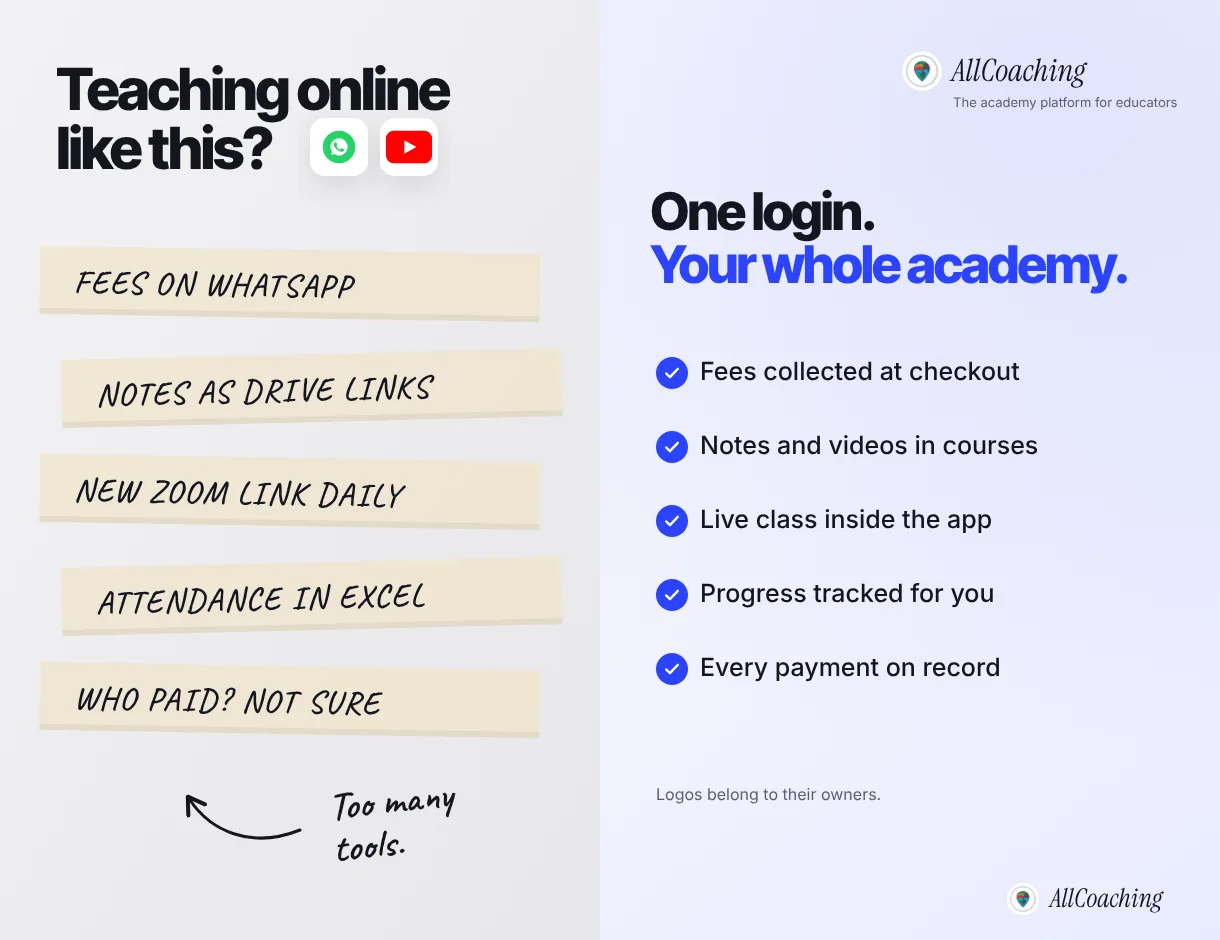
When a student pays, the checkout collects the fee by UPI or card, access to the course opens, the student can log in on the website or your app, and the site stays online without you managing servers. This is the difference between an academy and a stitched-together setup of separate tools.
On AllCoaching, this is the whole path: sign up, choose a plan, upload your course, connect your domain and start selling. Payments run through Razorpay with automatic payouts, and every plan includes your academy website on your own domain, your own white-label Android app, unlimited live classes (YouTube Live, Zoom or the built-in live room) and unlimited videos via YouTube. The iOS app is included on the Pro and Scale plans.
A day in a running academy
Here is an illustrative day for a JEE maths educator. In the morning, two students buy the crash course from a link in last night's YouTube video; both get access without a message to you. At 6 pm you run a live doubt session that is recorded into the course. At night you check which students skipped this week's mock and send them a reminder. None of these steps needs a spreadsheet.
When educators set up an academy with us, the slowest step is rarely the technology. It is deciding what the first course is and recording the demo lesson. Plan that before you sign up anywhere.
What does an online academy cost in India?
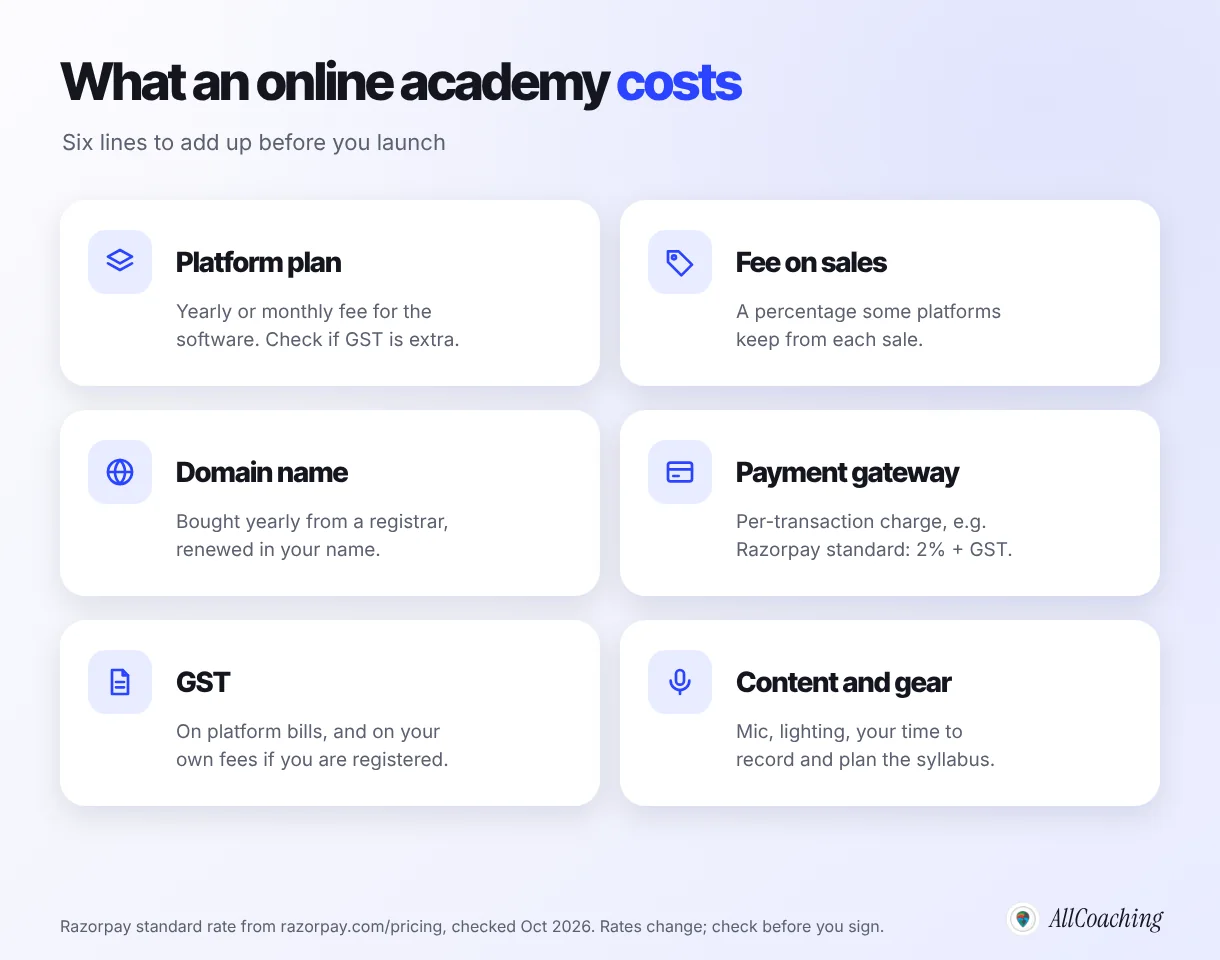
An online academy's cost is the sum of five things: the platform plan, any fee the platform takes on sales, your domain, payment-gateway charges and GST. Content production (a mic, lighting and your time) comes on top. Add all of them before comparing platforms.
The generic cost lines
- Platform plan. A yearly or monthly price for the software. Check whether GST is included or extra.
- Fee on sales. Some platforms keep a percentage of each sale; others charge only the plan. A percentage costs little when sales are small and more as you grow.
- Domain. Bought from a domain registrar and renewed every year. Register it in your own name so it stays yours.
- Payment gateway. Gateways charge per transaction. Razorpay's standard plan lists a 2% platform fee per successful domestic transaction, with 18% GST on that fee (checked October 2026).4 Ask your academy platform how gateway charges are handled.
- GST. Platform bills usually carry GST, and if you are GST-registered your own course fees may too. Our guide to GST for coaching institutes explains the rules.
What AllCoaching costs
AllCoaching starts with a 14-day free trial, with no card needed. After that you choose one of four yearly plans (prices exclude GST): Starter ₹6,999 with a 10% platform fee on sales, Growth ₹12,999 with 7.5%, Pro ₹24,999 with 5%, or Scale ₹99,999 with a 0% platform fee, so you keep 100% of every sale. Scale is bought through Contact us rather than self-serve. Before GST, Pro costs less than Scale below about ₹15 lakh of yearly sales, and Scale costs less above that. Full details are on the pricing page.5
To set your own course prices, use our guide on how to price online courses in India.
Build your own academy. Try it free for 14 days.
Website on your own domain, your own Android app (iOS app on Pro and Scale), unlimited live classes and UPI checkout on every plan. Plans from ₹6,999 a year after the trial (excl. GST).
No card needed · Cancel anytime in the trial · Your data stays exportableIs an online academy right for you?
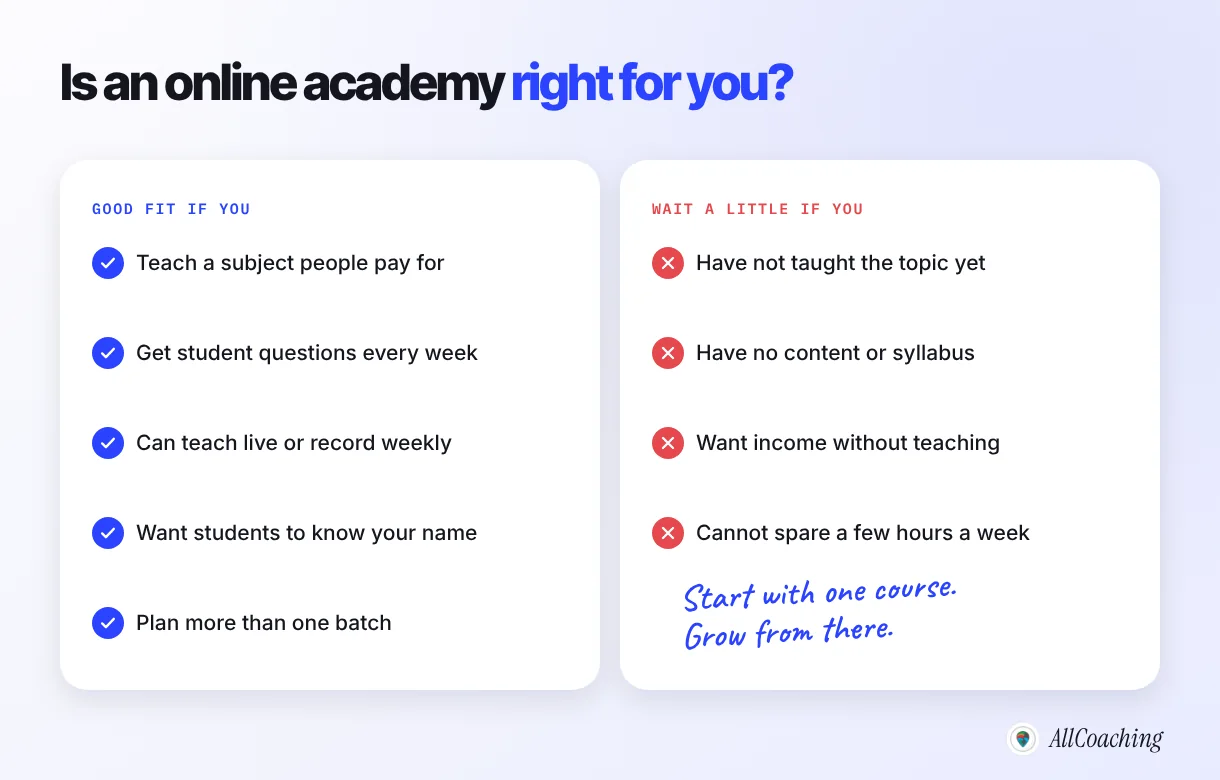
An online academy is right for you if you already teach something people pay for and want students to remember your name, not a platform's. It is too early if you have not yet taught the topic or have no time to teach each week.
Good fit
You teach an exam or skill with steady demand. Students already message you questions on WhatsApp or comment on your YouTube videos. You can teach live or record a few lessons a week. You plan to run more than one batch or course.
Wait a little
You have not taught the topic to real students yet. You have no syllabus or sample lessons. You want income without teaching. In these cases, teach a small group first, even for free, then build the academy around what worked.
Google's own guidance is a useful test for your academy's pages too. Its ranking systems "are designed to prioritize helpful, reliable information that's created to benefit people, and not content that's created to manipulate search engine rankings."2 An academy built on real teaching experience is exactly that kind of content.
"Google's automated ranking systems are designed to prioritize helpful, reliable information that's created to benefit people."
Google Search Central, Creating helpful, reliable, people-first contentHow to start an online academy: 6 steps
To start an online academy, pick one course you already teach well, set up the academy on a platform, upload that course with a free demo, connect your domain, and share the link with the students who already follow you. The six steps below are the short version.
- Choose your first coursePick one exam or skill you already teach well, and write its syllabus as a list of chapters and tests.
- Record a demo lessonRecord one strong free lesson of 10 to 20 minutes so students can judge your teaching before paying.
- Sign up and start the trialCreate your academy on a platform with a free trial, name it and add your logo and colours.
- Upload the courseAdd videos in syllabus order, PDF notes and at least one test, then set the price and validity.
- Connect your domainPoint your own domain, such as youracademy.in, to the academy so every link carries your name.
- Share and sellPost the course link in your YouTube descriptions, Instagram bio and WhatsApp groups, and run a live demo class.
For the full walk-through with screenshots and examples, read how to start an online academy in 5 steps. If students push back on installing an app, our guide on students who only want WhatsApp has practical fixes.
Glossary
- Online academy
- An educator's or institute's own branded school on the internet, where students buy courses, learn, take tests and attend live classes.
- Online course
- A single set of lessons on one topic, sold or shared online. An academy can sell many courses.
- LMS (learning management system)
- Software that delivers lessons and tests and tracks student progress. It is the engine inside an online academy.
- Custom domain
- Your own web address, such as youracademy.in, connected to your academy website instead of a platform's address.
- White-label app
- A student app that carries your academy's name and logo, built on a platform's technology.
- Test series
- A set of timed mock tests with answers and solutions, common in exam-prep academies.
- Cohort
- A group of students who start and finish a batch on the same dates, usually with live classes.
- Platform fee
- A percentage of each sale that an academy platform keeps, in addition to or instead of a plan price.
- Payment gateway
- The service that collects UPI, card and net-banking payments online and settles them to your bank account, for a per-transaction charge.
Frequently asked questions
What is an online academy?
An online academy is an educator's or institute's own school on the internet: a branded website and app where students discover courses, pay, and learn through recorded lessons, PDF notes, tests and live classes. It holds many courses, batches and students under one name.
What is the meaning of online academy?
Online academy means a teaching business that runs its classes, study material, tests and fee collection online under its own brand. In India it is also called an online coaching centre or online institute.
What is the difference between an online academy and an online course?
An online course is one product on one topic. An online academy is the whole school: it sells many courses, test series and live batches under your brand, keeps every student and payment in one place, and lets students come back for the next course.
Is an online academy the same as an LMS?
No. An LMS (learning management system) is the software that delivers and tracks lessons and tests. An online academy includes an LMS but also your brand and domain, checkout, a student app, live classes, marketing tools and student data.
What are the types of online academy?
The common types are exam-prep academies (NEET, JEE, SSC, UPSC, banking), skill academies (spoken English, yoga, music, coding), school-tuition academies, cohort or bootcamp academies, membership academies, and offline institutes that add online batches.
How does an online academy work?
You sign up on an academy platform, choose a plan, upload your course, connect your domain and start selling. When a student pays, the platform collects the fee, opens course access, serves the website and app, and keeps the site online.
How much does it cost to start an online academy in India?
Add up the platform plan, any fee on sales, a yearly domain, payment-gateway charges and GST. On AllCoaching, after a 14-day free trial with no card, plans are ₹6,999, ₹12,999 or ₹24,999 a year with a 10%, 7.5% or 5% fee on sales, or ₹99,999 a year with 0%, all excluding GST.
Do I need a website and an app for my online academy?
A website on your own domain is the minimum, because it is the one link you share everywhere. An app helps because most Indian students study on phones. Many academy platforms provide both from the same setup.
Can a small tutor or a single teacher run an online academy?
Yes. Many online academies in India are run by one teacher. Start with one course you already teach, add a test series and live doubt sessions, and grow into more batches as students arrive.
Sources
- Wikipedia, "Learning management system", en.wikipedia.org, checked October 2026.
- Google Search Central, "Creating helpful, reliable, people-first content", developers.google.com, checked October 2026.
- Telecom Regulatory Authority of India, Press Release No. 135/2026, "Indian Telecom Services Performance Indicator Report" for April to June 2026, 12 October 2026, trai.gov.in, checked October 2026.
- Razorpay pricing, razorpay.com/pricing, standard plan, checked October 2026.
- AllCoaching pricing, allcoaching.in/pricing, October 2026.
Amit builds AllCoaching, the academy platform Indian educators set up themselves: their own website on their own domain, their own app, and the tools to grow it. This guide explains what an online academy is in plain words, with every outside fact linked to its source.