
On this page
Start your online academy today. 7 days free.
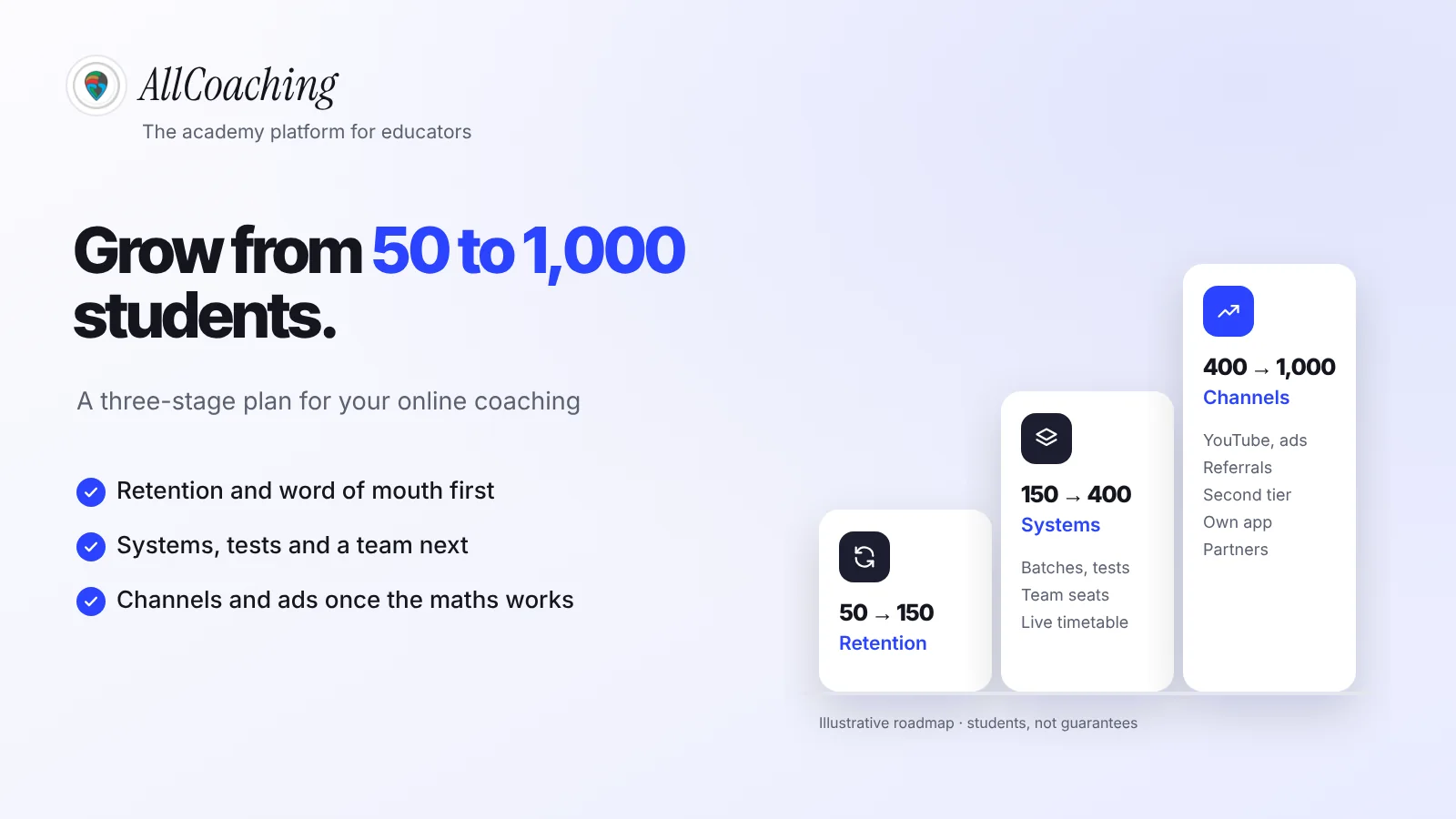
Start free trialTo grow online coaching from 50 to 1,000 students, work in three stages: from 50 to 150, make your current students finish, improve and recommend you; from 150 to 400, build systems such as batches, test series, a timetable and a team; from 400 to 1,000, add channels such as YouTube, referrals and paid ads once the numbers pay back.
Maybe you teach SSC maths in Hindi and your first 50 students came from YouTube and a few WhatsApp groups. Or you run a spoken English course from Indore and word of mouth has carried you this far. Now growth has slowed, doubts take your whole evening, and you are wondering whether ads are the answer.
This guide is the next chapter after getting your first students. It covers what to fix at each stage, the six numbers to track with simple formulas, an illustrative unit-economics example, when to hire, and which plan fits each size.
Key takeaways
- Grow in three stages, in order: retention (50 → 150), systems (150 → 400), channels (400 → 1,000).
- Retention comes first: completion, doubt replies within a day, tracked results and real reviews with permission make word of mouth work.
- Systems replace your personal effort: dated batches, a test series with rank and percentile, a fixed live timetable, team logins and one student list.
- Run paid ads only when CPA is well below what a student pays you after platform fees; illustrative: ₹1,000 CPA on a ₹3,000 course.
- Track six numbers monthly: enrolments, completion rate, renewal rate, CPL and CPA, refund rate and lifetime value.
- Hire at a signal, not a count: a second teacher when live classes crowd out content, a support person when messages take two or more hours a day.
- Plan maths changes with size: below about ₹4 lakh a year yearly Starter usually costs least; above that a monthly plan at 0% commission usually leaves more.
What does it take to grow online coaching from 50 to 1,000 students?
Growing online coaching from 50 to 1,000 students takes three different jobs in order: first keep and delight the students you have, then build systems that run without you in every step, and only then add channels such as YouTube, referrals and paid ads. Each stage fixes the thing that would break the next one.
At 50 students you can answer every doubt yourself on WhatsApp. At 400 you cannot, and if the experience gets worse as you grow, the new students you pay for leave as fast as they arrive. That is why the order matters more than any single tactic.
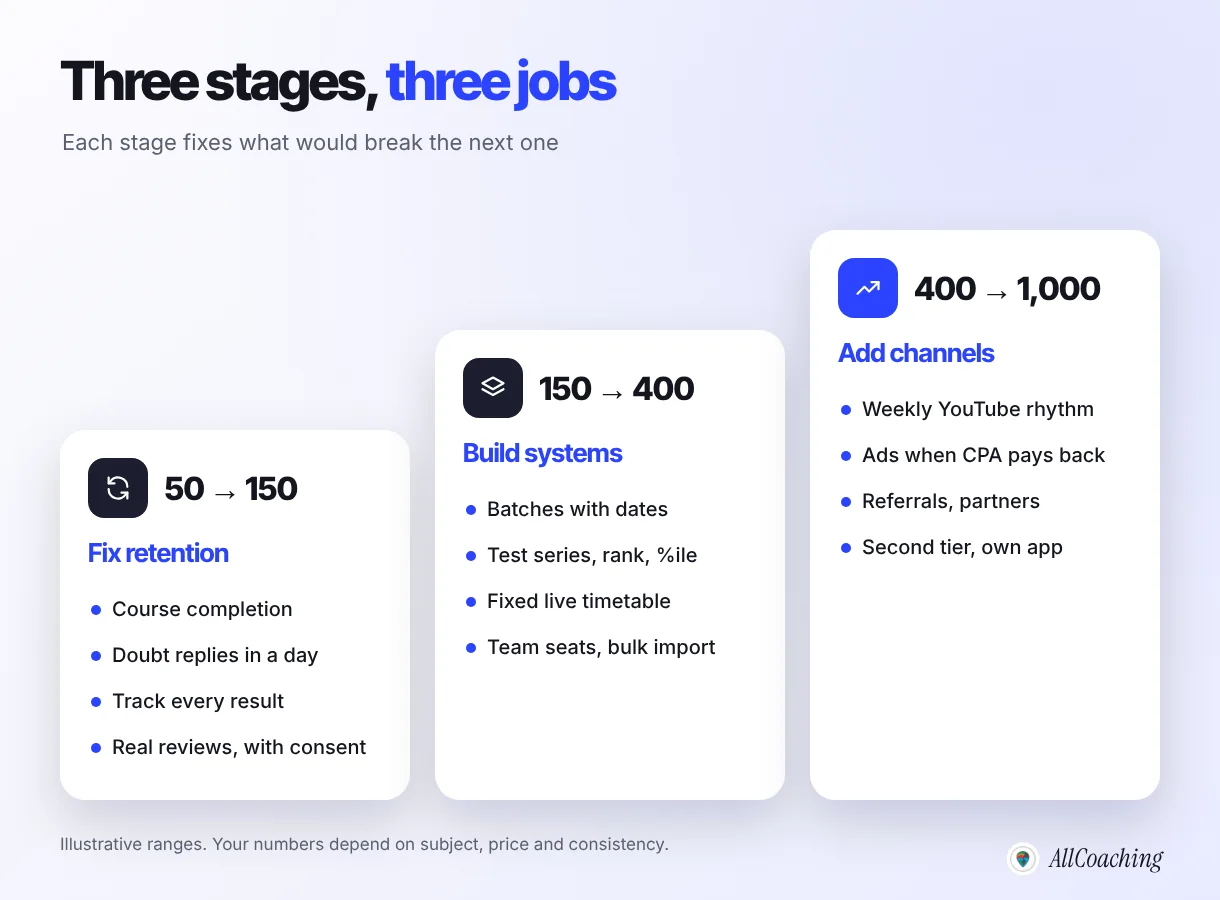
| Stage | Main job | What usually breaks if you skip it |
|---|---|---|
| 50 → 150 students | Retention and word of mouth | Students drop off midway, nobody recommends you |
| 150 → 400 students | Systems, tests, timetable, team | You become the bottleneck for every doubt and upload |
| 400 → 1,000 students | Channels, ads, second product, own app | Growth stalls at what word of mouth alone can bring |
None of this is a promise of a number. It is a sequence, so each rupee and hour you put in later works harder.
Stage 1, 50 to 150 students: fix retention and word of mouth
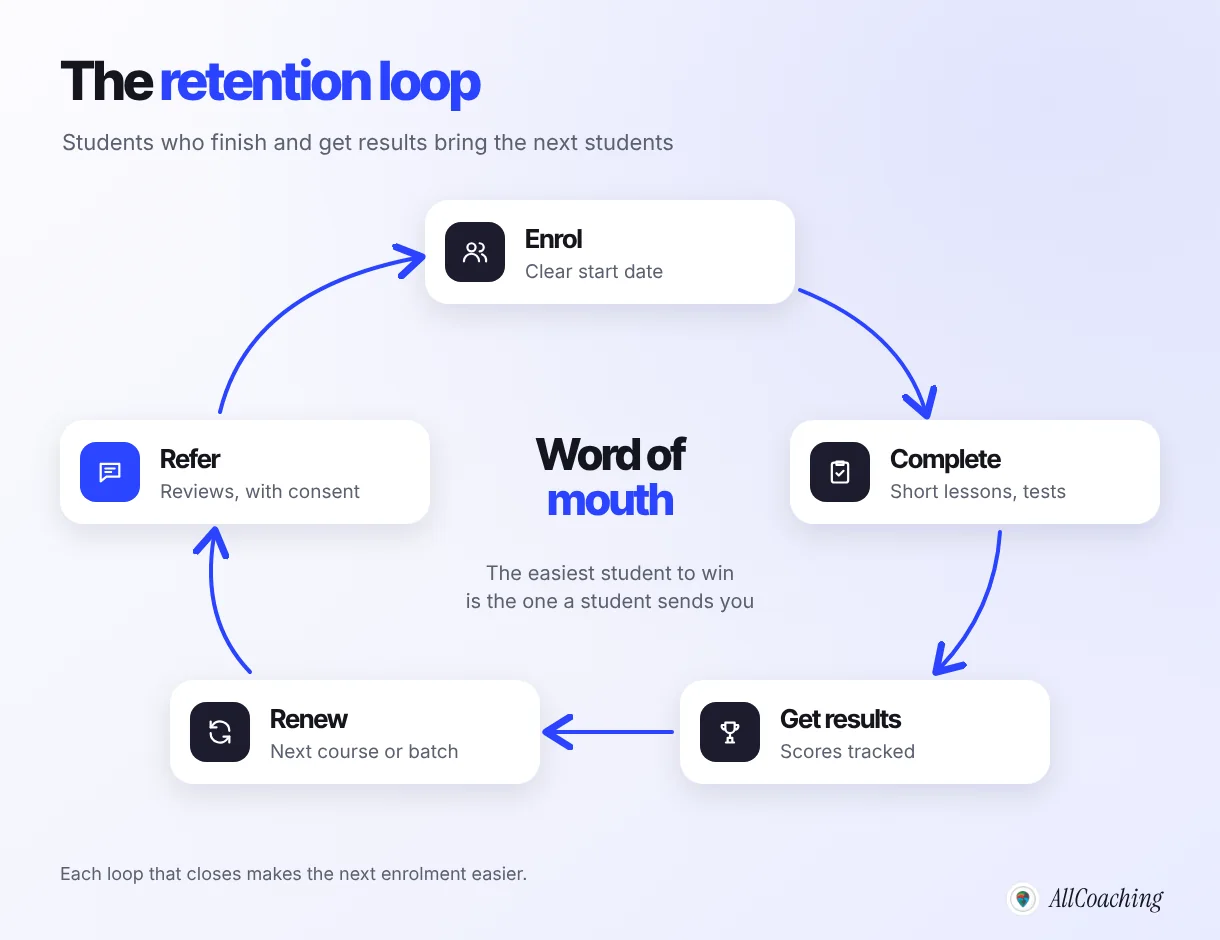
From 50 to 150 students, the fastest way to increase students in online coaching is to make your current students finish, improve and talk about you: raise course completion, answer doubts within a day, track every result and ask for honest reviews with permission. Word of mouth costs you nothing per student, and it only works when students get what they paid for.
Raise course completion
A student who stops at lecture 6 does not renew and does not recommend you. Break long recordings into 15 to 30 minute lessons, give every week a clear goal, and put a short test at the end of each chapter so students see their own progress. Check which lesson most students stop at and rework that one first.
Answer doubts within a day
Set a doubt routine you can keep: one fixed live doubt session a week plus replies within 24 hours on your chosen channel. Write the common doubts into a PDF or a short video so you answer each one once, not fifty times.
Track every result
Keep a simple sheet: student, course, test scores over time, final exam result or skill outcome. For an SSC or NEET batch that is marks and selections; for a spoken English or yoga course it is a before-and-after recording or a completed practice log. These records tell you what is working and give you honest stories to share.
Testimonials: only real, only with permission
Ask every student, not only the toppers, for a short honest review after a milestone. Publish a name, photo, score or quote only with written permission, and from a parent too for a minor. Never write reviews yourself or edit a student's words into something they did not say. A single fake testimonial can cost you more trust than ten real ones earn.
Question educators ask
Should I start ads at 50 students to grow faster?
Usually not yet. If half your students do not finish the course, ads mostly buy you more students who drop off. Fix completion and doubt support first, then use ads to multiply something that already works.
Stage 2, 150 to 400 students: build systems that run without you
From 150 to 400 students, scaling online coaching means turning your personal effort into systems: dated batches, a test series with rank and percentile, a fixed live timetable, team logins, one student list and a content library, plus a clear free-to-paid ladder. The goal is that the experience stays the same quality whether you have 150 students or 400.
- Batches with dates. Run each batch as its own course with a start date, a schedule and an end date, for example "SSC CGL 2027 Batch A, starts 5 January" (illustrative). Dates create urgency without discounting.
- Test series. Weekly tests in the real exam pattern give students a reason to log in every week and give you data on who is falling behind.
- A fixed live timetable. Same days, same times, published a month ahead. Students plan around a timetable; they forget an announcement.
- Team seats. A second login for a teacher or helper, so you stop sharing one password.
- One student list. Move every student from scattered WhatsApp groups and spreadsheets into your academy so access, payments and announcements live in one place.
- A content library. Recorded lessons, PDFs and past tests organised by chapter, so new students catch up on their own.
Build a free-to-paid ladder
A ladder gives every student a next step at a price that fits their commitment. Illustrative ladder for a NEET biology educator: free chapter notes and one free mock test → a test series at ₹499 → the full course at ₹3,000 → a crash course or mentorship batch before the exam. A spoken English coach might go free 7-day practice plan → 30-day course → advanced speaking batch. Our guide to pricing online courses in India covers how to set each rung.
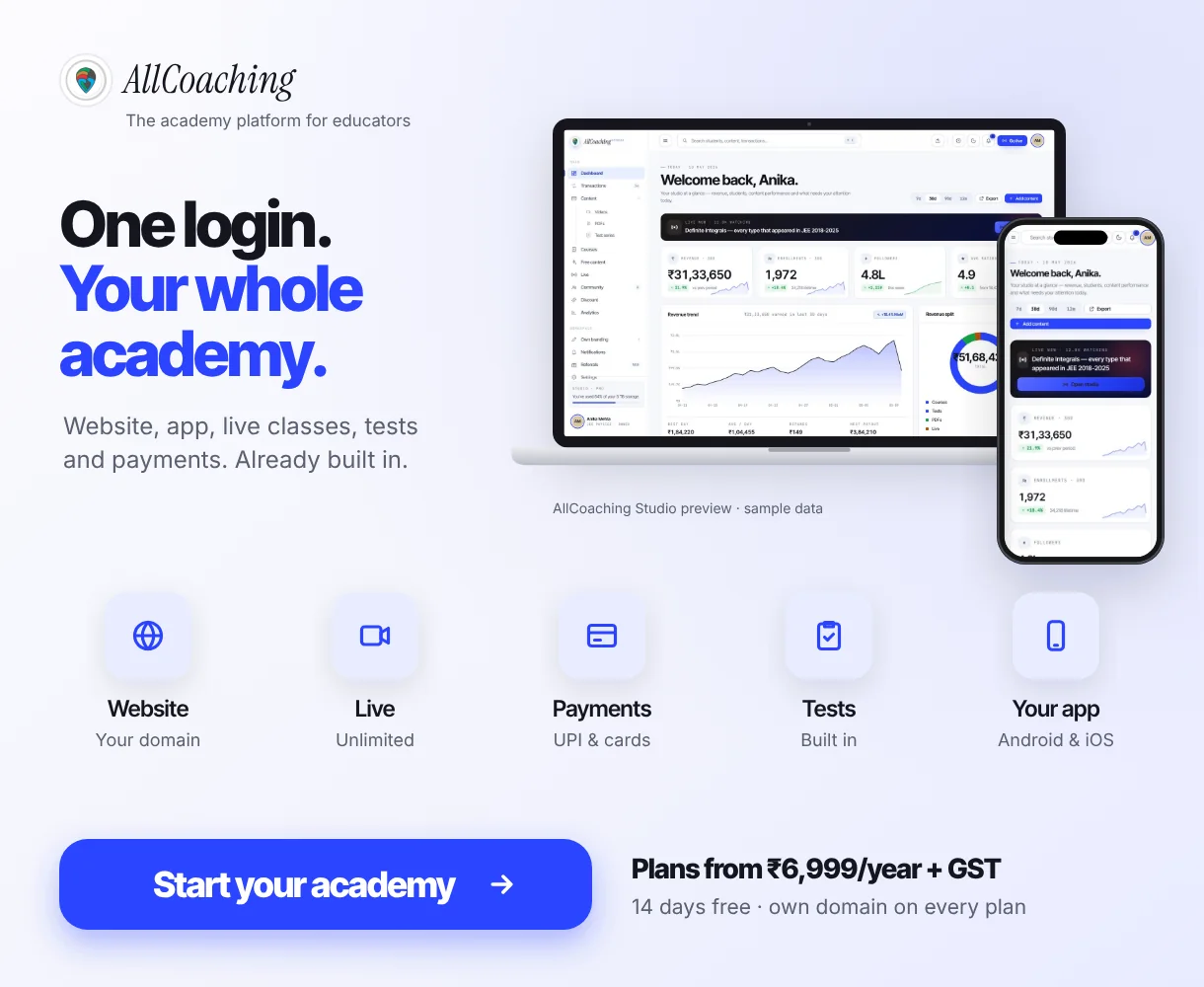
On AllCoaching, these systems are part of the studio. You can bulk-import your existing students from Excel or a Google Sheet, run test series with auto-grading, all-India rank and percentile, a full-screen anti-cheat lock and random question order, issue branded certificates automatically on completion, each with a unique ID, and give your team their own logins: 3 seats on Starter, 5 on Growth and 7 on Pro, you included. Free content sits in its own section, so the first rung of your ladder lives on your own academy, not on a borrowed platform.
Stage 3, 400 to 1,000 students: add channels at scale
From 400 to 1,000 students, online coaching business growth comes from adding channels one at a time on top of a system that already retains students: a steady YouTube rhythm, paid ads only when the numbers pay back, referrals and partnerships, a second product or tier, and your own app. Add one, measure it for a month or two, then add the next.
YouTube on a fixed rhythm
Pick a rhythm you can hold for a year, for example two lessons and three Shorts a week (illustrative). Each video answers one question students search and ends with one next step: a free test or notes on your academy. YouTube's audience retention report shows where viewers stop watching. In YouTube's own words, it "explains how well different moments of your video held viewers' attention".3 Use it to fix your openings.
Paid ads, only when unit economics work
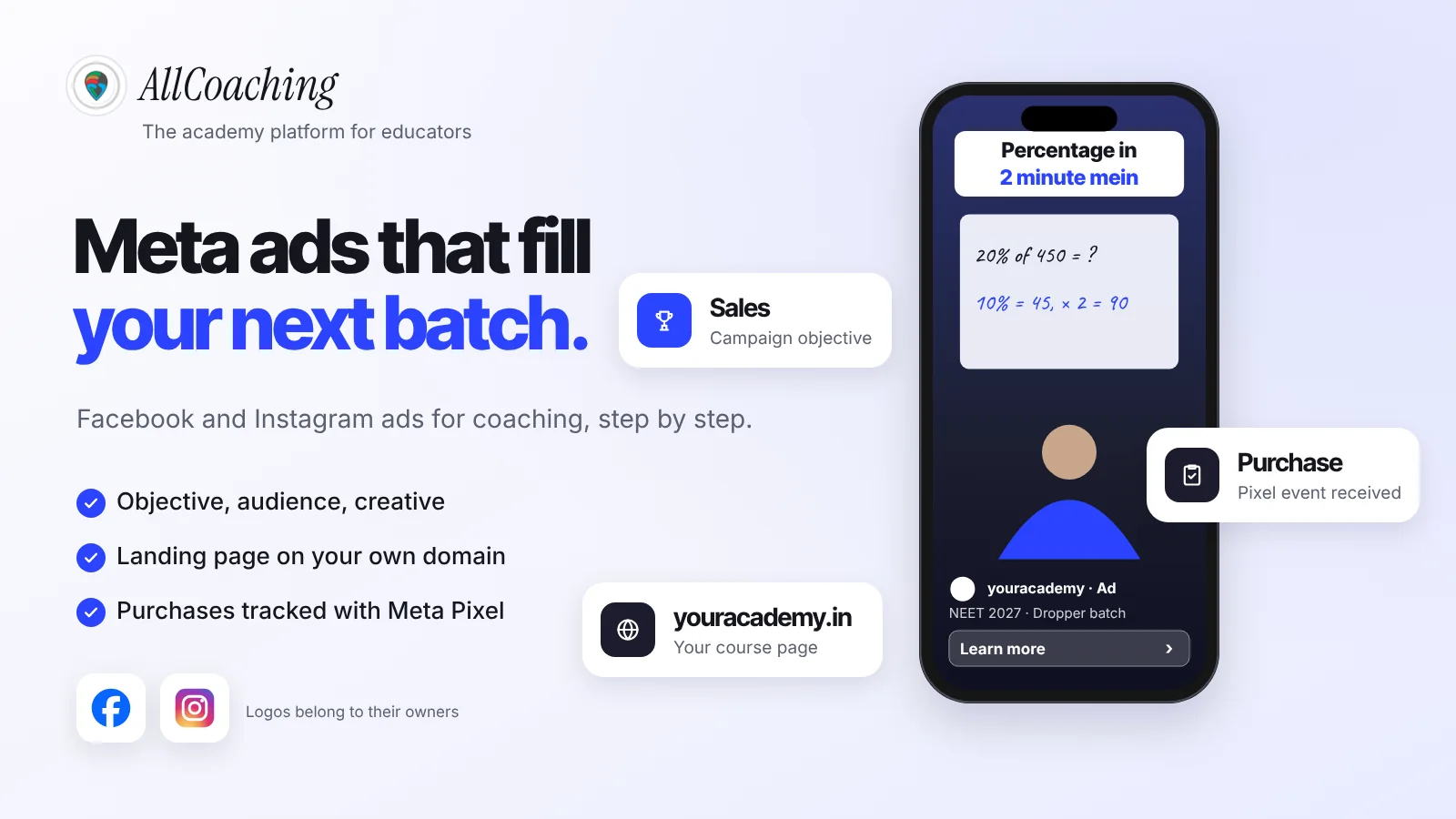
Ads multiply what already converts; they rarely fix what does not. Before you spend, know your cost per paid enrolment and what a student is worth to you (the next section shows the maths). Meta's help centre describes a custom audience as one that "lets advertisers build audiences from their own data sources or Meta engagement data for retargeting campaigns, new customer campaigns and other ad targeting options",1 which is how you retarget people who watched your free lesson or visited your course page. Our Meta ads guide for coaching institutes covers campaign set-up step by step.
Referrals and partnerships
Ask students who finished and improved to bring a friend, and make the ask at the moment of a good result. Partner with people who already teach your audience something next to your subject: a maths YouTuber for your reasoning course, a school for your spoken English batch, a yoga studio for your online pranayama course. Agree terms in writing.
A second product or tier
Your 400 current students are the easiest 400 sales of your next product. Add an advanced batch, a test-only tier, a mentorship tier or the next exam in the sequence (Prelims to Mains, Class 11 to Class 12). Use the online course launch plan to launch it to your own list first.
Your own app
At this size, an app with your name on it brings students back through notifications. Our guide to a white-label app for educators explains what that involves and what Google and Apple require.
Which metrics should you track as you grow?
Track six numbers every month: new enrolments, completion rate, renewal rate, cost per lead and cost per paid enrolment, refund rate and lifetime value. Together they tell you whether you are growing because students stay and return, or only because you are buying more of them.
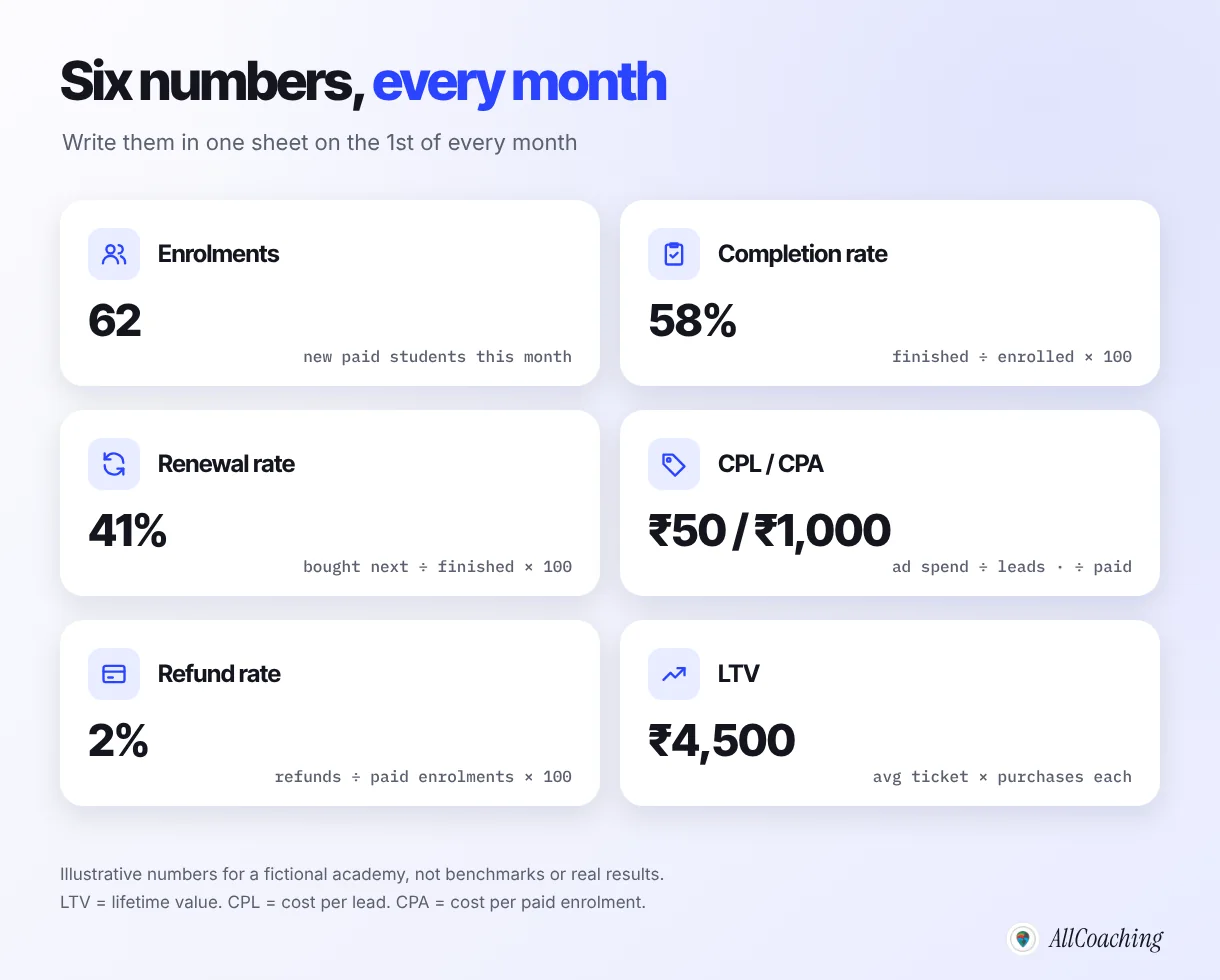
| Metric | Simple formula | Illustrative example |
|---|---|---|
| Enrolments | New paid students this month | 62 |
| Completion rate | Students who finished ÷ students enrolled × 100 | 58 of 100 = 58% |
| Renewal rate | Students who bought the next course or batch ÷ students who finished × 100 | 24 of 58 ≈ 41% |
| CPL | Ad spend ÷ leads | ₹20,000 ÷ 400 = ₹50 |
| CPA | Ad spend ÷ paid enrolments from ads | ₹20,000 ÷ 20 = ₹1,000 |
| Refund rate | Refunds ÷ paid enrolments × 100 | 1 of 50 = 2% |
| Lifetime value (LTV) | Average ticket × average purchases per student | ₹3,000 × 1.5 = ₹4,500 |
Look at students by cohort, the batch or month they joined, not only as one total. Google Analytics defines a cohort as "a group of users who share a common characteristic that is identified in this report by an Analytics dimension",2 and its cohort exploration shows how each group behaves over time. Add UTM tags to every link you share so each channel shows up separately in your analytics.4 If the January batch completes at 40% and the March batch at 60%, you know your changes are working.
From our side at AllCoaching, the educators who grow steadily tend to be the ones who can answer these questions from memory. The ones who stall usually know only their total student count.
Unit economics: when do paid ads make sense?
Paid ads make sense when what you spend to win one paid student (CPA) is comfortably below what that student pays you, after platform fees, and when your lifetime value is a healthy multiple of it. If one student costs ₹1,000 in ads and pays ₹3,000, each sale pays back the ad three times before you count renewals.
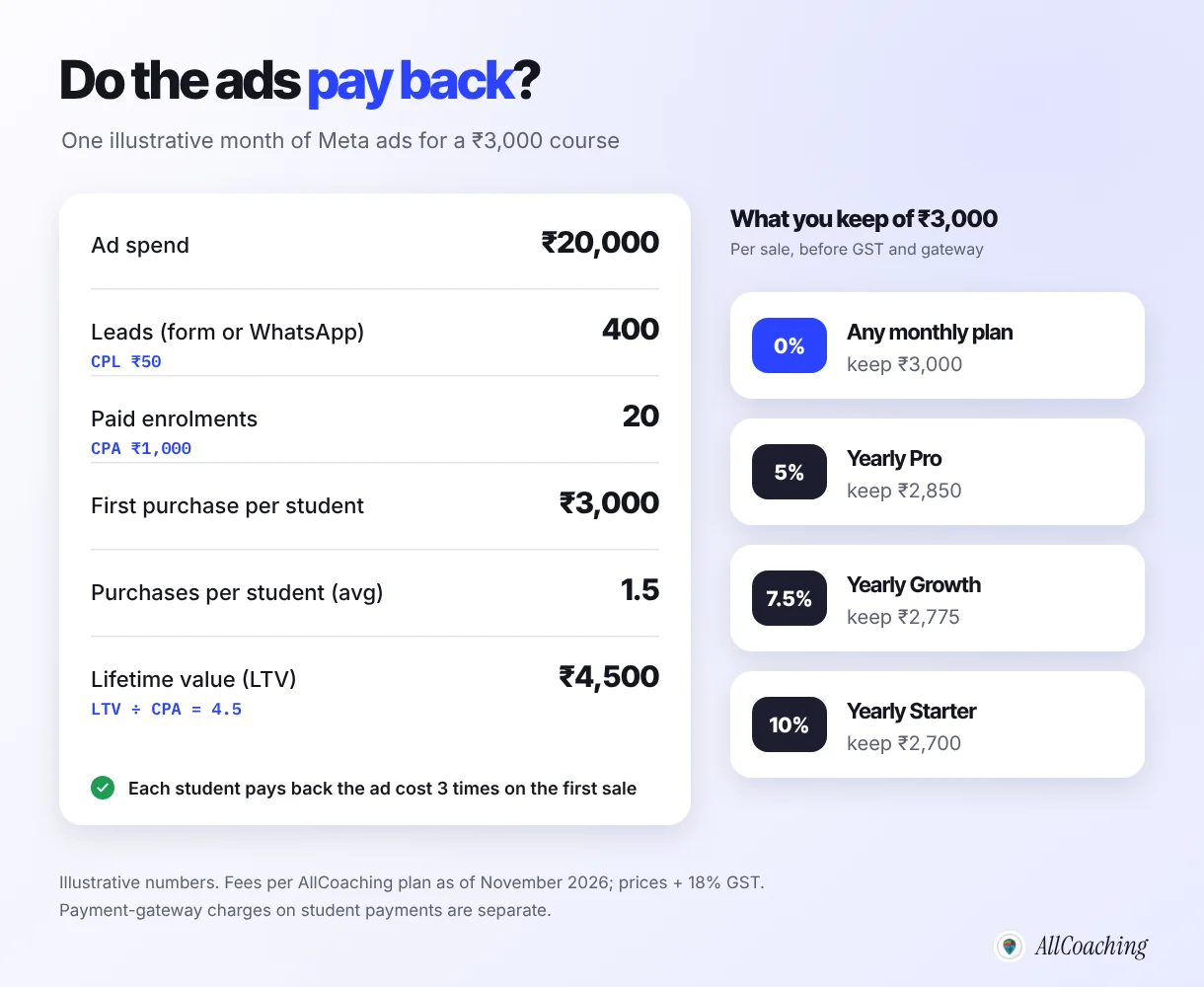
Illustrative example: you spend ₹20,000 on Meta ads in a month and get 400 leads, so your CPL is ₹50. Twenty leads buy your ₹3,000 course, so your CPA is ₹1,000. If the average student buys 1.5 courses over time, lifetime value is ₹4,500, or 4.5 times the CPA. If instead only five leads bought, CPA would be ₹4,000, more than the course price, and the right move is to fix the offer or the page before spending more.
The platform fee is part of the maths
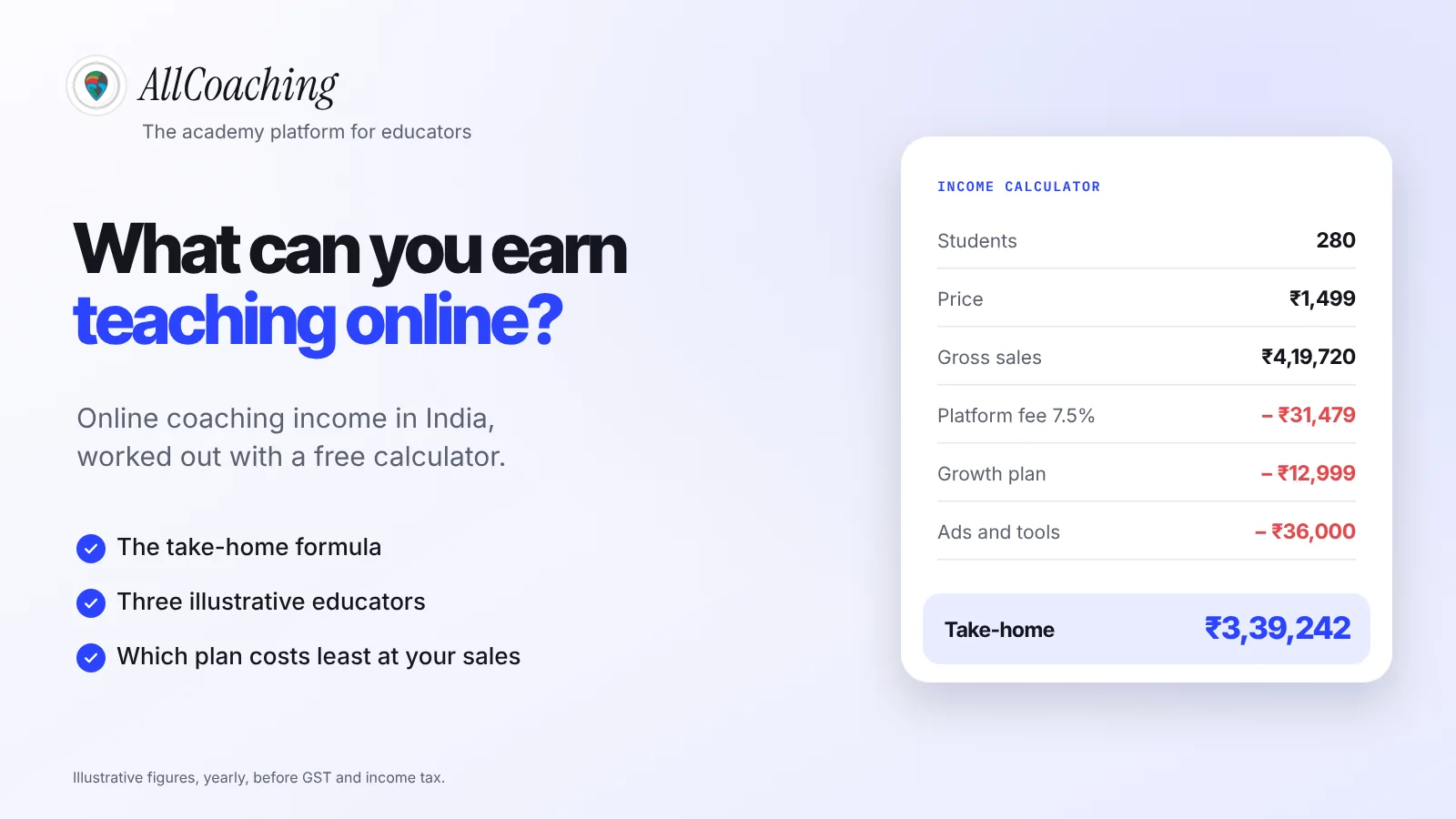
Your platform cost changes what each sale leaves you. On AllCoaching every monthly plan takes 0% commission, so a ₹3,000 sale leaves ₹3,000 before GST and gateway charges; yearly plans charge a fee per sale (10% on Starter, 7.5% on Growth, 5% on Pro). Here is the total yearly platform cost at three sizes, assuming an illustrative average of ₹3,000 a student:
| Yearly sales | Starter yearly | Growth yearly | Pro yearly | Starter monthly | Growth monthly | Pro monthly |
|---|---|---|---|---|---|---|
| ₹1.5 lakh (50 students) | ₹21,999 | ₹24,249 | ₹32,499 | ₹47,988 | ₹71,988 | ₹95,988 |
| ₹4.5 lakh (150 students) | ₹51,999 | ₹46,749 | ₹47,499 | ₹47,988 | ₹71,988 | ₹95,988 |
| ₹12 lakh (400 students) | ₹1,26,999 | ₹1,02,999 | ₹84,999 | ₹47,988 | ₹71,988 | ₹95,988 |
| ₹30 lakh (1,000 students) | ₹3,06,999 | ₹2,37,999 | ₹1,74,999 | ₹47,988 | ₹71,988 | ₹95,988 |
The pattern is simple: below about ₹4 lakh of yearly sales, yearly Starter usually costs least; above that, a monthly plan at 0% usually leaves you more. For a longer look at income at each size, see how much you can earn teaching online in India.
Which AllCoaching plan fits each growth stage?
Choose a plan by what the stage needs first, seats, storage, live hours and iOS, and then by cost: yearly Starter usually fits 50 to 150 students, a monthly plan fits once sales pass about ₹4 lakh a year, and Pro fits a larger team that needs iOS and 4K. You can upgrade any time, and the unused value you paid is credited.
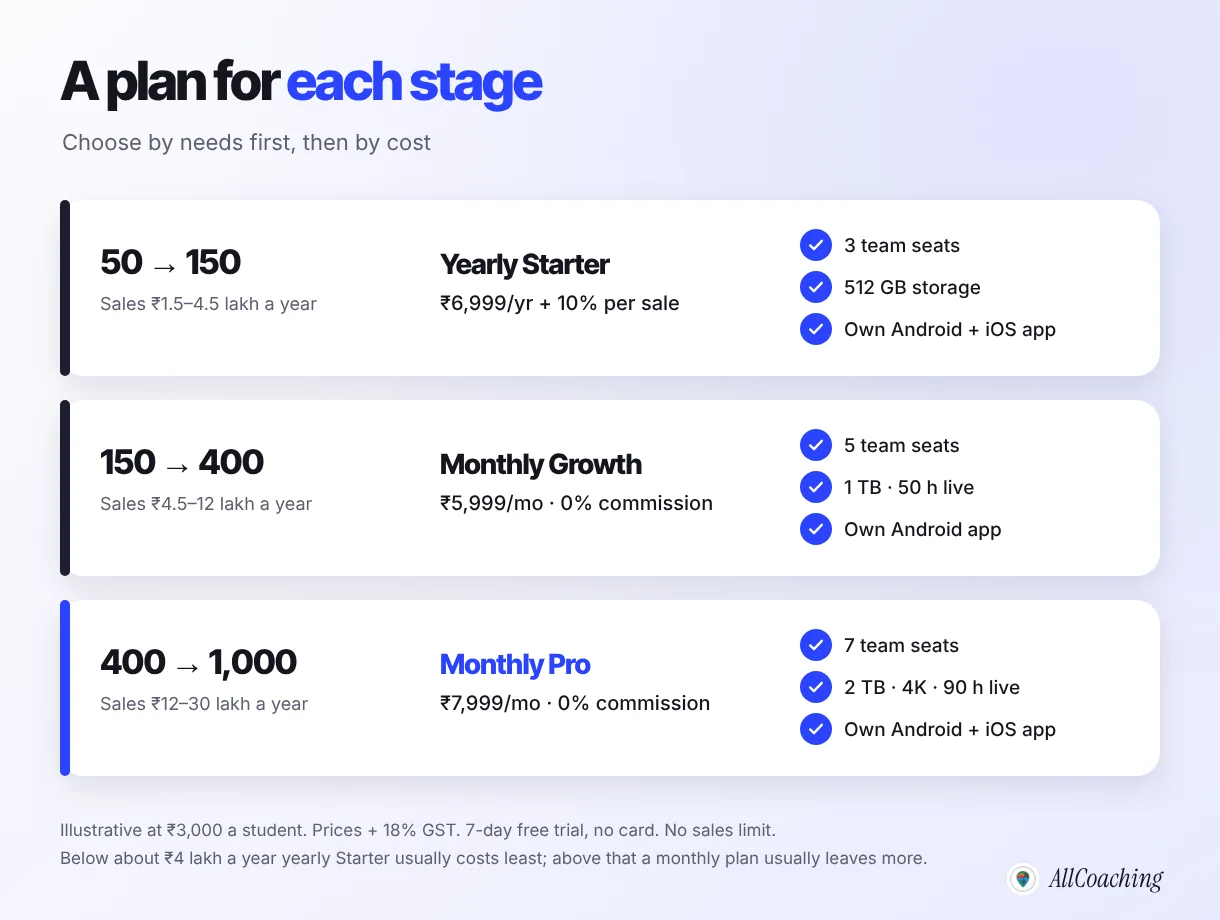
- 50 to 150 students: yearly Starter, ₹6,999 a year plus 10% per sale. Three team seats, 512 GB storage, your own Android app and iOS app.
- 150 to 400 students: a monthly plan at 0% commission. Starter at ₹3,999 a month costs least of the three; Growth at ₹5,999 a month adds 5 seats, 1 TB storage and 50 hours of built-in live classroom a month.
- 400 to 1,000 students: monthly Pro at ₹7,999 a month: 7 seats, 2 TB storage, 4K video, 90 hours of built-in live classroom and your own iOS app. If sales are lower than your team size suggests, yearly Pro at ₹24,999 a year plus 5% includes iOS too.
Every plan starts with a 7-day free trial, no card needed, and has no sales limit and no setup fee. Monthly plans take 0% commission: Starter ₹3,999, Growth ₹5,999, Pro ₹7,999 a month. Yearly plans are Starter ₹6,999 + 10%, Growth ₹12,999 + 7.5% and Pro ₹24,999 + 5% per sale. Prices exclude GST. Every plan includes unlimited live classes on YouTube Live or Zoom and your own domain. Full details are on the pricing page.
Build your own academy. Try it free for 7 days.
Website on your own domain, your own Android app, unlimited live classes and UPI checkout on every plan. 0% commission on every monthly plan from ₹3,999 a month, or yearly from ₹6,999 (excl. GST).
No card needed · Cancel anytime in the trial · Export your data any timeWhen should you hire a second teacher or a support person?
Hire a second teacher when your live classes crowd out new content and tests, and hire a support person when doubts, fee questions and WhatsApp messages take two or more hours of your day. Hire at a clear signal, not at a student count.
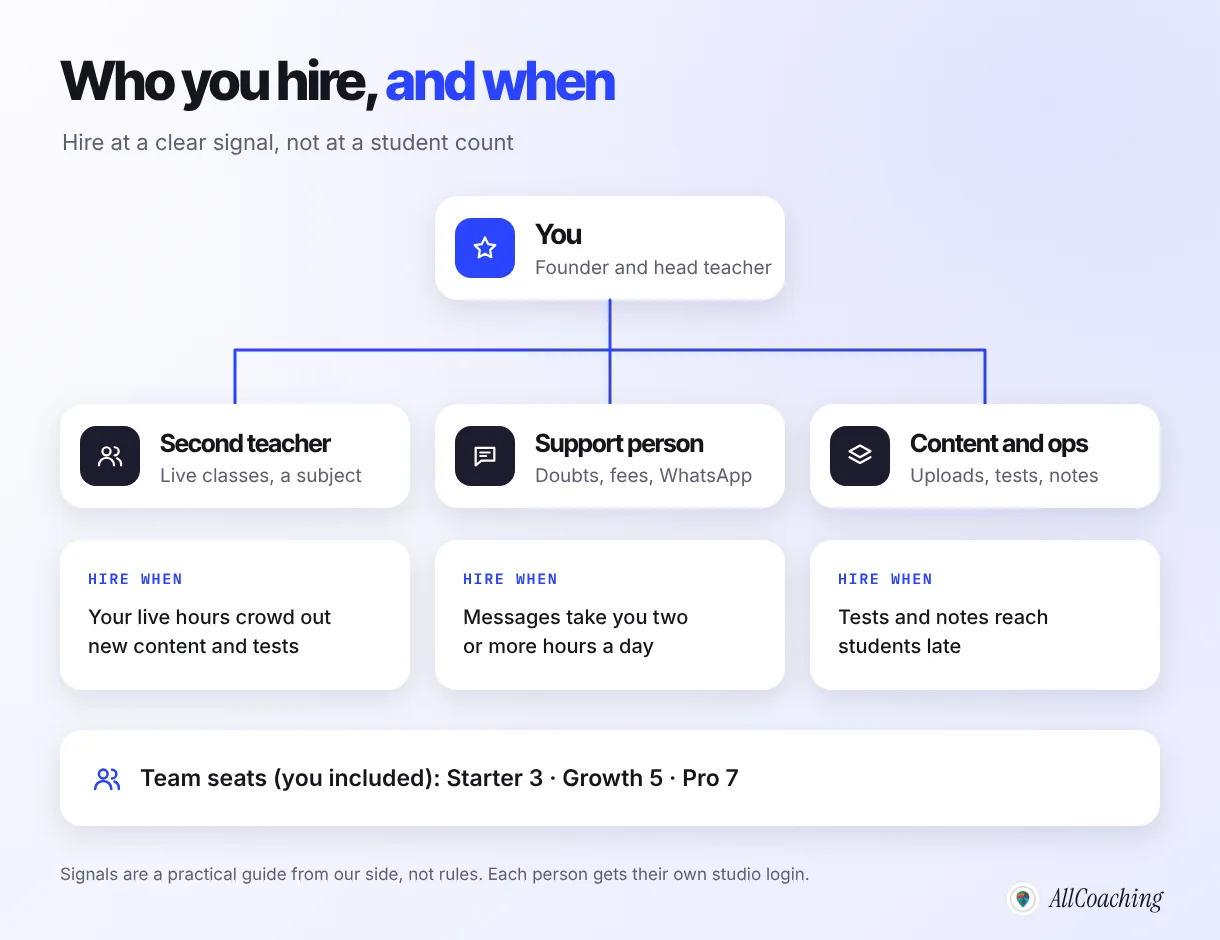
The second teacher
Start them on one subject or batch they own completely, for example the reasoning section of your banking course. Write down how you teach: lesson length, test rhythm, doubt rules. Then track completion and scores for their batch the same way you track yours.
The support person
Support is usually the first hire that gives you time back. Give them a written list of the 20 most common questions with answers: fees, batch dates, access problems, refunds, certificates. Decide what they can resolve alone and what comes to you.
Content and operations
As the library grows, someone needs to upload recordings, set tests and keep the timetable; this can start as part of the support role.
Give each person their own login, not your password, so you can see who changed what and remove access cleanly if someone leaves. Agree pay, notice and content ownership in writing before they start.
How to grow online coaching students: 8 steps
Measure where you are, fix completion and doubt support, collect real results, move to dated batches and a test series, build your team and one student list, then add channels one at a time and a second tier when the numbers say so. The steps follow the three stages in order.
- Measure your starting pointWrite down this month's enrolments, completion rate, renewal rate, refund rate and, if you run ads, CPL and CPA, in one sheet you update on the 1st of every month.
- Fix completion and doubt supportSplit long lectures into 15 to 30 minute lessons, add a short test after each chapter, rework the lesson most students stop at and answer doubts within 24 hours.
- Track results and collect real reviewsRecord each student's scores and outcomes, ask every student for an honest review after a milestone, and publish names, photos or scores only with written permission.
- Move to dated batches and a fixed timetableRun each batch as its own course with a start date, schedule and end date, and publish the live timetable a month ahead.
- Add a test series and a free-to-paid ladderRun weekly tests in the real exam pattern with rank and percentile, and give students a clear path from free notes or a free test to a test series, the full course and an advanced batch.
- Bring in a team and one student listBulk-import every student into your academy, give each helper their own login, and hire a support person or second teacher when the signals appear.
- Add one channel at a timeHold a steady YouTube rhythm, ask finished students for referrals, and start paid ads only when your CPA is comfortably below what a student pays you after fees.
- Launch a second tier and review your planOffer an advanced batch, mentorship or the next exam to current students first, add your own app, and check that your platform plan still fits your sales, team and storage.
If you have not yet reached your first 50 students, start with our guide to getting your first students, which covers the discovery side: publishing where students already search and sending them to an academy you own.
Mistakes that stall growth between 50 and 1,000 students
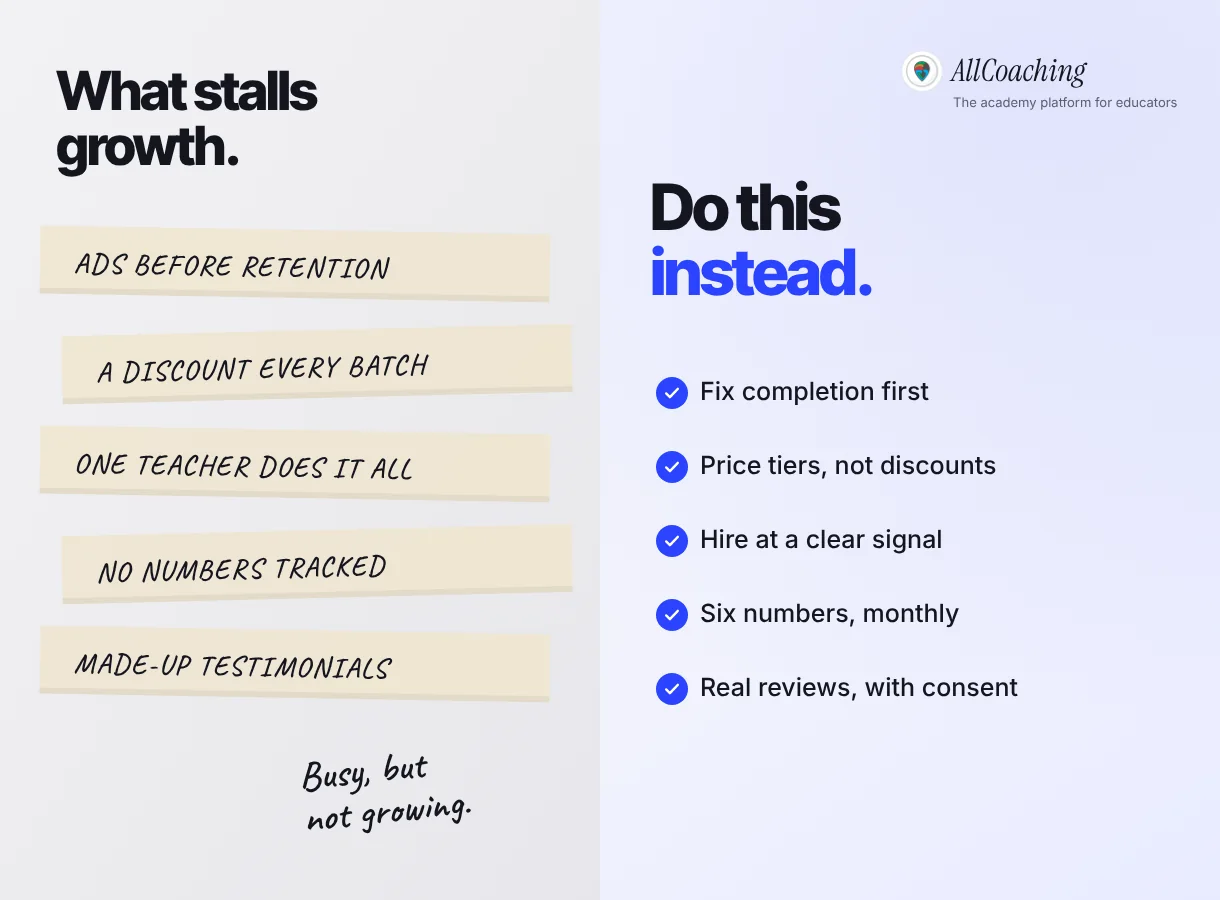
The mistakes that stall online coaching growth are running ads before retention works, discounting every batch, one teacher doing everything, not tracking numbers and using testimonials that are not real. Each has a simple fix.
Do
Fix completion before you buy traffic. Use price tiers and dated batches instead of constant discounts. Hire at a clear signal. Write six numbers in one sheet every month. Publish only real reviews, with written permission.
Avoid
Ads that send students into a course most of them do not finish. A sale every batch, which teaches students to wait. Doing every class, doubt and upload yourself at 400 students. Guessing which channel works. Inventing or editing testimonials.
None of these steps guarantees a number of students. What they do is make sure that every student you win stays longer, learns more and is more likely to bring the next one.
Glossary
- Retention
- How many students stay active, finish and come back for the next course or batch. High retention means growth does not depend only on new students.
- Cohort
- A group of students who share one starting point, such as the batch or month they joined, compared over time.
- Completion rate
- Students who finished a course divided by students who enrolled, times 100.
- Renewal rate
- Students who bought the next course or batch divided by students who finished the previous one, times 100.
- Churn
- Students who stop, such as leaving a monthly subscription or not renewing, as a share of students at the start of the period.
- Lifetime value (LTV)
- The total a student pays you over time, estimated as average ticket times average purchases per student.
- Customer acquisition cost (CAC)
- Everything you spend to win one paying student, including ads, content, tools and team time.
- Cost per lead (CPL)
- Ad spend divided by the number of leads, such as form fills or WhatsApp enquiries.
- Cost per acquisition (CPA)
- Ad spend divided by the number of paid enrolments that came from those ads.
- Unit economics
- The money in and out for one student: what they pay, minus platform fees, gateway charges and the cost of winning them.
Frequently asked questions
How do I grow my online coaching from 50 to 1,000 students?
Work in three stages. From 50 to 150 students, improve completion, doubt support and results so students recommend you. From 150 to 400, build systems: dated batches, a test series, a fixed timetable, a team and one student list. From 400 to 1,000, add channels such as YouTube, referrals, partnerships and paid ads once your numbers pay back.
How long does it take to go from 50 to 1,000 students?
There is no fixed timeline. It depends on your subject, price, exam calendar, consistency and how well students do. Some educators grow in one exam season, others over several years. No platform or plan can guarantee a number of students.
Should I run paid ads to grow my online coaching?
Run ads once students already finish your course and recommend it, and only when your cost per paid enrolment is comfortably below what a student pays you after platform fees. Start small, measure CPL and CPA, and stop or fix the offer if one student costs more than they pay.
How can I increase students in online coaching without discounts?
Use dated batches, a free-to-paid ladder and price tiers instead of constant sales. Raise completion so students renew and recommend you, ask finished students for referrals, and publish real results with permission.
What metrics should an online coaching business track?
Track new enrolments, completion rate, renewal rate, cost per lead, cost per paid enrolment, refund rate and lifetime value every month, and compare each batch or month of joiners as a cohort.
What is a good completion rate for an online course?
There is no single benchmark that fits every subject and price. Measure your own completion rate for each batch and work to raise it over time by shortening lessons, adding weekly tests and fixing the lesson where most students stop.
When should I hire a second teacher for my coaching?
Hire a second teacher when your own live classes crowd out new content, tests and doubt support. Start them on one subject or batch they own, write down how you teach, and track their batch completion and scores like your own.
Can I move my existing students to my own academy?
Yes. On AllCoaching you can bulk-import students from Excel or a Google Sheet, so students from WhatsApp groups and spreadsheets move into one list with course access, announcements and payments in one place.
Which AllCoaching plan fits a growing coaching academy?
Choose by needs first, then cost. Yearly Starter at ₹6,999 plus 10% per sale usually costs least below about ₹4 lakh of yearly sales. Above that, a monthly plan at 0% commission from ₹3,999 a month usually leaves more. Pro adds 7 seats, 4K and iOS. Prices exclude GST and every plan starts with a 7-day free trial, no card needed.
Sources
- Meta, "About custom audiences", Meta Business Help Centre. facebook.com/business/help, checked November 2026.
- Google, "[GA4] Cohort exploration", Analytics Help. support.google.com, checked November 2026.
- Google, "Measure key moments for audience retention", YouTube Help. support.google.com, checked November 2026.
- Google, "URL builders: Collect campaign data with custom URLs", Analytics Help. support.google.com, checked November 2026.
Amit builds AllCoaching, the academy platform Indian educators set up themselves: their own website on their own domain, their own app, and the tools to grow it. We see the same growth pattern across the educators who run their academies on AllCoaching, so this guide is written from that side; every number in it is illustrative and every rule from Google or Meta is linked to its own help page, checked November 2026.