
On this page
Start your online academy today. 7 days free.
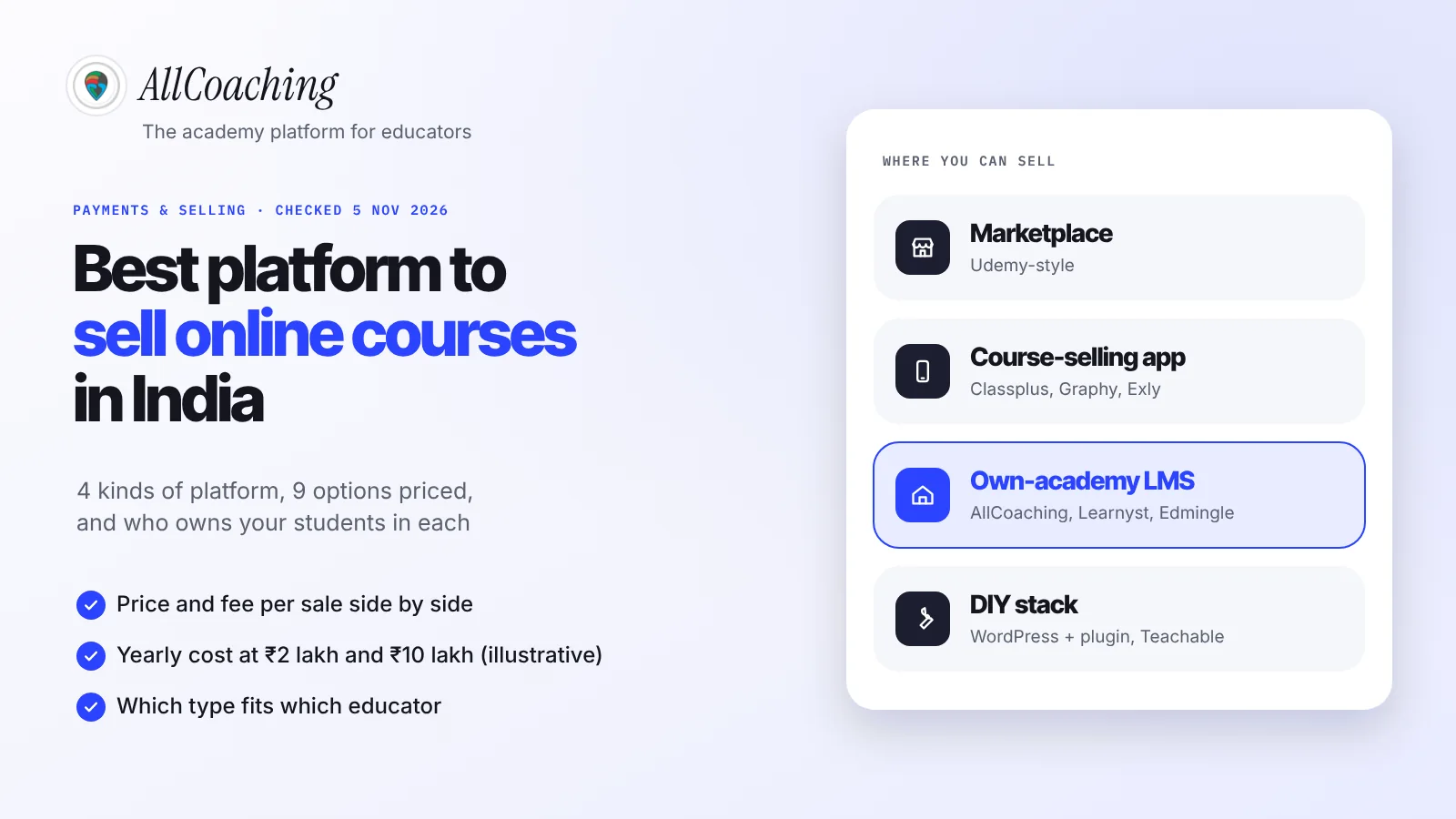
Start free trialThe best platform to sell online courses in India depends on who you want to own the student: a marketplace finds students but keeps them, a course-selling app gives you a storefront in its system, an own-academy LMS puts your brand, domain and app first, and a DIY stack leaves every part to you. Pick the type first, then compare price and fee per sale.
Maybe you teach SSC maths in Hindi and your YouTube lives get a few hundred viewers, or you run a NEET batch of 500 students on WhatsApp and Google Drive. Either way, the first real decision is not which app has the most features. It is where your course will live, and whose students they will be in five years.
This guide explains the four types of platform, puts nine options' prices and fees per sale side by side from their official pages, works out a year's cost at two sales levels, and ends with seven steps to choose and start selling. If you have not built your course yet, start with our guide on how to sell courses online in India.
Key takeaways
- There are four types of platform: marketplaces (Udemy-style), course-selling apps (Classplus, Graphy, Exly-type), own-academy LMS platforms (AllCoaching, Learnyst, Edmingle) and DIY stacks (WordPress + an LMS plugin, Teachable, Thinkific).
- Ownership is the real difference: on a marketplace the platform owns the student; in your own academy or DIY stack you do; course-selling apps sit in between.
- Always read the fee next to the price: Exly lists 10%, 6% or 3% per sale, Teachable Starter 7.5%, while Classplus and Edmingle do not state a fee (official pages, checked 5 Nov 2026).
- Illustrative yearly cost at ₹2 lakh of sales ranged from ₹20,000 to ₹1,07,988 on the rupee platforms we checked, before GST and gateway charges.
- The gateway fee comes on top: Razorpay's standard India pricing lists 2% per successful domestic transaction, with 18% GST on the fee.
- A marketplace is right when you have no audience and want to test a topic; once students come to you, sell from your own academy.
- AllCoaching takes 0% commission on every monthly plan from ₹3,999 a month, or yearly from ₹6,999 + 10% per sale, + GST, with your own domain and Android app on every plan and a 7-day free trial.
The best platform to sell online courses in India: the short answer
There is no single best platform to sell online courses in India; there are four kinds of platform, and the right one depends on who you want to own the student. A marketplace finds students for you but keeps them, a course-selling app gives you a storefront inside its system, an own-academy LMS puts your brand, domain and app first, and a DIY stack gives you everything to build and maintain yourself.
"Where should I sell my course?" is really three questions: who will find my students, how much of each sale will I keep, and what happens to my students if I leave. Each type answers them differently.
- No audience yet, testing a topic: a marketplace is a fair place to start.
- You have a YouTube channel, a WhatsApp group or a batch of students: sell from your own academy, where the students stay yours.
- A coaching institute with teachers and test series: an own-academy LMS with team seats and your own app.
- A developer on hand and time to maintain it: a DIY stack can work.
How we checked these platforms
We read every price in this guide from the company's own pricing page on 5 November 2026, wrote down the fee per sale next to the price, and left a figure out wherever the page did not show it clearly. We did not round any price up or down, and we did not convert dollar prices to rupees, because exchange rates move.
AllCoaching is one of the options here, so every competitor figure links to its source, "not stated" means the page did not say, and where another type fits better, we say so.
Two pages could not be used as published. Udemy's instructor revenue share article returned an access check when we tried to open it, so we do not quote a percentage for Udemy.11 Graphy's pricing page showed different rupee figures in different places from our connection, so we do not quote a rupee price for Graphy.10 If either matters to you, open the page yourself from India before you decide.
The 4 types of online course platforms in India
Online course platforms in India fall into four types: marketplaces, course-selling apps, own-academy LMS platforms and DIY stacks. They differ less in features than in who the student belongs to, whose name the student sees, and how the money reaches you.
1. Marketplaces (Udemy-style)
A marketplace is a large catalogue where students browse many teachers' courses. You upload, the marketplace brings traffic, runs the checkout and pays you a revenue share. The student's account, reviews and usually the pricing rules belong to the marketplace, so if you leave, your students stay behind.
2. Course-selling apps and storefronts (Classplus, Graphy, Exly-type)
These platforms give you a store or an app inside their system, a checkout, and tools to sell courses, tests or sessions. The student is yours to market to, but your own branded app, your own domain or a white-label setup is often a higher tier or a paid add-on. Exly, for example, lists a mobile app add-on starting at ₹60,000 a year and a custom website add-on starting at ₹60,000 a year on its pricing page.6
3. Own-academy LMS (AllCoaching, Learnyst, Edmingle)
An own-academy LMS builds an academy that carries your name: a website on your domain, your logo and colours, courses, test series and live classes, and on many plans an app in your name. The student enrols with your academy. Payment usually reaches you through a gateway account in your name, and your student list can be exported. They differ mostly in price, fee per sale and which plan includes the app.
4. DIY stacks (WordPress + an LMS plugin, Teachable, Thinkific)
A DIY stack means you assemble the parts: a WordPress site, hosting, an LMS plugin such as Tutor LMS, a payment gateway, a video host, and an app built separately if you want one. Global course builders like Teachable and Thinkific do much of the assembly for you but are priced in US dollars. Full control comes with full responsibility: if a plugin update breaks checkout on launch night, you fix it.
Question educators ask
Is Udemy or my own website better for selling courses in India?
Udemy is better for finding your first students without an audience, because it brings the traffic. Your own website or academy is better once students already come to you from YouTube, Instagram or WhatsApp, because they enrol with you, you set the price, and you can sell to them again.
Who owns the student, the brand, the payout and the data
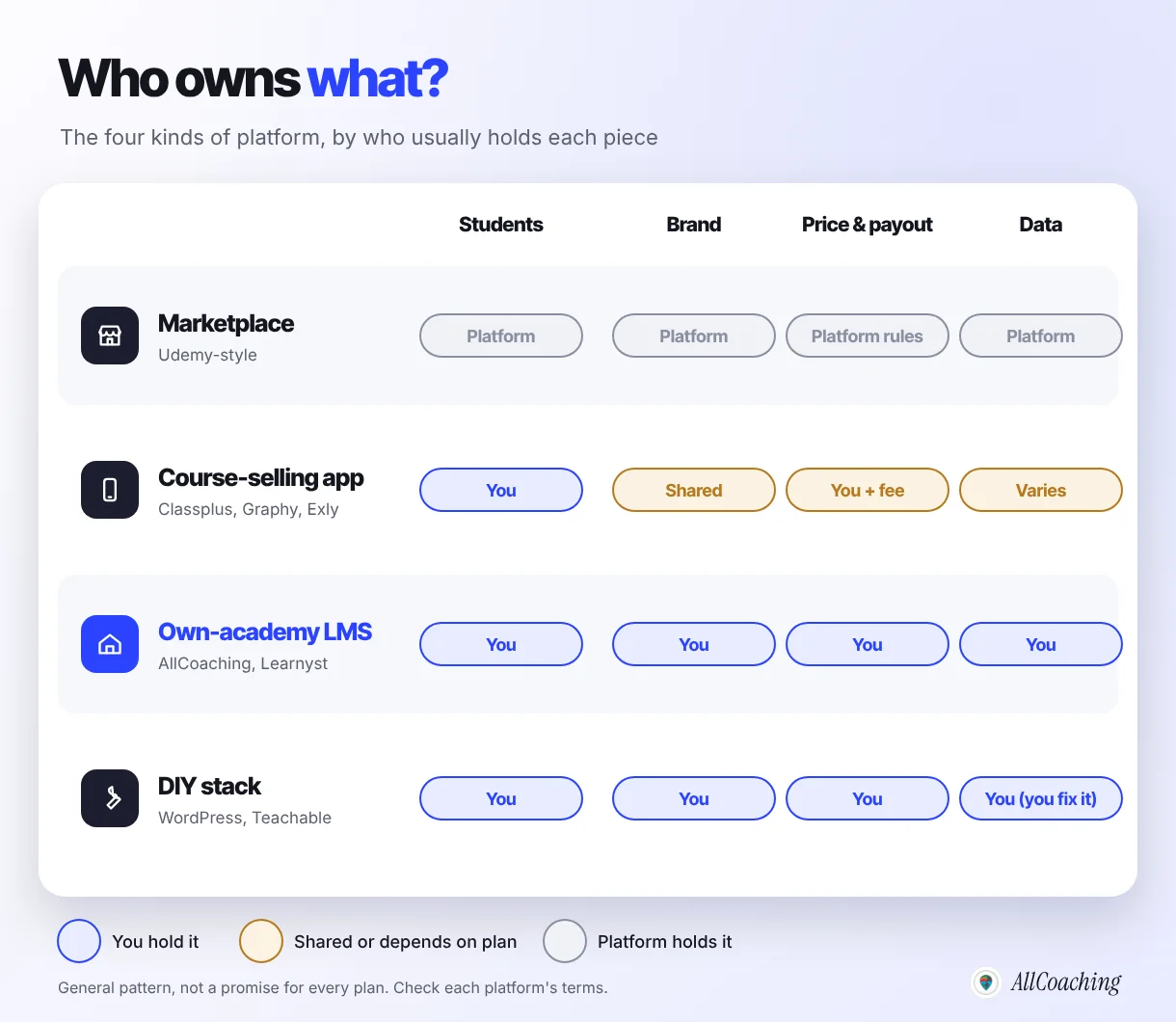
On a marketplace the platform owns the student relationship; on an own-academy LMS or a DIY stack you do; course-selling apps sit in between, depending on the plan. These four questions matter more over five years than any single feature.
| Who usually holds it | Marketplace | Course-selling app | Own-academy LMS | DIY stack |
|---|---|---|---|---|
| The student account | Platform | You, inside their system | You | You |
| The brand students see | Platform first, you second | Shared; own app or domain often extra | Yours: domain, logo, app | Yours |
| The price and payout | Platform rules and revenue share | You set it; platform fee per sale on many plans | You set it; fixed fee, with or without a fee per sale | You set it; you pay each tool |
| Student data and export | Limited | Varies by plan | Exportable | Yours, on your server |
The question we hear most often from educators moving to their own academy is not about features. It is "my students are on someone else's app; how do I bring them over?" Starting in the right place is easier than moving later.
Online course platforms in India: price and fee per sale, side by side
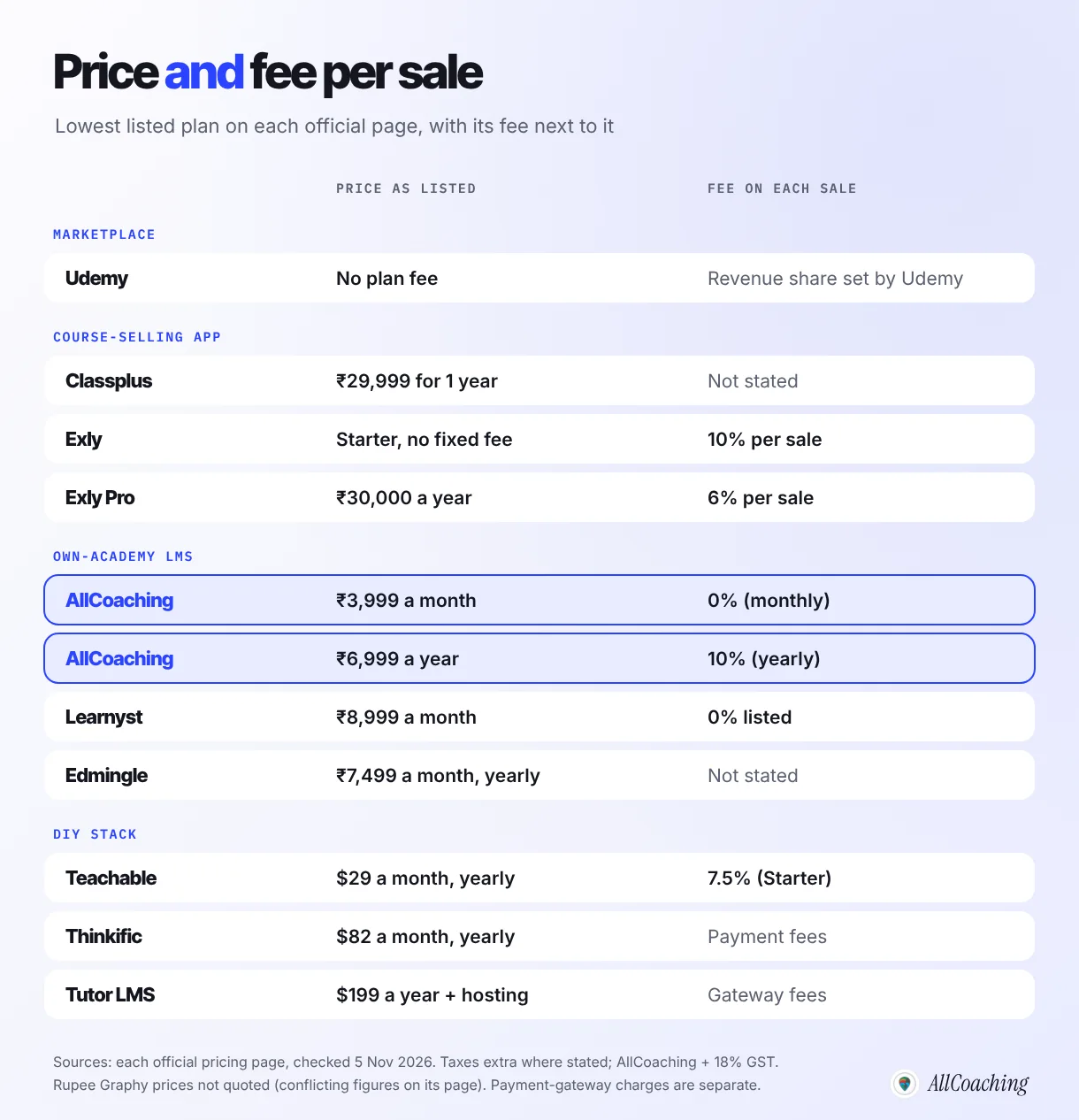
The price on a pricing page is only half the cost; the other half is the fee taken from each sale. The table puts both next to each other for nine options, as each official page showed them on 5 November 2026.
| Platform (type) | Lowest listed price | Fee on each sale | Source, checked 5 Nov 2026 |
|---|---|---|---|
| Udemy (marketplace) | No plan fee | Revenue share set by Udemy; page not retrieved, so not quoted | support.udemy.com |
| Classplus (course-selling app) | ₹29,999 for 1 year; ₹39,999 for 2 years | Not stated | classplusapp.com/new-web |
| Exly (course-selling app) | Starter: no fixed fee; Pro ₹30,000 a year; Premium ₹1,08,000 a year | 10% · 6% · 3% | exlyapp.com/pricing |
| AllCoaching (own academy) | Monthly from ₹3,999 a month; yearly from ₹6,999 a year; + 18% GST | 0% on monthly plans · 10%, 7.5% or 5% on yearly | allcoaching.in/pricing |
| Learnyst (own academy) | Professional ₹8,999 a month + taxes | 0% transaction fees listed | learnyst.com/pricing |
| Edmingle (own academy) | Core ₹7,499 a month billed annually (₹8,999 billed monthly) + taxes | Not stated | edmingle.com/in/pricing |
| Teachable (DIY, US dollars) | Starter $29 a month billed annually ($39 monthly) | 7.5% on Starter; 0% on Builder and above with Teachable Payments | teachable.com/pricing |
| Thinkific (DIY, US dollars) | Start $82 a month billed annually ($109 monthly) | Payment processing (Thinkific Payments at 2.9%) | thinkific.com/pricing |
| Tutor LMS on WordPress (DIY) | Free core; Pro Individual $199 a year, 1 site; hosting extra | None stated; gateway fees apply | tutorlms.com/pricing |
What the table does not show
- Classplus shows ₹29,999 for one year against a struck-out ₹34,999; the page does not mention GST, a fee per sale or a trial.7
- Learnyst lists its rupee prices "+ taxes"; a branded Android app is listed from Premium (₹14,999 a month), and branded Android and iOS apps from Business (₹49,999 a month).4
- TagMango, another course-selling platform, lists Basic at zero fixed fee and 10% commission, which its page says includes the Indian payment gateway, up to Ultimate at ₹35,000 a month + GST with zero commission.9
- Add-ons change the total: Exly's mobile app starts at ₹60,000 a year6 and Thinkific's branded mobile app is a $199 a month add-on.3
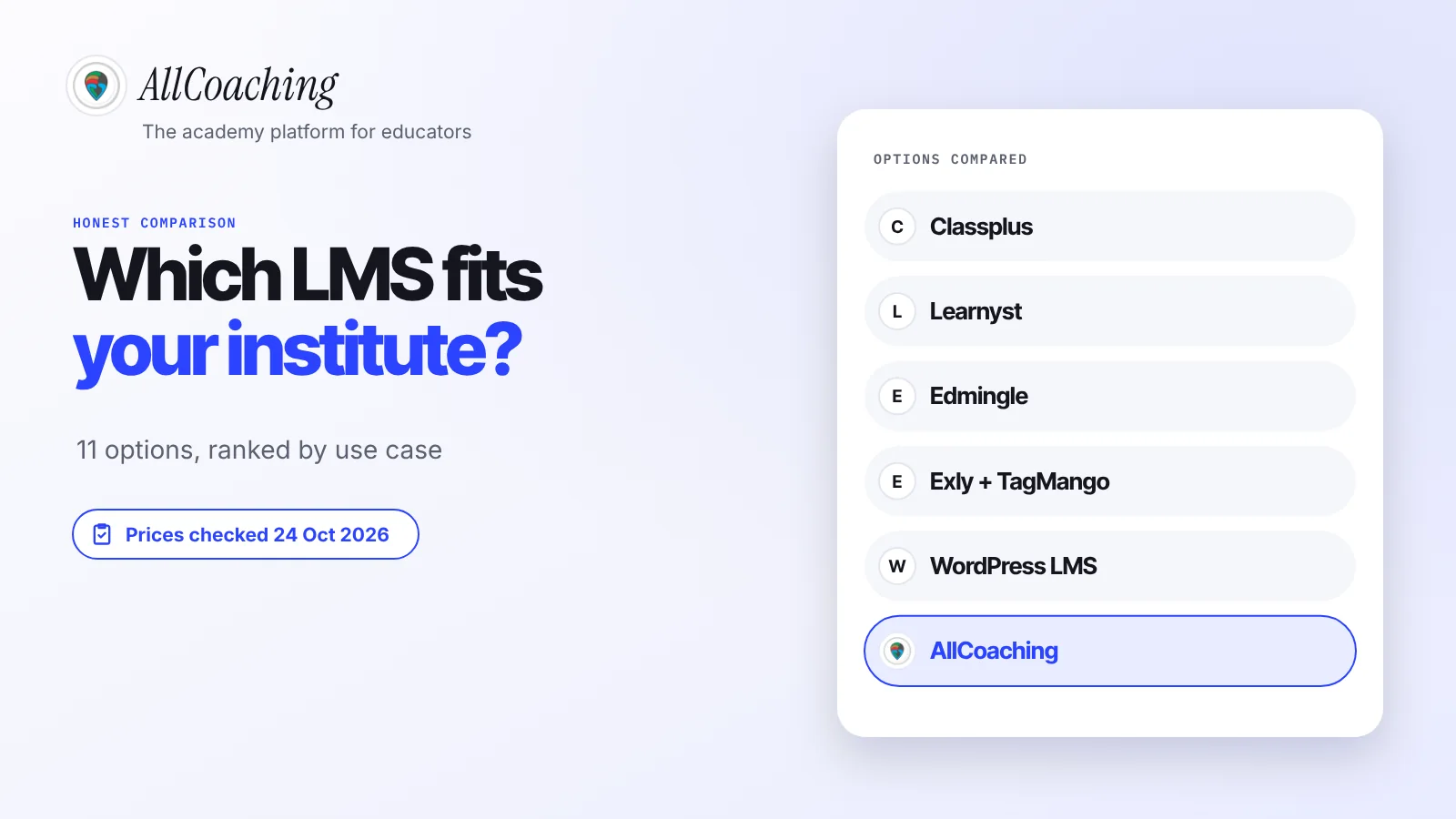
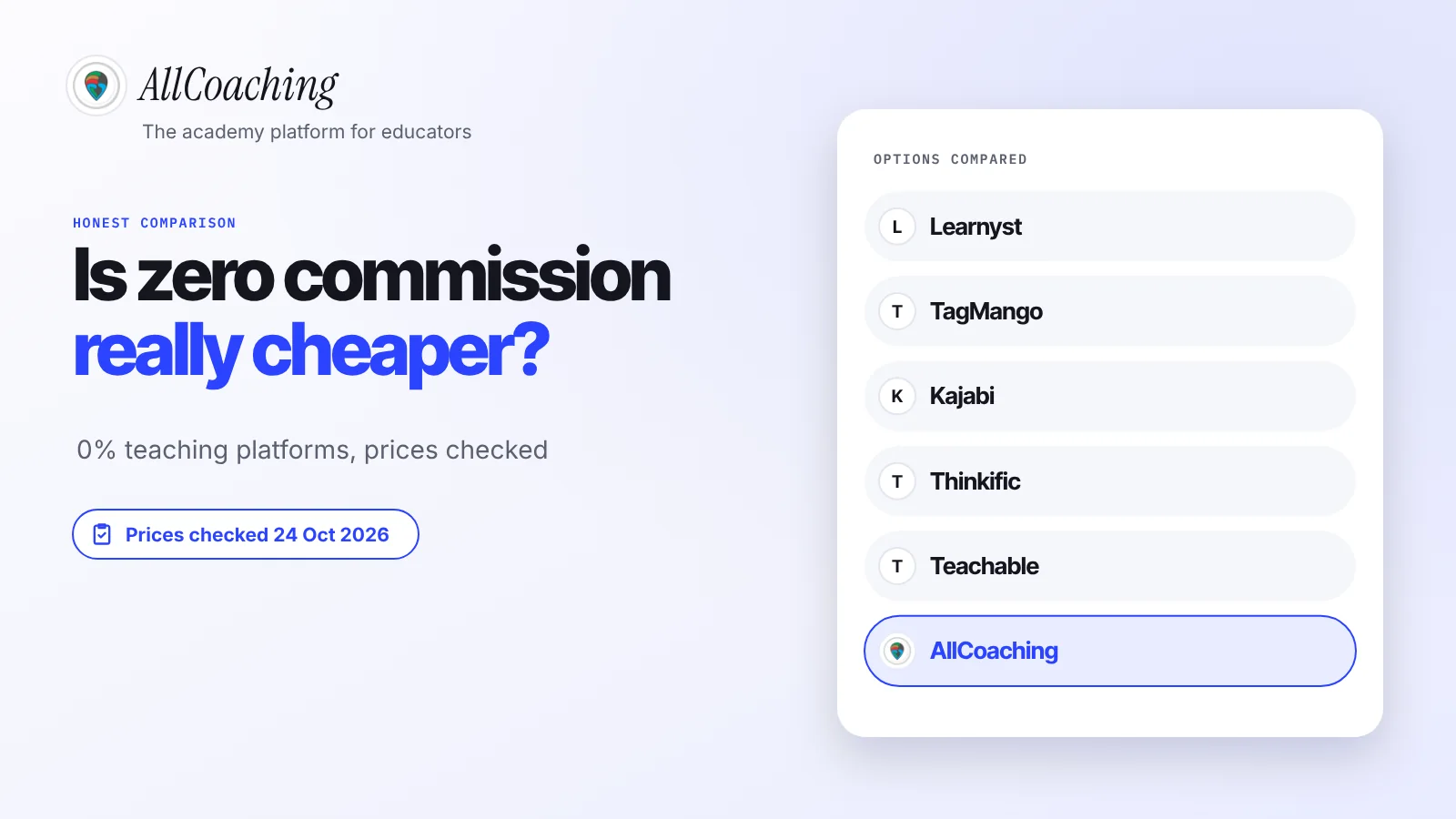
For a deeper look at the own-academy group alone, our guide to the best LMS for coaching institutes in India compares eleven LMS options by use case, and the zero-commission teaching platform comparison covers only plans that take 0% per sale.
What it costs in a year at ₹2 lakh and ₹10 lakh of sales
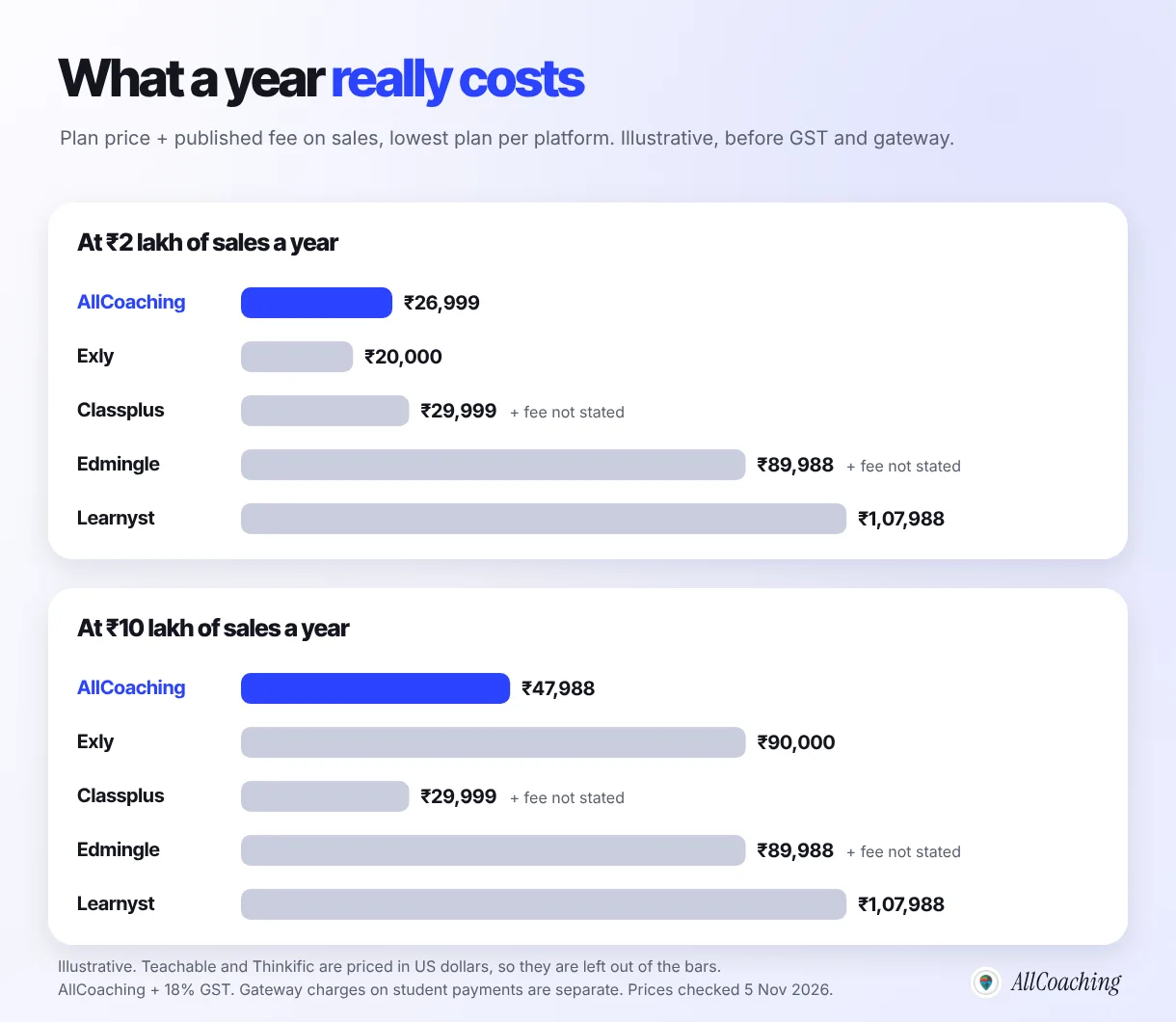
At ₹2 lakh of course sales a year, a plan with a low fixed fee and a percentage usually costs least; at ₹10 lakh, a fixed fee with 0% per sale usually leaves you more. The table shows the lowest-cost plan on each platform from its published prices; it is illustrative, before GST and gateway charges, and plans include different things.
| Platform | At ₹2 lakh of sales a year | At ₹10 lakh of sales a year |
|---|---|---|
| AllCoaching | ₹26,999 (Starter yearly: ₹6,999 + 10%) | ₹47,988 (Starter monthly: 12 × ₹3,999, 0%) |
| Exly | ₹20,000 (Starter: 10%) | ₹90,000 (Pro: ₹30,000 + 6%) |
| TagMango | ₹20,000 (Basic: 10%, gateway included) | ₹1,00,000 (Basic: 10%, gateway included) |
| Classplus | ₹29,999 + any fee per sale (not stated) | ₹29,999 + any fee per sale (not stated) |
| Edmingle | ₹89,988 (Core: 12 × ₹7,499 billed annually); fee not stated | ₹89,988; fee not stated |
| Learnyst | ₹1,07,988 (Professional: 12 × ₹8,999, 0%) | ₹1,07,988 |
| Teachable (US dollars) | $348 + ₹15,000 (Starter: $29 × 12 + 7.5%) | $828 (Builder: $69 × 12, 0% with Teachable Payments) |
Add the payment gateway on top
Every UPI or card payment also passes through a payment gateway with its own fee. Razorpay's standard India pricing lists a platform fee of 2% per successful transaction on domestic payment methods, up to 3% on international cards, no setup fee and no annual maintenance charge, with 18% GST on Razorpay's fee.1 At ₹2 lakh of sales that is about ₹4,000 plus GST on the fee; at ₹10 lakh, about ₹20,000 plus GST.
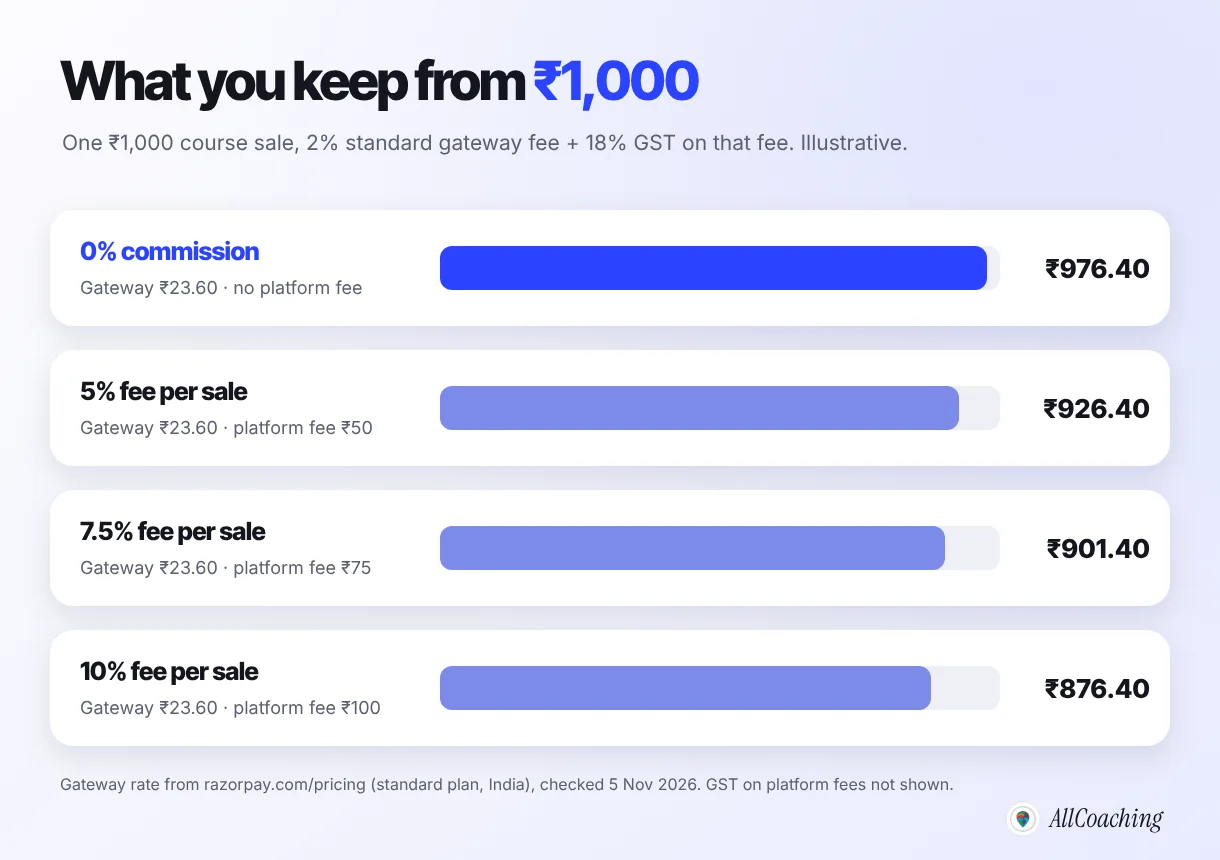
On AllCoaching the line between the two billing options sits at about ₹4 lakh of sales a year: below it, yearly Starter usually costs least; above it, a monthly plan at 0% usually leaves more (illustrative, before GST). To see how course price and batch size change this, read how to price online courses in India; the LMS cost guide for independent educators runs the maths at more sales levels.
Which type of platform fits which educator
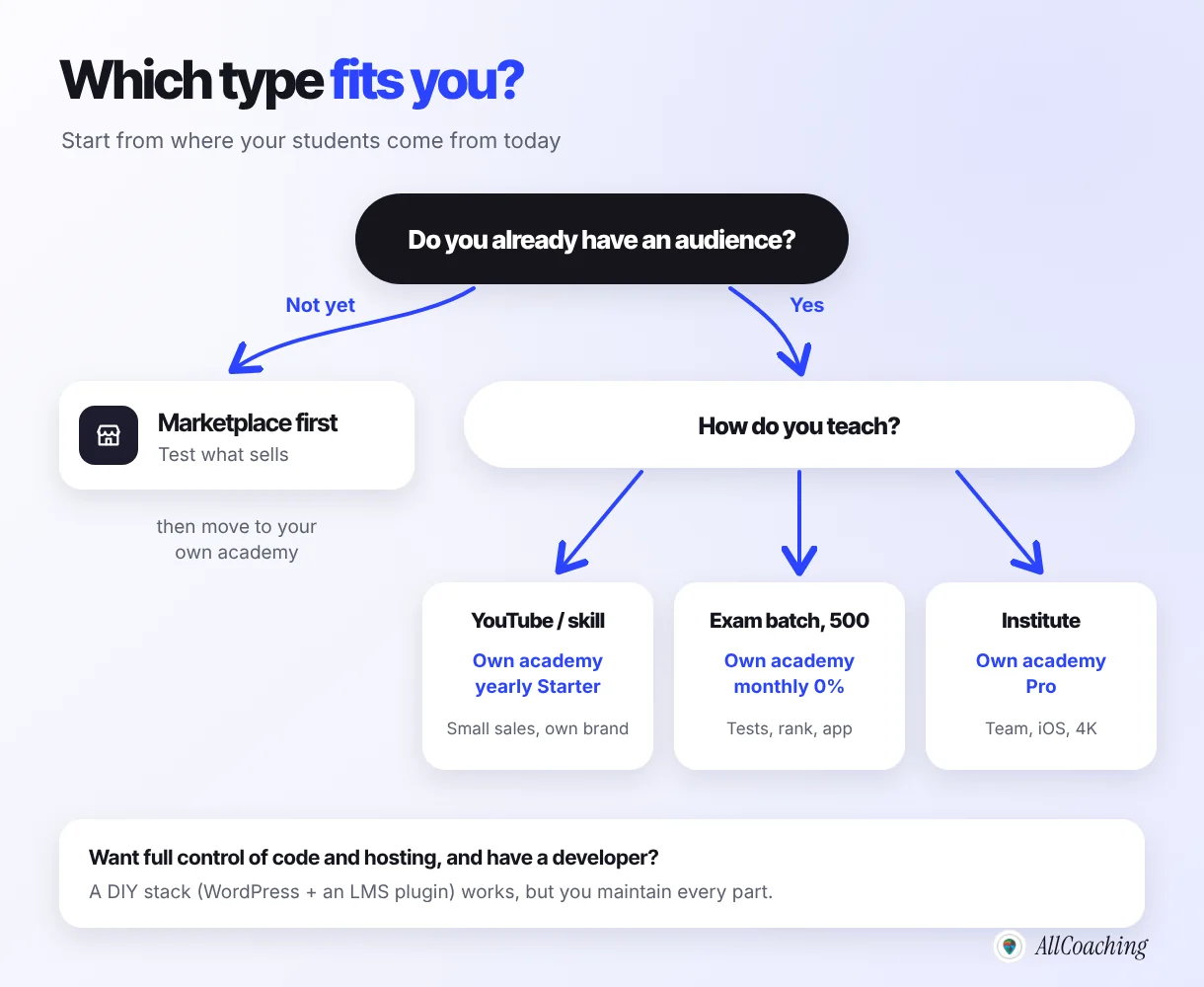
Start from where your students come from today: with no audience, a marketplace can find your first buyers; with any audience of your own, sell from your own academy so the students stay with you. Here is how that plays out for four common educators.
A beginner with a YouTube audience
Say you teach spoken English or Excel on YouTube with a few thousand subscribers. Your viewers already know your face, so they do not need a marketplace to find you; they need a link in the description that opens your course. An own academy with a small fixed fee fits, and at low sales a yearly plan with a fee per sale usually costs less than a monthly one. Our guide on how to sell courses online in India walks through the first ₹10,000.
An exam coach with 500 students
A NEET, SSC or banking coach with 500 students needs test series with rank, a live classroom, recordings and an app students open every day. At this size a fee per sale adds up quickly, so a 0% plan usually leaves more, and the branded app should be in the plan you can afford.
A skill educator selling cohorts and workshops
Yoga, music, vastu or digital marketing educators often sell a mix of live cohorts, recorded courses and one-to-one sessions. A storefront can suit sessions and bookings; once the recorded course is the main product, an own academy keeps it under your domain.
A coaching institute
An institute with several teachers needs team logins, an iOS app for some students, bigger video storage and a website parents trust. Compare the own-academy plan that includes iOS, not just the starting price. If you are leaving an existing app, our Classplus alternative guide covers switching without losing students.
When a marketplace really is the right choice
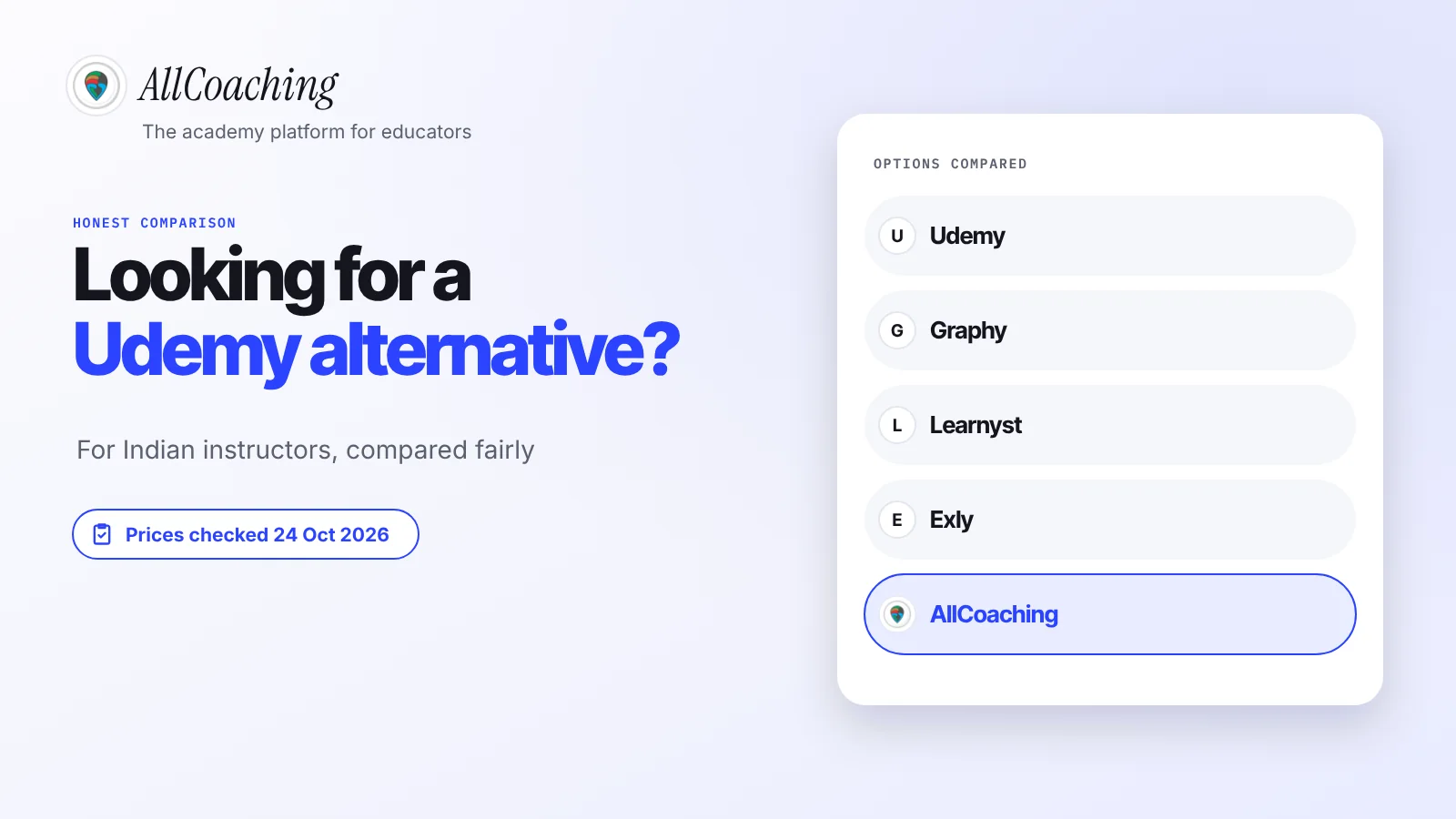
A marketplace is the honest answer when you have no audience and want to test whether anyone will pay for a topic, and it can run alongside your own academy for discovery. The marketplace owns the student and sets the share, so plan to bring your best students to your own academy over time. Our Udemy alternative guide explains how to keep both.
Selling from your own academy on AllCoaching
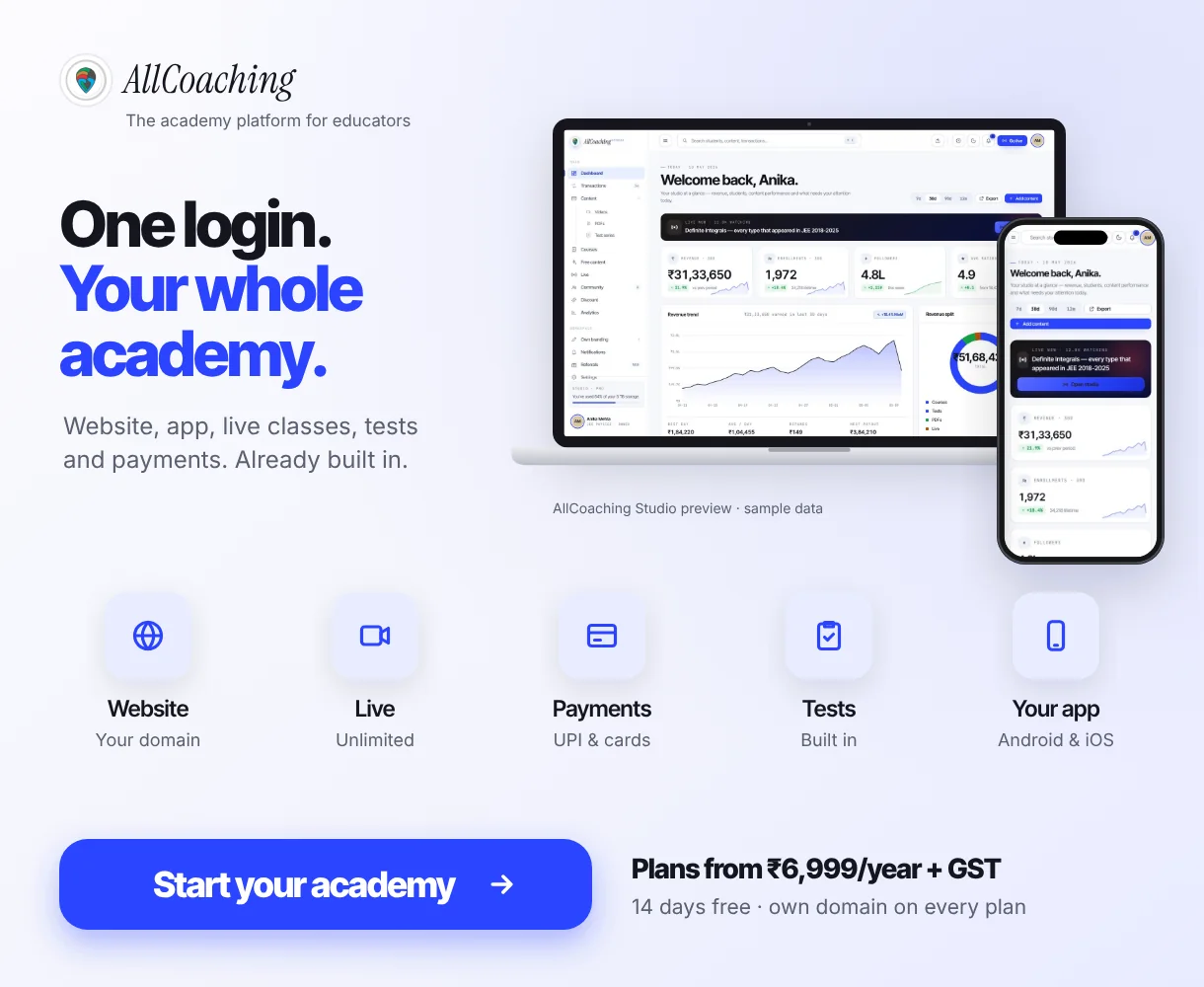
AllCoaching is an own-academy platform: you sign up, choose a plan, upload your course, connect your domain and start selling, with your own website, your own Android app on every plan, and an iOS app on Pro monthly and every yearly plan. Students enrol with your academy, pay by UPI or card through Razorpay, and payouts go to your bank automatically.
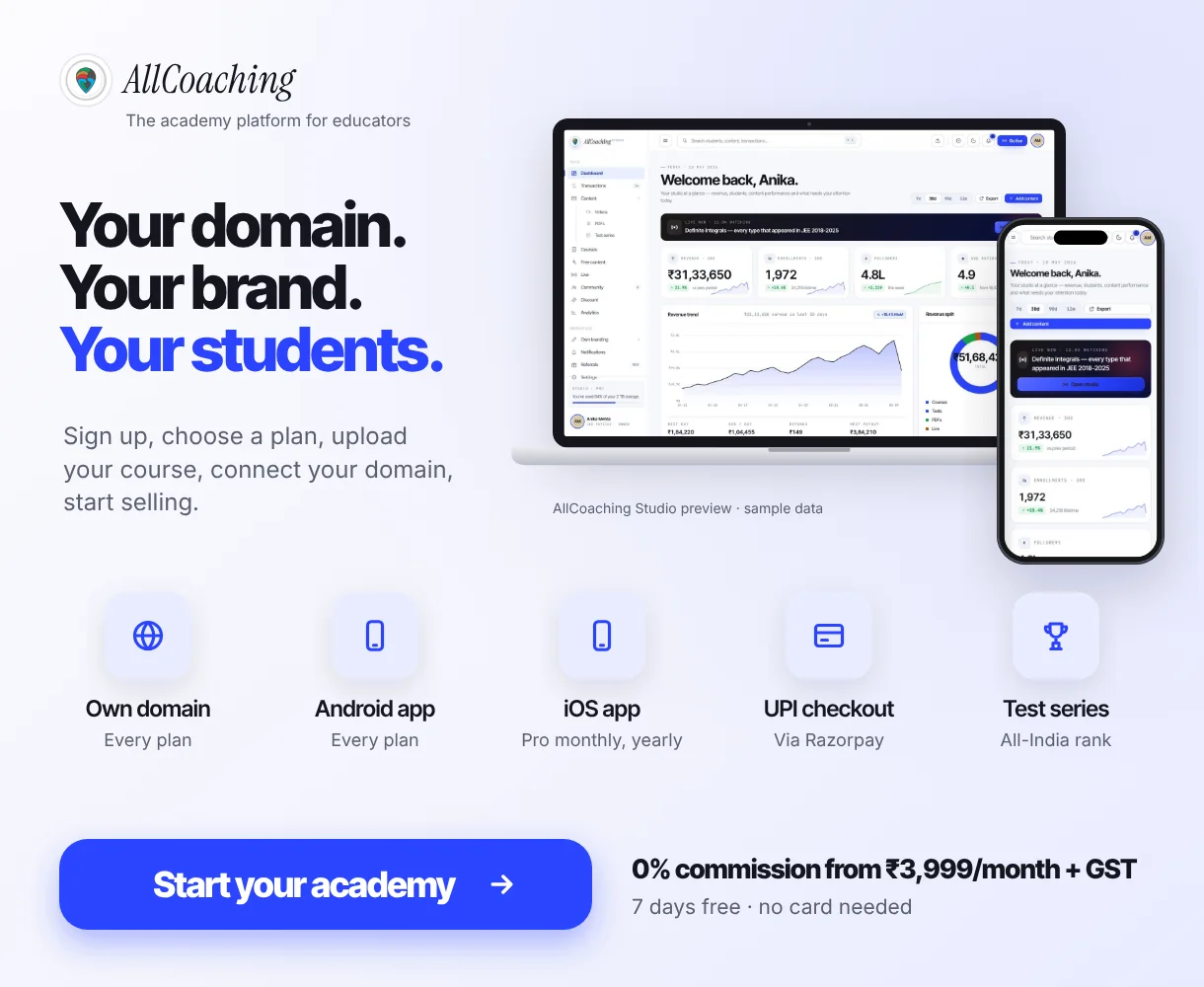
Pricing is published and set up yourself, with no sales call. Every plan starts with a 7-day free trial, no card needed. Monthly plans take 0% commission: Starter ₹3,999, Growth ₹5,999 and Pro ₹7,999 a month. Yearly plans have a lower fixed fee and a fee per sale: Starter ₹6,999 a year + 10%, Growth ₹12,999 + 7.5% and Pro ₹24,999 + 5%. Prices exclude 18% GST, there is no sales limit and no setup fee, and gateway charges on student payments are separate. The pricing page lists what each plan includes.
Every plan includes test series with all-India rank and percentile, an anti-cheat full-screen lock and random question order, branded certificates, bulk student import from Excel or Google Sheet, and a course page with SEO, schema and checkout created when you save a course. More than 500 educators already sell on AllCoaching; your courses can also be discovered on the AllCoaching app as an extra. If you stop, your academy goes offline at the end of the paid period and you get 30 days to export your content and data.
Build your own academy. Try it free for 7 days.
Website on your own domain, your own Android app, unlimited live classes and UPI checkout on every plan. 0% commission on every monthly plan from ₹3,999 a month, or yearly from ₹6,999 (excl. GST).
No card needed · Cancel anytime in the trial · Export your data any timeHow to choose a platform and start selling: 7 steps
Know where your students come from, estimate a year of sales, pick the type of platform, compare two or three on total cost, check ownership, test one real course in a free trial, then launch to the audience you already have. The whole decision fits in a week.
- Write down where your students come fromList your audience today: YouTube subscribers, Instagram followers, a WhatsApp group, a classroom batch or none yet. This decides whether you need a platform that finds students or one that keeps them.
- Estimate a year of salesMultiply a realistic number of students by your course price, for example 100 students at ₹1,999. Use it only to compare costs; it is not a target.
- Pick the type of platformNo audience: start on a marketplace. Your own audience: an own-academy LMS. Sessions and workshops: a course-selling storefront can fit. A developer on hand: a DIY stack.
- Compare two or three on total costFor each, add the yearly price, the fee per sale at your estimated sales, the gateway fee, GST and any add-on such as an app or a custom domain.
- Check who owns whatConfirm you can use your own domain, publish an app in your name, set your own prices and export your students and content.
- Test one real course in a free trialUpload one module, connect UPI checkout, and buy it yourself on a phone on mobile data. Fix anything that would make a student give up.
- Launch to the audience you haveShare the course link with your YouTube, Instagram and WhatsApp audience, then review sales and costs after 90 days and adjust the plan.
Step 6 is where most problems show up: buy your own course by UPI on a basic Android phone on mobile data. If you would not finish that journey, neither will your students.
Common mistakes when choosing where to sell online courses
The common mistakes are choosing by the headline price, ignoring the fee per sale, letting students live only on someone else's app, having no export plan, and paying in dollars for students who pay in rupees. Each one is easy to avoid before you start and hard to fix later.
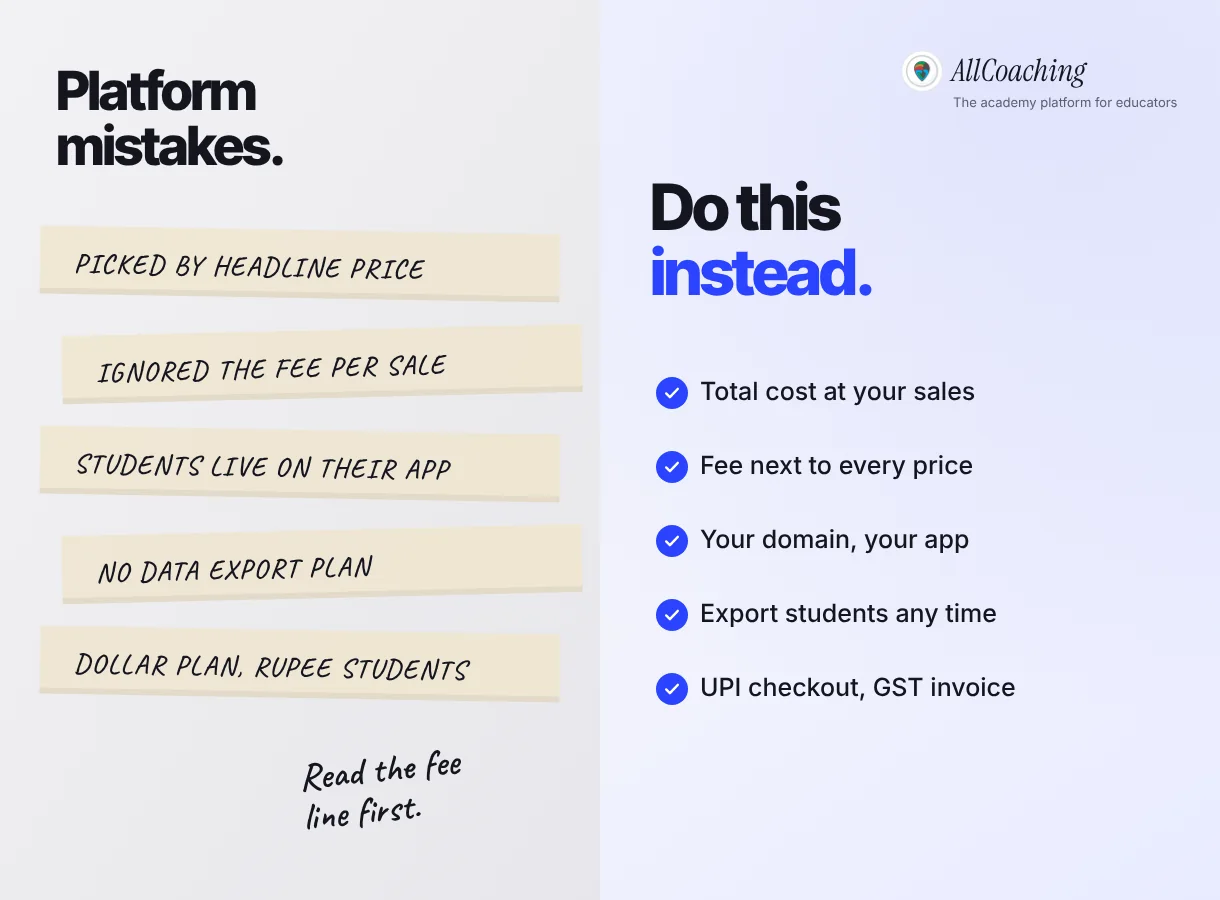
- Choosing by headline price. Work out the total for a year at your expected sales, as in the table above.
- Ignoring the fee per sale. 10% of ₹10 lakh is ₹1 lakh a year. Write the fee next to every price you compare.
- Students live on their app. Prefer your own domain and app, so a later move does not mean every student reinstalling.
- No export plan. Ask how you export students and content before you pay, not when you leave.
- Dollar plan, rupee students. A USD plan moves with the exchange rate; you still need UPI checkout and GST invoices.
We built AllCoaching after watching educators spend more evenings stitching tools together than teaching. Choose the platform that gives those evenings back.
Glossary
- Revenue share
- The part of each sale a platform pays to the educator, with the platform keeping the rest. Common on marketplaces, where the platform sets the split.
- Commission (fee per sale)
- A percentage of each sale that the platform takes, on top of or instead of a fixed subscription price.
- Payment gateway
- The service that takes a student's UPI, card or netbanking payment and passes the money to the seller's account, for a fee per transaction. Razorpay is one example.
- MDR
- Merchant discount rate: the fee a merchant pays on each card or digital payment. Gateways usually show it as a percentage of the transaction.
- Settlement
- The transfer of collected payments, minus fees, from the payment gateway to the seller's bank account.
- White-label
- A product built by one company but shown under another's name, such as an app published with the educator's logo and name instead of the platform's.
- LMS
- Learning management system: software to host courses, tests and live classes, enrol students and track their progress.
- Course marketplace
- A platform where many teachers list courses in one catalogue and students buy from the platform, which brings traffic and keeps the student relationship.
- Own academy
- An online academy that runs on the educator's own brand and domain, often with its own app, where students enrol directly with the educator.
Frequently asked questions
What is the best platform to sell online courses in India?
There is no single best platform. A marketplace suits a beginner with no audience, a course-selling app suits educators selling sessions and small products, an own-academy LMS suits educators who want their own brand, domain and app, and a DIY stack suits those with a developer. Choose the type first, then compare total yearly cost at your expected sales.
Where can I sell online courses in India without commission?
Several own-academy platforms publish 0% fee plans. AllCoaching takes 0% commission on every monthly plan, from ₹3,999 a month plus GST, and Learnyst lists 0% transaction fees on its Professional plan at ₹8,999 a month plus taxes, checked on 5 November 2026. Payment-gateway charges still apply on every platform.
Is Udemy good for Indian teachers?
Udemy can be good for finding first students without an audience, because it brings the traffic. The trade-off is that Udemy owns the student relationship and sets the revenue share. Many educators use a marketplace to test a topic and then sell from their own academy.
How much does it cost to sell online courses in India?
It depends on the platform and your sales. Illustratively, at ₹2 lakh of sales a year, the lowest-cost plan on the rupee platforms we checked ranged from ₹20,000 to ₹1,07,988 before GST and gateway charges. Add a gateway fee of about 2% per payment on top.
What is the difference between a marketplace and my own academy?
On a marketplace, students buy from the platform's catalogue, the platform runs checkout and pays you a share, and the student account belongs to the platform. In your own academy, students enrol on your website or app, you set the price, the money reaches your account, and you can export your student list.
Can I sell online courses on my own website in India?
Yes. An own-academy LMS gives you a course website on your own domain with UPI and card checkout, or you can build one yourself with WordPress, an LMS plugin and a payment gateway. The first is faster to set up; the second gives full control but you maintain every part.
Do Teachable and Thinkific work for Indian educators?
They work, but both are priced in US dollars. Teachable lists Starter at $29 a month billed annually with a 7.5% transaction fee, and Thinkific lists Start at $82 a month billed annually, checked on 5 November 2026. Check UPI checkout and GST invoicing for your students before you choose.
What payment gateway fee will I pay when selling courses?
Razorpay's standard India pricing lists a 2% platform fee per successful domestic transaction and up to 3% on international cards, with 18% GST on Razorpay's fee and no setup fee, checked on 5 November 2026. Some course platforms include the gateway in their commission; check each page.
Does AllCoaching give me my own app?
Yes. Every AllCoaching plan includes your own Android app, published on your own Play Store account, and the iOS app is included on Pro monthly and every yearly plan. Every plan starts with a 7-day free trial, no card needed.
Sources
- Razorpay, Pricing (India). razorpay.com/pricing, checked 5 November 2026.
- Teachable, Pricing. teachable.com/pricing, checked 5 November 2026 (US dollars).
- Thinkific, Pricing. thinkific.com/pricing, checked 5 November 2026 (US dollars).
- Learnyst, Pricing. learnyst.com/pricing, checked 5 November 2026 (rupee prices from the plan comparison on the page).
- Edmingle, India pricing. edmingle.com/in/pricing, checked 5 November 2026.
- Exly, Pricing. exlyapp.com/pricing, checked 5 November 2026.
- Classplus, pricing page. classplusapp.com/new-web, checked 5 November 2026.
- Tutor LMS, Pricing. tutorlms.com/pricing, checked 5 November 2026 (US dollars).
- TagMango, Pricing. tagmango.com/pricing, checked 5 November 2026.
- Graphy, Pricing. graphy.com/pricing, checked 5 November 2026; the page showed different rupee figures in different places from our connection, so no rupee price is quoted.
- Udemy, Instructor Revenue Share. support.udemy.com, attempted 5 November 2026 (returned an access check; content not retrieved, so no percentage is quoted).
- AllCoaching, Pricing. allcoaching.in/pricing.
Amit builds AllCoaching, the academy platform Indian educators set up themselves: their own website on their own domain, their own app, and the tools to grow it. AllCoaching is one of the platforms in this guide, so every competitor price links to its official page, checked 5 November 2026, figures we could not confirm are left out, and we say where a marketplace or another type fits better.