
On this page
Start your online academy today. 14 days free.
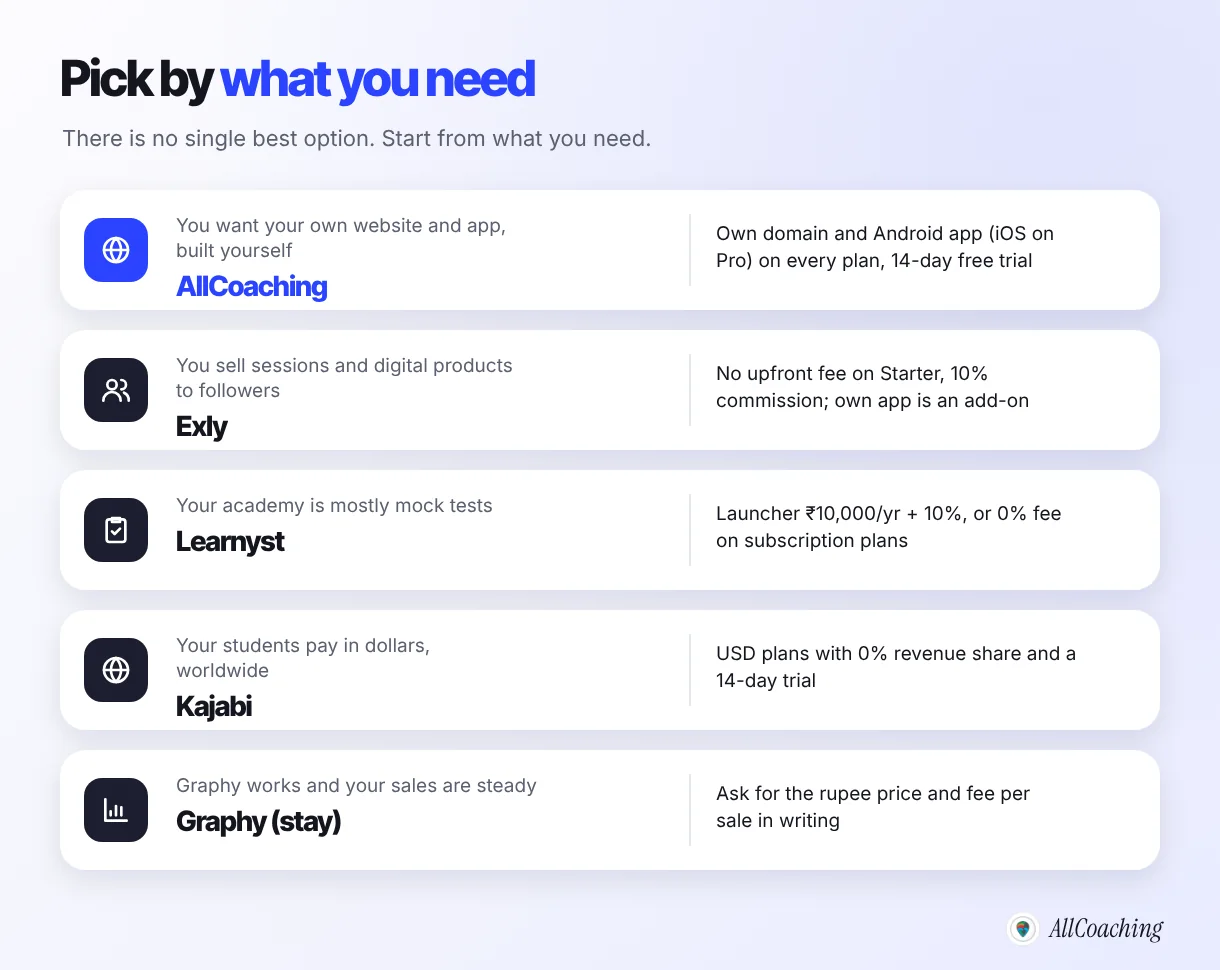
Start free trialThe best Graphy alternative depends on what you sell and what you want to own: for an educator who wants a website on their own domain and their own Android app (iOS app on Pro and Scale), set up without a sales call, AllCoaching is the closest fit; for selling sessions and digital products to followers, Exly; for mock tests, Learnyst; and for a dollar-paying global audience, Kajabi. If Graphy already works for you and your sales are steady, staying is a reasonable choice.
We are AllCoaching, so read this knowing who wrote it. Every competitor price below comes from that company's own pricing page, with the link and the date we checked it, and we say where another platform fits better than ours.
One thing we could not do is quote Graphy's rupee prices. Graphy publishes plans on graphy.com/pricing, but prices are shown by country and we could not confirm the Indian rupee plans on 24 Oct 2026; check the page from India.[1] So this guide compares Graphy on what it offers, and compares the alternatives on what they publish.
Key takeaways
- Graphy's rupee prices could not be confirmed on 24 Oct 2026: its pricing page shows prices by country, and from our connection it showed US dollar plans. Check graphy.com/pricing from India before comparing.
- Graphy offers a 14-day free trial and describes itself as an all-in-one platform with a website builder, branded apps, digital products and AI sales agents.
- AllCoaching starts at ₹6,999 a year plus 10% on sales (Starter), with Growth ₹12,999 + 7.5%, Pro ₹24,999 + 5% and Scale ₹99,999 + 0%; GST extra; 14-day free trial with no card.
- Exly's Starter plan has no upfront fee and takes a 10% commission; its own mobile app (iOS and Android) is an add-on from ₹60,000 a year.
- On published prices, Exly Starter costs less than AllCoaching up to about ₹5 lakh of sales a year if you do not need your own app; with Exly's app add-on, AllCoaching costs less at every level we checked.
- Learnyst publishes ₹10,000 a year + 10% (Launcher) and 0%-fee plans from ₹8,099 a month billed annually; TagMango and Kajabi also publish prices, Kajabi in US dollars.
- You can switch without losing students by running both platforms side by side until your current batches finish.
The short answer: pick by what you need
There is no single best Graphy alternative for everyone. There is a best fit for each kind of teaching business, so start from the problem you want to solve.
If you are still unsure, the next two sections explain how we compared and why educators usually start looking.
How we compared Graphy and its alternatives
We compared Graphy with five platforms Indian educators often shortlist against it: AllCoaching, Exly, TagMango, Learnyst and Kajabi. We looked at the five things a teaching business pays for or depends on.
- Price you can see before signing up, taken only from each company's own pricing page.
- Fee on your sales, because a percentage changes the total as you grow.
- What you own: your domain, your Android app (iOS app on Pro and Scale) listing, and your student data.
- How you start: a self-serve trial, or a demo and sales call.
- Who it is built for: exam academies, skill teachers, coaches selling sessions, or a global audience.
Why educators look for a Graphy alternative
Graphy is a capable, well-known platform, and for many educators selling to an existing YouTube or Instagram audience it does the job well. The reasons people start comparing usually fall into three groups.
1. Not being sure what you will pay in rupees
When we opened Graphy's pricing page on 24 Oct 2026, it showed US dollar plans from our connection, and the rupee figures inside the page did not agree with each other. That does not mean anything is wrong with Graphy's pricing. It means you should see the rupee plan, the fee per sale and GST in writing before you compare.
Question educators ask
Is Graphy too expensive, or am I just not selling enough yet?
Usually it is about stage, not the platform. A yearly plan feels heavy when sales are small and light when they grow. Ask Graphy for the rupee price and fee per sale for your plan, then compare the total at your real sales level, not the headline number.
2. Wanting your own app on every plan
Many educators now expect their own Android app (iOS app on Pro and Scale), under their own name, from day one. Check which Graphy plan includes the iOS app; on several platforms the app is a higher tier or a paid add-on.
3. Wanting students to find you, not only buy from you
A course platform gives you a place to sell. Bringing buyers is still your job: your YouTube channel, Instagram, WhatsApp groups and Google search. Graphy's pricing page does not describe a built-in student marketplace, so ask whether one exists. We cover this angle in detail in our guide to a Graphy alternative with organic traffic.
5 Graphy alternatives, compared fairly
Here is each option as its own company describes it, with the published price, what to check and who it suits. Graphy comes first so you can compare against it.
Graphy (the platform you are comparing)
- Good at
- An all-in-one platform with a website builder, branded mobile apps, digital products and AI sales and support agents; it says it gives you "everything you need to launch, scale, and automate your online teaching business".
- Published price
- Graphy publishes plans on graphy.com/pricing, but prices are shown by country and we could not confirm the Indian rupee plans on 24 Oct 2026; check the page from India.[1]
- Free trial
- 14 days.
- Check
- The rupee price of your plan, the fee per sale, whether GST is extra, and which plan includes the iOS app.
- Best for
- Educators with an existing audience who are happy with their current setup.
1. AllCoaching
- Good at
- An academy you build yourself, like Shopify for coaching: website on your own domain, your own Android app (iOS app on Pro and Scale), courses, tests, PDF notes, unlimited live classes and UPI checkout in one studio. Courses can also be discovered on the AllCoaching marketplace app.
- Published price
- Starter ₹6,999/yr + 10% on sales, Growth ₹12,999/yr + 7.5%, Pro ₹24,999/yr + 5%, Scale ₹99,999/yr + 0%; GST extra.[6]
- Free trial
- 14 days, no card needed.
- Check
- The percentage on sales adds up as you grow. Content protection (DRM) is not a feature we claim; if it is essential, compare platforms that publish it.
- Best for
- Exam and skill educators who want their own brand and want to set it up themselves.
2. Exly
- Good at
- Storefront, payments, CRM and WhatsApp and email automation for coaches selling courses, consultations and digital products; it calls itself "an all-in-one solution to all things business".
- Published price
- Starter: no upfront fee + 10% commission; Pro ₹30,000/yr (₹2,500/month billed annually) + 6%; Premium ₹1,08,000/yr (₹9,000/month billed annually) + 3%. Mobile app (iOS and Android) add-on from ₹60,000/yr.[2]
- Free trial
- Not stated on the pricing page.
- Check
- GST is not stated; a custom website and white-label branding are listed as add-ons.
- Best for
- Coaches selling sessions, cohorts and digital products to an audience they already have.
3. TagMango
- Good at
- Courses, community and automation for coaches, with an AI add-on stack and optional branded apps; its page promises a custom domain live "24 hours from onboarding".
- Published price
- Basic: no fixed fee + 10% commission (up to 200 students); Pro ₹5,000/month + 5.5%; Advanced ₹15,000/month + 3.5%; Ultimate ₹30,000/month with zero commission (gateway charge from 1.9%); all + GST. A custom domain needs the Freedom Setup at ₹24,999/yr.[3]
- Free trial
- Not stated; the page offers to book a call.
- Check
- Own Play Store and iOS apps come with the Branded Apps Stack, ₹74,999 + GST, charged once as a setup fee.
- Best for
- Coaches running paid communities and cohorts who want automation.
4. Learnyst
- Good at
- Courses, mock tests and live classes with DRM content protection and test series; it offers "features required to market and sell your content online across globe".
- Published price
- Launcher ₹10,000/yr + 10% of sales; Professional ₹8,999/month (₹8,099/month billed annually) with 0% transaction fees; Premium and Business up to ₹49,999/month; taxes extra.[4]
- Free trial
- Not stated as a trial; the buttons say "Get started for free".
- Check
- Its page says apps are published under Learnyst's developer account; a branded Android app starts from Premium.
- Best for
- Exam-prep academies where mock tests and test series are the main product.
5. Kajabi
- Good at
- Courses, coaching, memberships, website, email and funnels in one place; "One subscription runs your whole business, and Kajabi takes no revenue share."
- Published price
- In US dollars: Basic $179, Growth $249, Pro $499 a month, or $143, $199 and $399 a month billed annually; 0% revenue share, card processing fees apply. Indian GST treatment is not stated.[5]
- Free trial
- 14 days, plus a 30-day money-back guarantee.
- Check
- The branded app is on the Pro plan; prices were viewed from outside India.
- Best for
- Educators selling mainly to a global, dollar-paying audience.
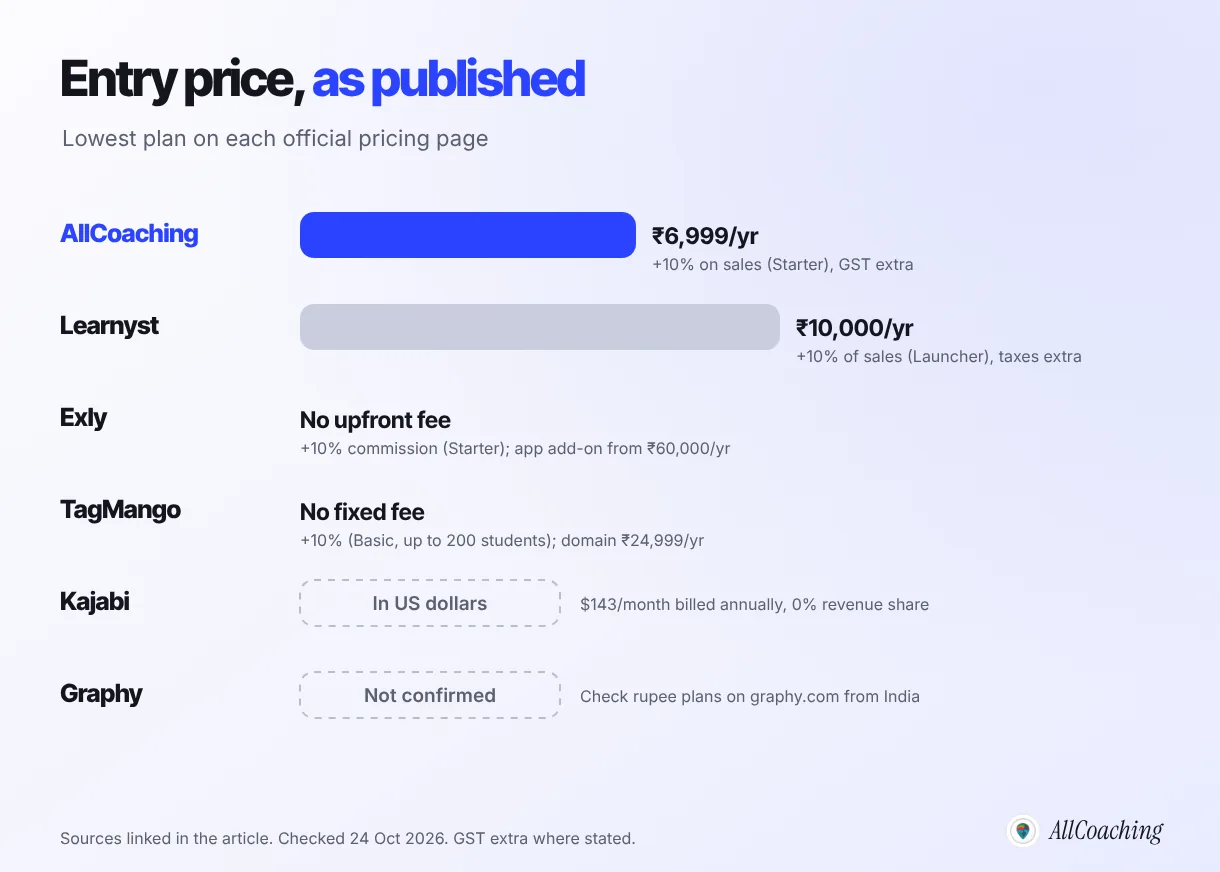
Graphy alternatives: side-by-side table
The table sets the published facts next to each other. "Not stated" means the official pricing page did not say, not that the fee or feature does not exist.
| Exly | TagMango | Learnyst | AllCoaching | |
|---|---|---|---|---|
| Lowest published price | No upfront fee (Starter) | No fixed fee (Basic, up to 200 students) | ₹10,000 a year (Launcher) | ₹6,999 a year (Starter) |
| Fee on sales | 10% · 6% · 3% commission | 10% · 5.5% · 3.5% · zero (gateway from 1.9%) | 10% on Launcher; 0% on subscription plans | 10% · 7.5% · 5% |
| Taxes | Not stated | + GST | + taxes | GST extra |
| Free trial | Not stated | Not stated (book a call) | "Get started for free" | 14 days, no card |
| Own domain website | Custom website add-on from ₹60,000 a year | Freedom Setup ₹24,999 a year | Ask | Yes, every plan |
| Own Android app (iOS app on Pro and Scale) | Add-on from ₹60,000 a year | Branded Apps Stack ₹74,999 + GST, charged once | Branded Android from Premium; Android and iOS from Business, under Learnyst's developer account | Yes, every plan |
For a three-way look at two of the best-known coaching platforms, see Classplus vs Graphy vs AllCoaching. If you came from Spayee, note that spayee.com now redirects to Graphy; our Spayee and Learnyst alternative guide covers that move.
What the alternatives really cost as you grow
A yearly price tells only half the story when a platform also takes a percentage. The chart adds each published plan price to its published fee at five sales levels and picks the lowest-cost plan each time. Graphy is not in the chart because we could not confirm its rupee prices.
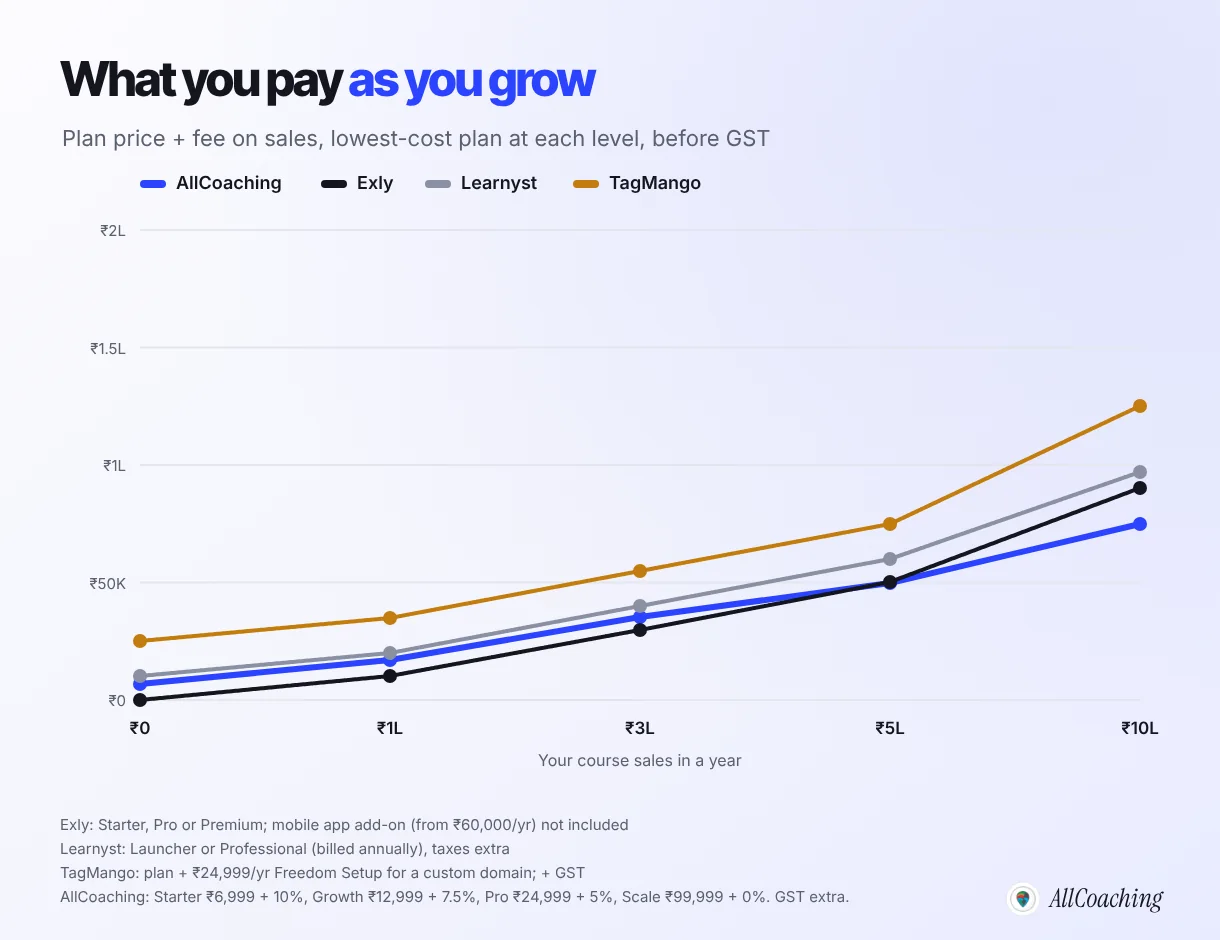
| Your sales in a year | AllCoaching (best plan) | Exly | Learnyst | TagMango |
|---|---|---|---|---|
| No sales yet | ₹6,999 (Starter) | ₹0 | ₹10,000 | ₹24,999 |
| ₹1 lakh | ₹16,999 (Starter) | ₹10,000 | ₹20,000 | ₹34,999 |
| ₹3 lakh | ₹35,499 (Growth) | ₹30,000 | ₹40,000 | ₹54,999 |
| ₹5 lakh | ₹49,999 (Pro) | ₹50,000 | ₹60,000 | ₹74,999 |
| ₹10 lakh | ₹74,999 (Pro) | ₹90,000 | ₹97,188 | ₹1,24,999 |
The honest reading: if you do not need your own app or domain, Exly's Starter plan costs less than AllCoaching up to about ₹5 lakh of sales a year, because it has no upfront fee. Add Exly's mobile app add-on (from ₹60,000 a year) and AllCoaching costs less at every level in the chart. Learnyst's Launcher plan sits close to AllCoaching Starter at low sales; above about ₹14.4 lakh a year its 0%-fee Professional plan (₹97,188 a year billed annually) costs less than AllCoaching. Use our plan finder to run your own numbers, and our guide on how to price online courses in India to set the course price itself.
Build your own academy. Try it free for 14 days.
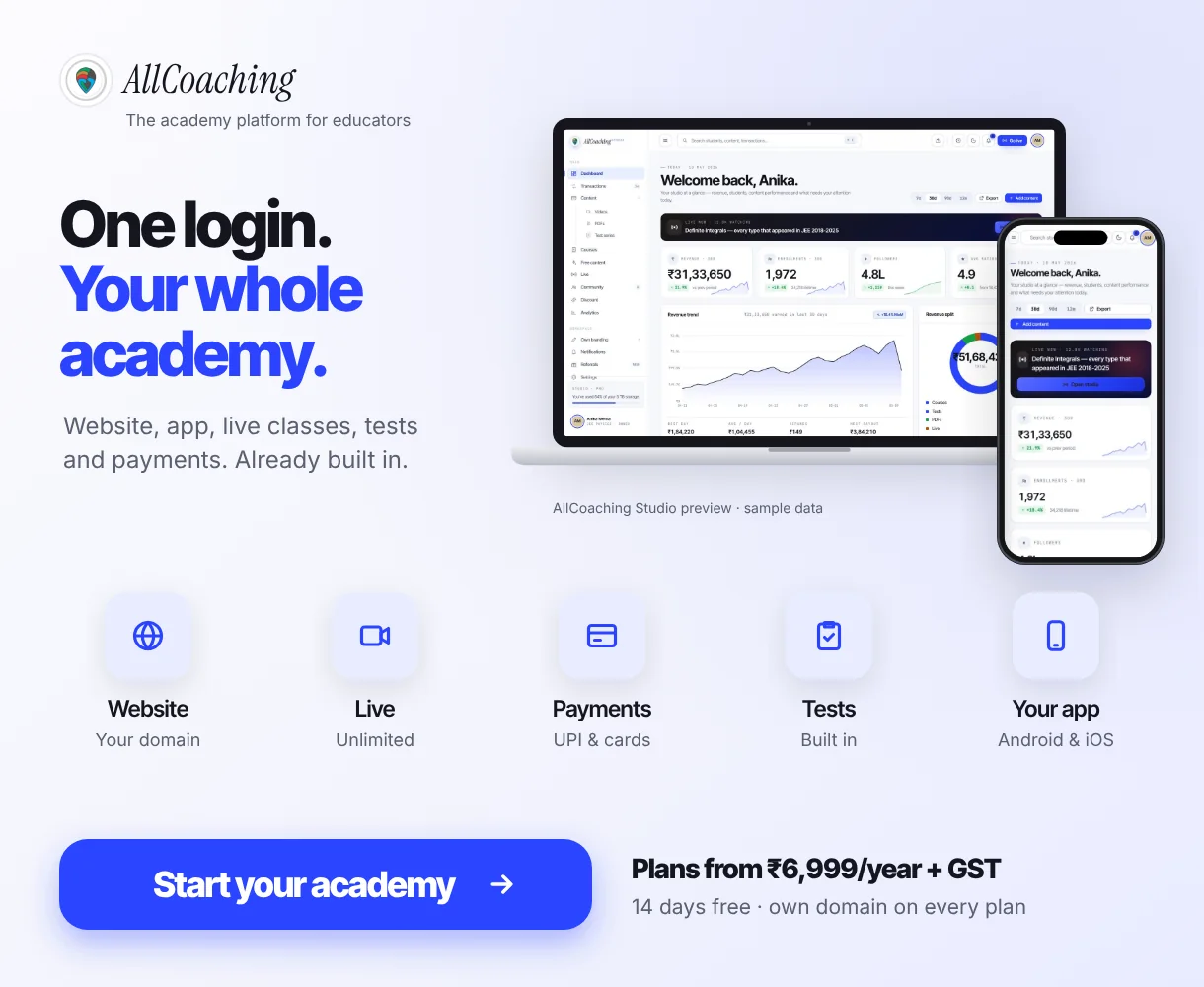
Website on your own domain, your own Android app (iOS app on Pro and Scale), unlimited live classes and UPI checkout on every plan. Plans from ₹6,999 a year after the trial (excl. GST).
No card needed · Cancel anytime in the trial · Your data stays exportableWhich Graphy alternative fits you
New educator selling the first course
Keep fixed costs low and start quickly. A self-serve platform with a 14-day trial lets you build and test before you commit. Our guide on how to sell courses online in India walks through the first sale.
YouTube teacher moving viewers to paid courses
You need a website on your own domain and an app your viewers can install from a link in the description. See how to monetise a YouTube teaching channel with your own app and LMS with a custom domain.
Coach selling sessions, cohorts and digital products
Exly and TagMango are built around this. If you also want structured courses, live batches and your own app on the same plan, compare them with an academy platform. Our Exly alternative for coaches guide goes deeper.
Test-series academy (SSC, banking, NEET, JEE)
If most of your income comes from mocks, look closely at Learnyst's test engine and compare it with building tests inside your own academy. See best platform for selling PDF notes and test series.
Selling mainly abroad
If your students pay in dollars, a USD platform such as Kajabi may suit you better than an India-first one. Our Kajabi alternative in India guide covers the other direction.
How to switch from Graphy without losing students
The safe way to switch is to run both platforms side by side. Current students keep access on Graphy until their batch or validity ends; new students join your new academy.
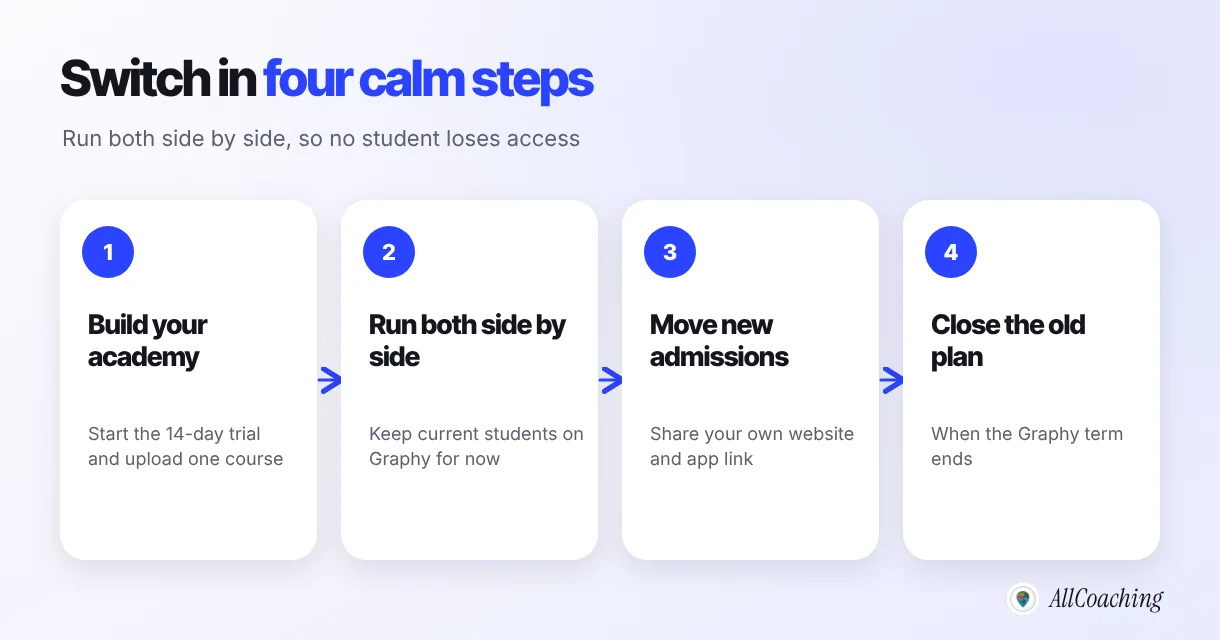
- Build your new academyStart the 14-day trial, connect your domain and upload one complete course with a free demo lesson.
- Run both platforms side by sideKeep current students on Graphy until their batch or course validity ends, so nobody loses access.
- Send new students to your academyPut your own website and app link in your YouTube descriptions, Instagram bio and WhatsApp groups.
- Export records and close the old planDownload student and payment records from Graphy, then let the plan end at its renewal date.
The full checklist, including messages to send students, is in how to switch coaching apps without losing students.
Glossary
- Platform fee
- A percentage a platform keeps from each sale. AllCoaching's is 10%, 7.5% or 5% depending on the plan.
- Commission
- Another name for a fee on each sale, used by platforms such as Exly and TagMango.
- White-label app
- An Android or iOS app that carries your academy's name and logo, built on a platform's technology.
- Custom domain
- Your own web address, such as youracademy.in, connected to your academy website instead of a platform subdomain.
- Parallel run
- Keeping the old and new platforms active at the same time during a switch, so current students keep access.
Frequently asked questions
What is the best Graphy alternative in India in 2026?
It depends on what you sell. AllCoaching fits educators who want their own website and Android app (iOS app on Pro and Scale) built themselves, from ₹6,999 a year plus a fee on sales. Exly suits coaches selling sessions and digital products, Learnyst suits test-heavy academies, Kajabi suits a global audience, and staying on Graphy is reasonable if your sales are steady.
How much does Graphy cost in India?
We could not confirm it. Graphy publishes plans on graphy.com/pricing, but prices are shown by country and we could not confirm the Indian rupee plans on 24 Oct 2026. Check the page from India and ask for the fee per sale and GST in writing.
Does Graphy have a free trial?
Yes. Graphy's pricing page offers a 14-day free trial. AllCoaching also starts with a 14-day free trial, and no card is needed to start it.
Is there a Graphy alternative with no upfront fee?
Yes. Exly's Starter plan has no upfront fee and takes a 10% commission, and TagMango's Basic plan has no fixed fee and takes 10% for up to 200 students. AllCoaching is not one of these: it has one annual plan from ₹6,999 a year plus 10% on sales, with your own domain and Android app (iOS app on Pro and Scale) included.
How is AllCoaching different from Graphy?
AllCoaching includes a website on your own domain and your own white-label Android app (iOS app on Pro and Scale) on every plan, with unlimited live classes and UPI checkout, set up yourself in the studio. Its prices are published in rupees, and courses can also be discovered on the AllCoaching marketplace app.
Can I move my courses and students from Graphy without losing them?
Yes. Build your new academy, keep current students on Graphy until their batch ends, send new students to your own website and app, then export your records and let the Graphy plan end at renewal.
Which Graphy alternative is best for a small or new educator?
A new educator usually does best with a low fixed cost and a trial, so they can build and sell before paying much. Exly Starter has no upfront fee if you do not need your own app; AllCoaching starts at ₹6,999 a year with your own app and domain included and a 14-day free trial.
Do Graphy alternatives bring you students?
Mostly no; finding students stays your job on most platforms. AllCoaching also lists your courses on its marketplace app, which helps discovery, but your own website, YouTube, Instagram and WhatsApp remain the main ways students find you.
Sources
- Graphy pricing, graphy.com/pricing (redirected to graphy.com/us/pricing from our connection), checked 24 Oct 2026; rupee plans not quoted here because they could not be confirmed.
- Exly pricing, exlyapp.com/pricing, checked 24 Oct 2026.
- TagMango pricing, tagmango.com/pricing, checked 24 Oct 2026.
- Learnyst pricing, learnyst.com/pricing, checked 24 Oct 2026 (prices shown in ₹ for Indian visitors).
- Kajabi pricing, kajabi.com/pricing-new, checked 24 Oct 2026 (viewed from outside India).
- AllCoaching pricing, allcoaching.in/pricing.
Amit builds AllCoaching, the academy platform Indian educators set up themselves: their own website on their own domain, their own app, and the tools to grow it. AllCoaching wrote this comparison, so we link every competitor figure to its official source and say where another option fits better.