
On this page
Start your online academy today. 14 days free.
Start free trialClassplus, Graphy and AllCoaching all let an Indian educator sell courses under their own brand, but they are built for different people. Classplus is a coaching app and website sold on a listed yearly price. Graphy is an all-in-one platform aimed at creators selling to their own audience. AllCoaching is an academy you build yourself, like Shopify for coaching, with your own website, your own Android app (iOS app on Pro and Scale), and a 14-day free trial.
We are AllCoaching, so read this knowing who wrote it. Every Classplus and Graphy fact below comes from that company's own website, with the link and the date we checked it (24 Oct 2026), and we say where each of the others is the better choice.
One thing we could not do is compare Graphy's rupee prices. Graphy publishes plans on graphy.com/pricing, but prices are shown by country and we could not confirm the Indian rupee plans on 24 Oct 2026. So this guide compares the three on how they work, trials, apps and ownership, and shows cost only for Classplus and AllCoaching, which both publish rupee prices.
Key takeaways
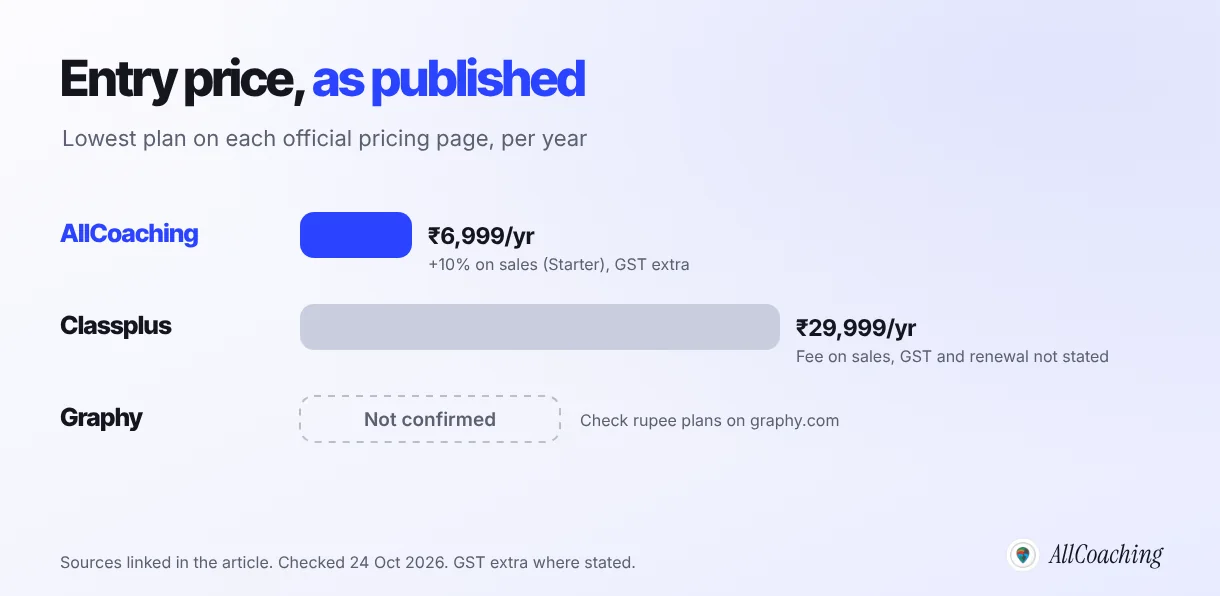
- Classplus lists ₹29,999 for 1 year and ₹39,999 for 2 years on classplusapp.com/new-web (checked 24 Oct 2026); GST, any fee on sales and the renewal price are not stated.
- Graphy's Indian rupee prices could not be confirmed on 24 Oct 2026, because its pricing page shows prices by country; check graphy.com/pricing from India.
- Graphy offers a 14-day free trial; Classplus's pricing page does not mention one; AllCoaching gives 14 days free with no card.
- AllCoaching publishes Starter ₹6,999, Growth ₹12,999 and Pro ₹24,999 a year plus a 10%, 7.5% or 5% fee on sales, GST extra.
- On published prices, AllCoaching costs less than Classplus up to about ₹2.3 lakh of sales a year; above that, Classplus's listed price is lower on paper.
- Every AllCoaching plan includes your own domain and your own Android app (iOS app on Pro and Scale); on Classplus the plan card lists an Android app, and on Graphy, ask which plan includes which app.
- None of the three replaces your own marketing. AllCoaching also lists your courses on its marketplace app as a supporting source of students.
Classplus vs Graphy vs AllCoaching: the short answer
Choose by the kind of teaching business you run, not by the brand name. Each of the three is strong for a different educator.
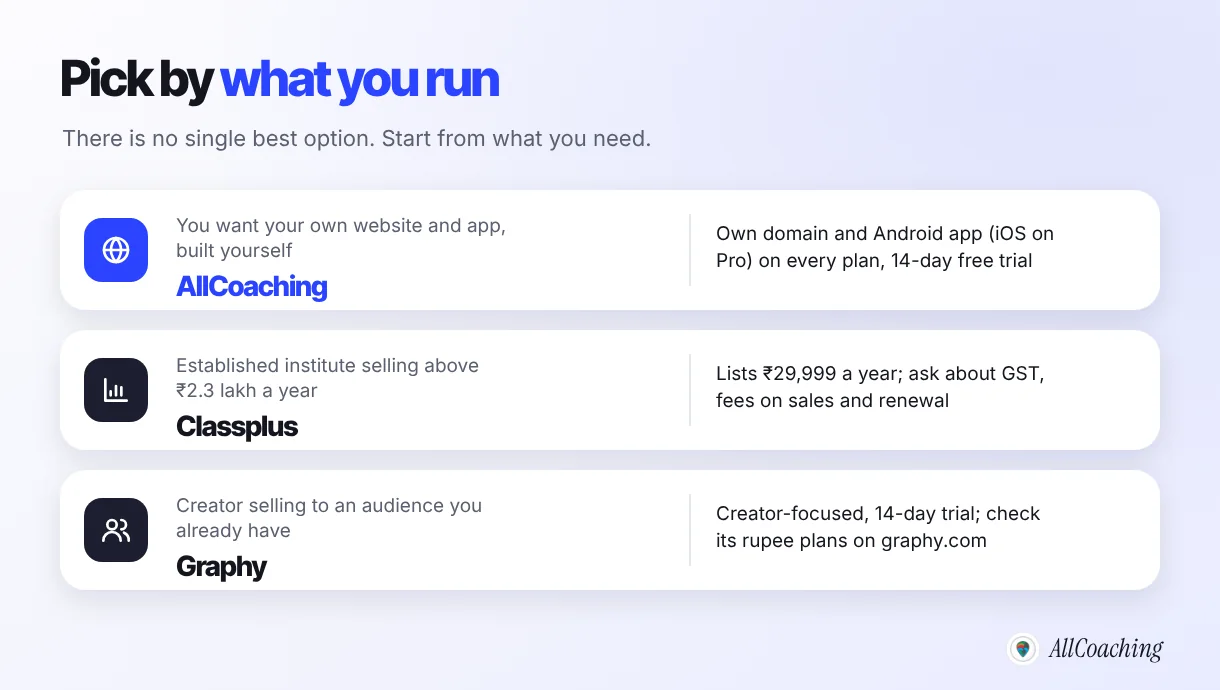
If two rows sound like you, the comparison table and the cost section below will usually settle it.
How we compared the three platforms
We read each company's own website on 24 Oct 2026 and compared five things an educator depends on.
- How the platform works: who it is built for and how you pay.
- Price and fee on sales, only where the official site states them in rupees.
- Free trial: whether you can try before paying.
- What you own: your domain, your Android app (iOS app on Pro and Scale), your student data.
- How you start and change things: self-serve or through a sales team.
How Classplus, Graphy and AllCoaching differ
The three platforms differ less in features than in who they are built for and how you start.
Classplus: a coaching app and website on a yearly plan
Classplus says: "Get your own brand's teaching app, create your own website & sell courses". Its plan lists an Android app, a website, an admin portal, unlimited recorded courses, live classes, student enrolments and storage, and "A.I. Powered Leads".[1] It lists ₹29,999 for one year and ₹39,999 for two.
Graphy: an all-in-one platform for creators and coaches
Graphy describes itself as "everything you need to launch, scale, and automate your online teaching business — all in one place": a website builder, branded mobile apps, digital products and AI sales and support agents.[2] It offers a 14-day free trial. Graphy comes from the team behind Spayee, and spayee.com now redirects to graphy.com.[3]
AllCoaching: an academy you build yourself
AllCoaching works like Shopify for coaching: sign up, choose a plan, upload your course, connect your domain and start selling. Payments, student access, apps and hosting run on their own. You get a website on your own domain and your own Android app (iOS app on Pro and Scale) on every plan, with unlimited live classes through YouTube Live, Zoom or the built-in room.[4]
Question educators ask
I am new and have no audience yet. Classplus, Graphy or AllCoaching?
Start with whichever lets you build and test before paying much. Graphy and AllCoaching both offer a 14-day free trial, and AllCoaching's lowest plan is ₹6,999 a year. Classplus's listed ₹29,999 a year is easier to justify once you already have paying students. Whichever you pick, your first students will come from your own YouTube, Instagram and WhatsApp.
The three platforms, compared fairly
Here is each platform as its own company describes it, with what it publishes about price, what to check, and who it suits best.
1. Classplus
- Good at
- A branded teaching app plus website for coaching businesses, with unlimited recorded courses, live classes, enrolments and storage on its plan.
- Published price
- ₹29,999 for 1 year, ₹39,999 for 2 years (checked 24 Oct 2026).[1]
- Free trial
- Not mentioned on the pricing page.
- Check
- GST, any fee on your sales, the renewal price, and whether an iOS app is included (the plan cards list Android).
- Best for
- Established coaching institutes with steady sales that want a flat yearly price.
2. Graphy
- Good at
- An all-in-one platform for creators and coaches: website builder, branded apps, digital products and AI sales agents.
- Published price
- Graphy publishes plans on graphy.com/pricing, but prices are shown by country and we could not confirm the Indian rupee plans on 24 Oct 2026; check the page from India. graphy.com/pricing[2]
- Free trial
- 14 days.
- Check
- The rupee price of each plan, the fee per sale, and which plan includes the Android and iOS apps.
- Best for
- Creators and coaches selling courses and digital products to an audience they already have.
3. AllCoaching
- Good at
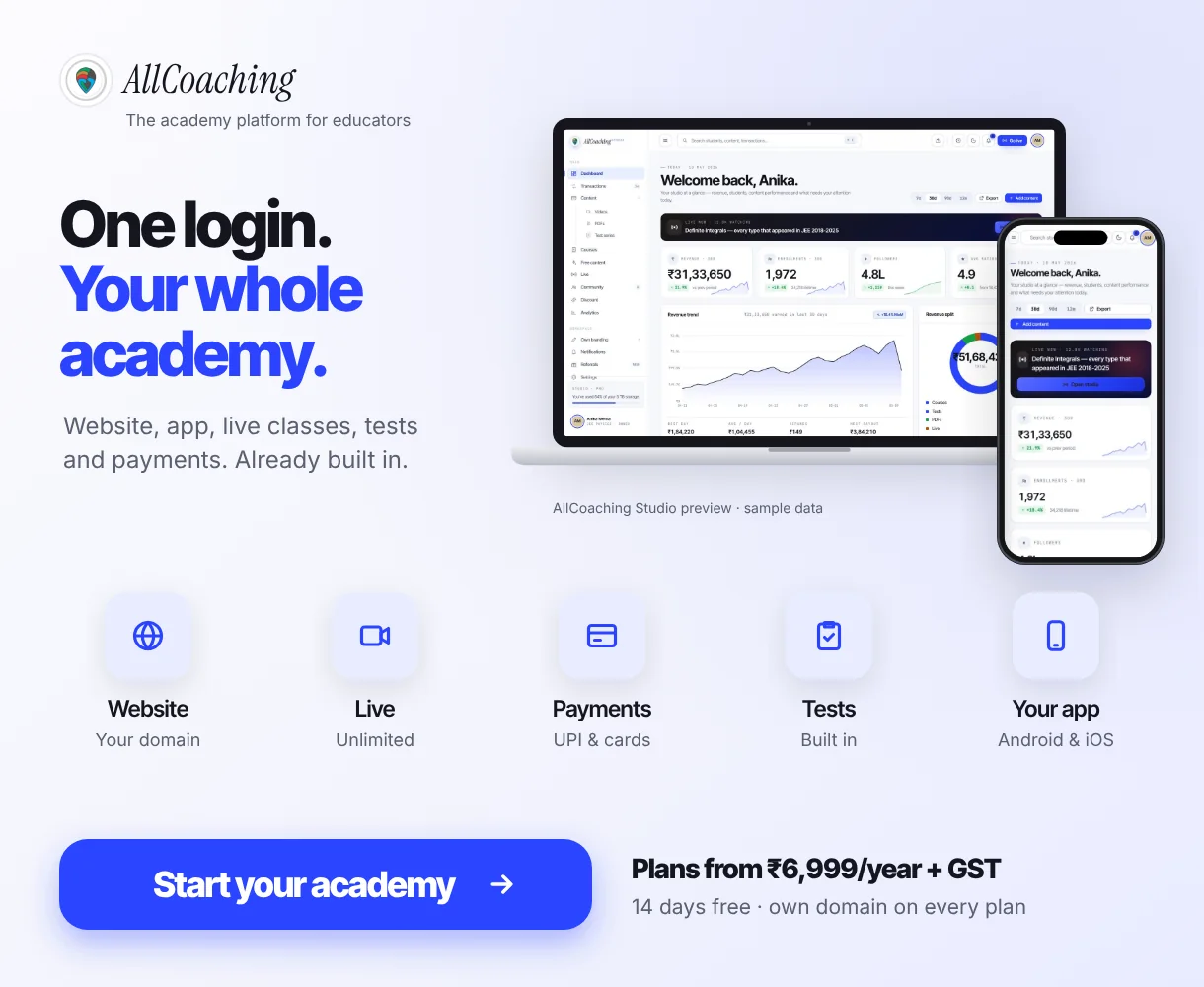
- An academy you build yourself: website on your own domain, your own Android app (iOS app on Pro and Scale), courses, tests, notes, unlimited live classes and UPI checkout in one studio.
- Published price
- Starter ₹6,999/yr + 10% on sales, Growth ₹12,999/yr + 7.5%, Pro ₹24,999/yr + 5%, Scale ₹99,999/yr + 0%; GST extra. Pricing
- Free trial
- 14 days, no card needed.
- Check
- The fee on sales adds up as you grow; above about ₹2.3 lakh a year, Classplus's listed price is lower on paper.
- Best for
- Educators who want their own brand and want to set it up and change it themselves.
Classplus vs Graphy vs AllCoaching: comparison table
The table puts the published facts next to each other. "Not stated" means the official page did not say, not that the fee or feature does not exist.
| Classplus | Graphy | AllCoaching | |
|---|---|---|---|
| Built for | Coaching businesses | Creators and coaches | Educators and coaching institutes |
| Rupee price | ₹29,999 for 1 year; ₹39,999 for 2 years | Not confirmed (shown by country) | ₹6,999 · ₹12,999 · ₹24,999 a year |
| Fee on sales | Not stated | Not confirmed for India | 10% · 7.5% · 5% |
| GST | Not stated | Not stated | 18% GST extra |
| Free trial | Not mentioned | 14 days | 14 days, no card |
| Website | Yes | Website builder | Yes, on your own domain |
| Apps | Android app listed; iOS not listed | Branded apps; ask which plan | Your own Android app (iOS app on Pro and Scale) on every plan |
| Student discovery | "A.I. Powered Leads" listed | AI sales agents described | Courses also listed on the AllCoaching marketplace app |
For plan-by-plan pages, see AllCoaching vs Classplus and AllCoaching vs Graphy. For more options beyond these three, read our Classplus alternatives guide and Graphy alternatives guide.
Classplus vs AllCoaching: what each costs as you grow
Only Classplus and AllCoaching publish rupee prices we could confirm, so the cost comparison covers those two. Graphy is left out until its Indian prices can be checked.
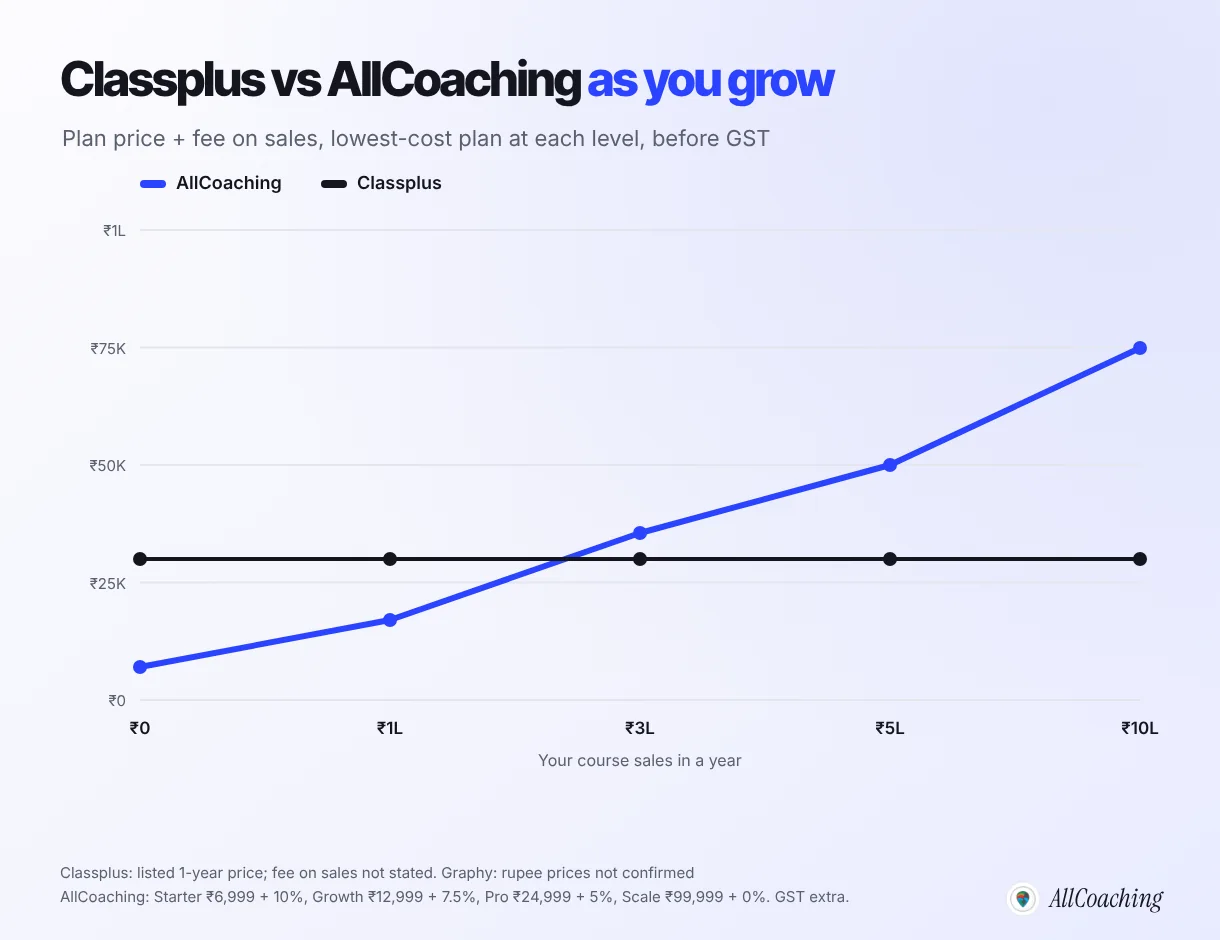
| Your sales in a year | AllCoaching (best plan) | Classplus |
|---|---|---|
| No sales yet | ₹6,999 (Starter) | ₹29,999 |
| ₹1 lakh | ₹16,999 (Starter) | ₹29,999 |
| ₹3 lakh | ₹35,499 (Growth) | ₹29,999 |
| ₹5 lakh | ₹49,999 (Pro) | ₹29,999 |
| ₹10 lakh | ₹74,999 (Pro) | ₹29,999 |
The honest reading: up to about ₹2.3 lakh of sales a year, AllCoaching costs less on published prices, because Starter is ₹6,999 and the fee applies only when you sell. Above that, Classplus's ₹29,999 is lower on paper, provided Classplus confirms there is no fee on sales and tells you the renewal price.
To add Graphy, open graphy.com/pricing from India, note the yearly price and per-sale fee of the plan you need, and add them at your sales level the same way. Our plan finder does the AllCoaching side for you.
Build your own academy. Try it free for 14 days.
Website on your own domain, your own Android app (iOS app on Pro and Scale), unlimited live classes and UPI checkout on every plan. Plans from ₹6,999 a year after the trial (excl. GST).
No card needed · Cancel anytime in the trial · Your data stays exportableDo Classplus, Graphy or AllCoaching bring you students?
Mostly no: all three are tools for selling your own teaching, and your first students will come from your own channels. What differs is the help each one describes.
- Classplus lists "A.I. Powered Leads" on its plan. Ask what that includes and where the leads come from.
- Graphy describes AI sales and support agents, aimed at converting an audience you already have. No built-in student marketplace is described on its pricing page.
- AllCoaching also lists your courses on the AllCoaching marketplace app on Android, iOS and the web. It helps discovery; it is not a replacement for your own marketing.
We have watched this closely with the 500+ educators selling on AllCoaching: the ones who grow treat their own YouTube channel, Instagram and WhatsApp as the main road, and their academy website as the place those roads lead. Our guide to getting your first 500 students covers that.
You can also use AllCoaching alongside Classplus or Graphy while you test it. Nothing stops you running two platforms for one batch before you decide.
Which one fits you
Established coaching institute with steady sales
If you already sell well above ₹2.3 lakh a year and want a flat price, Classplus can cost less on paper. Confirm GST, fees and renewal in writing. Our best LMS for coaching institutes guide covers more options at this size.
Creator with a big audience selling digital products
If you have a large YouTube or Instagram following and sell courses and digital products, Graphy is built for that. Check its rupee prices from India before comparing.
New or growing educator who wants their own academy
For a JEE physics teacher, an SSC maths educator or a spoken English coach starting out, a low fixed price and a free trial matter most. AllCoaching starts at ₹6,999 a year, and you build it yourself. Start with how to sell courses online in India.
Educator who cares most about owning the brand
If your own domain and your own app matter more than anything, compare what each plan includes. See LMS with a custom domain and our online coaching business plan.
How to move from Classplus or Graphy to AllCoaching
The safe way to switch is to run both platforms side by side. Current students stay where they are until their batch ends; new admissions go to your new academy.
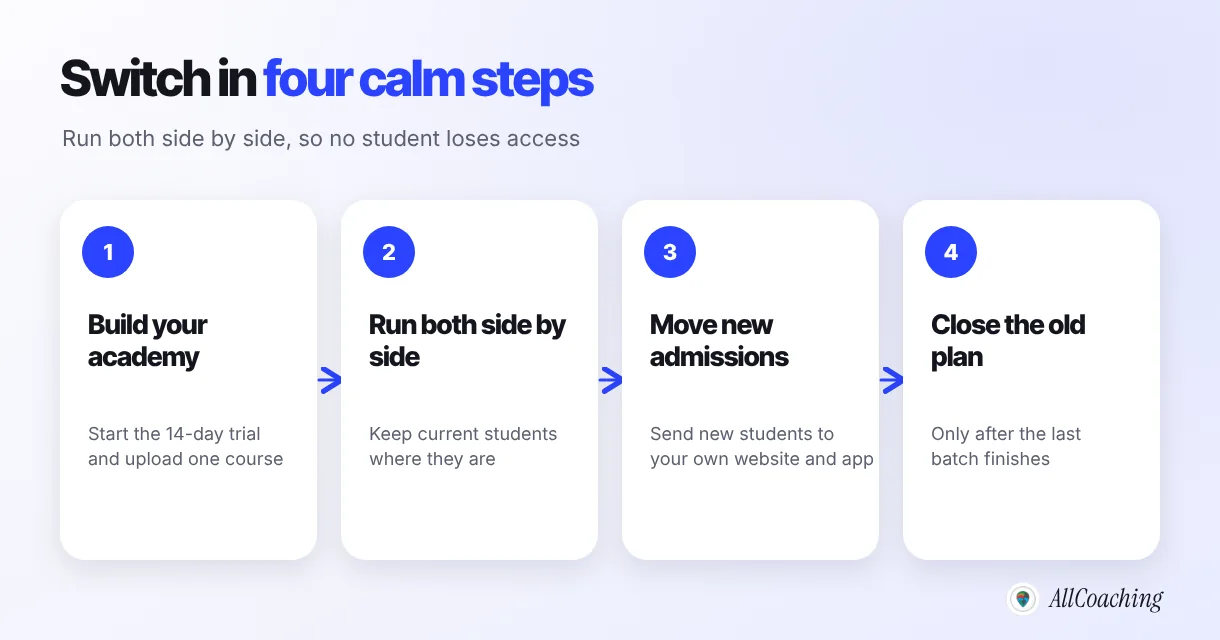
- Build your new academyStart the 14-day trial, connect your domain and upload one complete course with a free demo lesson.
- Run both platforms side by sideKeep current students on Classplus or Graphy until their batch or validity ends, so nobody loses access.
- Send new admissions to your academyShare your own website and app link on YouTube, Instagram and WhatsApp for every new batch.
- Export records and close the old planDownload student and payment records, then let the old plan end at renewal.
The full checklist, including messages to send students, is in how to switch coaching apps without losing students.
Glossary
- White-label app
- An Android or iOS app that carries your brand's name and logo, built on a platform's technology.
- Creator commerce platform
- A platform built for people with an audience to sell courses, digital products and memberships.
- Platform fee
- A percentage a platform keeps from each sale. AllCoaching's is 10%, 7.5% or 5% depending on the plan.
- Custom domain
- Your own web address, such as youracademy.in, connected to your academy website.
- Marketplace discovery
- Students finding your course while browsing one app that lists many educators, in addition to your own channels.
Frequently asked questions
Which is better, Classplus or Graphy?
It depends on what you run. Classplus is built for coaching businesses and lists ₹29,999 a year; Graphy is built for creators and coaches selling to their own audience and offers a 14-day free trial. Graphy's rupee prices could not be confirmed on 24 Oct 2026, so check graphy.com/pricing from India.
Which is better for new teachers, Classplus or AllCoaching?
For a new teacher, AllCoaching is usually easier to start with: a 14-day free trial with no card, then plans from ₹6,999 a year plus a fee on sales. Classplus lists ₹29,999 a year, which suits institutes that already have steady sales.
How much does Graphy cost in India?
We could not confirm it. Graphy publishes plans on graphy.com/pricing, but prices are shown by country and we could not confirm the Indian rupee plans on 24 Oct 2026, so check the page from India.
How much does Classplus cost in 2026?
Classplus lists ₹29,999 for 1 year and ₹39,999 for 2 years on classplusapp.com/new-web (checked 24 Oct 2026). The page does not state GST, any fee on sales or the renewal price.
Is AllCoaching cheaper than Classplus?
On published prices, AllCoaching costs less up to about ₹2.3 lakh of sales a year, because plans start at ₹6,999 and the fee applies only to sales. Above that, Classplus's listed price is lower on paper, before any fees it may charge.
Which platform helps educators find students?
All three are mainly tools, so your own YouTube, Instagram and WhatsApp stay the main source of students. Classplus lists A.I. Powered Leads, Graphy describes AI sales agents, and AllCoaching also lists your courses on its marketplace app.
Can I use AllCoaching alongside Classplus or Graphy?
Yes. You can build an AllCoaching academy during the 14-day trial while your current platform keeps running, test it with one batch, and move fully only when you are ready.
Is AllCoaching only for new educators or also for coaching institutes?
Both. Every plan includes your own domain, your own Android app (iOS app on Pro and Scale), unlimited live classes and separate teacher logins, and the Growth and Pro plans lower the fee on sales to 7.5% and 5% as an institute grows.
Sources
- Classplus pricing page, classplusapp.com/new-web, checked 24 Oct 2026.
- Graphy pricing, graphy.com/pricing, checked 24 Oct 2026; the page showed non-Indian prices from our connection, so rupee plans are not quoted here.
- Spayee website, spayee.com, checked 24 Oct 2026; redirects to graphy.com.
- AllCoaching pricing, allcoaching.in/pricing.
Amit builds AllCoaching, the academy platform Indian educators set up themselves: their own website on their own domain, their own app, and the tools to grow it. AllCoaching wrote this comparison, so we link every competitor figure to its official source and say where another option fits better.