White Label Coaching
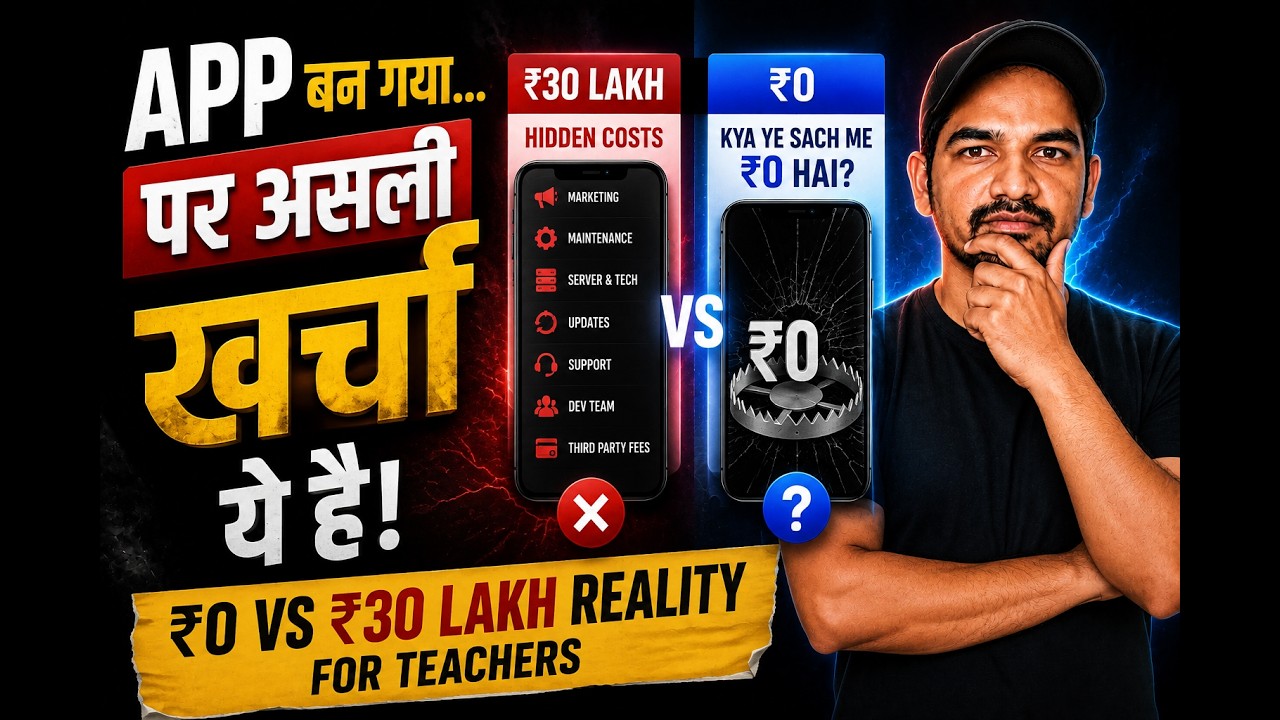
App Development Cost in India.
Every white-label vendor advertises a small monthly number. The actual Year 1 outflow for a typical Indian coaching institute lands between ₹4 lakh and ₹11 lakh once setup, transaction cuts, bandwidth, branding, marketing markups, and annual escalation clauses are on the table. This is the line-by-line founder breakdown the vendor quotation will never give you.
Amit Ratan
Founder & CEO, AllCoaching
Published May 14, 2026 · Updated June 1, 2026 · 20 min read · EdTech Economics
The pricing page is the marketing. The contract is the math. Every line item that is not on the pricing page is on the invoice — once it is too late to negotiate.
The question every Indian coaching institute owner asks when they begin evaluating a white-label coaching app — what does this actually cost? — is the right question, asked of the wrong document. The pricing page is not where the cost lives. The pricing page is where the customer-acquisition number lives. The cost lives in the contract, in the add-on catalog, in the per-transaction commission percentages, in the annual escalation clause, in the marketing-services markup, and in the four to eight separate invoices that will arrive in your inbox over the next twelve months — long after the signup decision has already been made.
This article is the founder-written, line-by-line financial decomposition that the vendor quotation does not include. Every cost layer that gets bundled, deferred, marked up, or quietly tier-locked into a higher plan is documented here, with ₹ ranges drawn from real Indian market quotations across the major white-label coaching app providers in 2026. The stakes here are not small — India's EdTech market is projected to reach ₹2,50,850 crore (about US$29 billion) by 2030,[1] and the white-label app vendors selling into that boom have every incentive to keep the true cost of their software opaque. By the end, you will know what a white-label coaching app actually costs in India in 2026 — and the transparent alternative that ends the spreadsheet for institute owners who would rather spend their attention on teaching than on auditing vendor invoices.
If you are reading this with a vendor quotation already in your inbox, do not sign anything until you have run that quotation against the twelve-layer cost framework in section three. Most institutes who do this discover their true Year 1 outflow is 3–5x what the pricing page suggested. The point of this article is to make sure you are not the next one. As a structural pattern, the institutes we see hit by the worst contract surprises are not the smallest; they are the ones at the ₹50 lakh to ₹2 crore annual revenue band who assumed they had read enough fine print to be safe.
Key Takeaways — the entire post in six facts:
₹4–11 lakh per year is the real Year 1 cost of a typical Indian white-label coaching app — against a headline pricing-page figure of ₹2,499–₹24,999 per month. The 3–5x gap is structural, not vendor-specific.
12 hidden cost layers appear in nearly every white-label contract — setup, monthly license, per-transaction commission (1.5–4% on top of gateway), payment gateway markup (0.3–1%), storage and bandwidth overages, custom domain, push and SMS credit packs, branding refresh, annual escalation 15–25%, support tier upgrades, marketing services markup 3–5x, and data export fees.
Annual price escalation 15–25% baked into contracts compounds to a 50%+ price increase over three years. Most contracts cap escalation, most do not. Read page 11 of the master service agreement before signing.
Marketing services markup 3–5x is the largest hidden layer — a ₹1 lakh monthly marketing services package typically represents ₹20,000–₹30,000 in actual Meta and Google ad spend with the rest going to vendor margin.
Switching costs ₹2–5 lakh in operational disruption after 6 months — student data migration, branded URL transition, parent communication, content re-uploads. The cost of leaving is engineered to exceed the cost of staying.
3-year TCO comparison — White-label ₹52–96 lakh cumulative; AllCoaching marketplace ₹11–17 lakh cumulative. 5–8x cost reduction with distribution included rather than externalised to self-funded marketing.
Founder ka video
Coaching App Banane Ka Kharcha Kitna Hai? | 2026 Ka Asli HisaabAmit Ratan · YouTube
"The headline pricing is engineered for signup. The real pricing is engineered for retention — once you can no longer leave without losing your students, your data, and the branded domain you have already advertised to parents. The gap between these two numbers is the white-label business model."
— The pricing-asymmetry observation behind AllCoaching's transparent-economics design
The Headline Number — What Vendors Show You First
Walk onto any white-label coaching app provider's pricing page in 2026 and you will see something close to the following structure — three tiers, each with a single monthly figure, ascending from starter to enterprise. The number is engineered to feel proportional to the scale of your institute. The number is also engineered to exclude everything else.
The Pricing-Page Illusion
Typical White-Label Coaching App Tier Quotes in India (2026)
Starter tier: ₹2,499–₹5,999 per month + ₹25,000–₹75,000 one-time setup. Growth tier: ₹9,999–₹24,999 per month + ₹75,000–₹2,00,000 setup. Pro / Enterprise tier: ₹35,000–₹1,25,000 per month + ₹2–8 lakh setup. Each tier headline figure represents only the base software license — every other necessary component (transactions, bandwidth, storage, branding, push notifications, support, marketing) is invoiced separately or bundled at successively higher tiers. The pricing page is the smallest possible number you can compute that still describes the product — not the real total.
The math of this design is straightforward. An institute owner comparing three vendors anchors on the monthly figure they see first — say, ₹9,999/month. They multiply by twelve, get ₹1.2 lakh per year, decide that is affordable for the revenue they project, and proceed to signup. Only after the signup does the rest of the cost structure become visible — and by then, the institute has already committed branding, communicated launch dates to students, and negotiated payment processing in the vendor's payment gateway. The cost of switching has already started to exceed the cost of accepting the add-on charges as they arrive. This is not an accident; it is the architecture of the business model.
"The ₹9,999/month figure exists for one purpose — to anchor your evaluation before you have read the contract. Once you have signed, the same vendor will quote you ₹40,000–₹90,000 per month in real running cost without any meaningful change in product. The gap between the two numbers is the part of their P&L that depends on you not reading the fine print."
None of this is illegal. Most of it is not even unethical in any narrow sense — every add-on is documented somewhere, every commission percentage is buried in the terms, every bandwidth tier is technically disclosed. The criticism is structural, not moral. The pricing model is engineered to maximise signup, not to maximise institute-owner financial clarity — and the only defence is to read past the headline and demand a full annualised quotation with every cost layer itemised, before any payment is made. The next section is your reading list.
· · ·
The 12 Hidden Cost Layers in Every White-Label Contract
Twelve recurring cost layers appear across virtually every white-label coaching app contract in the Indian market. Some are itemised in the contract; some appear only in monthly invoices; some live in the support knowledge base under headings the institute owner is unlikely to read before signing. Knowing all twelve in advance is the difference between budgeting accurately and being surprised quarterly.
Layer 1 — Setup & Onboarding
₹25,000 – ₹2,00,000 one-time
The non-refundable setup fee covers app configuration, basic branding, account provisioning, and first-time content import. Some vendors waive this for annual plans; most do not. Read the refund clause carefully — many setup fees are explicitly non-refundable even if you cancel within the first month.
Layer 2 — Monthly Software License
₹2,499 – ₹1,25,000 per month
The headline number on the pricing page. Tier-locked to feature sets, student counts, content limits, and live-class concurrency caps. Every meaningful feature is tier-gated — analytics, certificates, custom-branded login pages, push notification scheduling, and bulk content tools typically sit one or two tiers above starter. Annualise this against your real feature requirements, not against the headline tier alone.
Layer 3 — Per-Transaction Commission
1.5% – 4% of every payment, on top of gateway charges
Most institute owners assume the monthly fee covers transactions. It does not. White-label platforms typically charge a commission of 1.5–4% on top of the payment gateway's own 1.8–2.5% — meaning every ₹10,000 course sale loses ₹350–₹650 to the combined cut before the educator receives the balance. On ₹15 lakh in annual revenue, this layer alone consumes ₹45,000–₹1,00,000 per year.
Layer 4 — Payment Gateway Markup
0.3% – 1% above standard gateway rates
White-label vendors often re-sell payment-gateway access at marked-up rates rather than letting institutes connect directly. Standard Razorpay or PayU rates of 1.8–2.0% become 2.3–2.8% when routed through a vendor-controlled gateway — a quiet 0.5–1% markup that compounds across every transaction. Some vendors lock institutes into specific payment processors entirely. The markup is easy to hide precisely because the underlying rails are now so cheap and ubiquitous — UPI alone moved ₹27.97 lakh crore across 21.63 billion transactions in December 2025 at near-zero merchant cost,[2] which is exactly why an institute should compare its quoted rate against the best UPI payment gateway for online courses at standard rates before accepting a vendor's bundled processing.
Layer 5 — Storage Tier Overages
₹500 – ₹3,000 per 100 GB over quota
Starter and growth tiers come with storage caps — typically 50 GB to 500 GB. Once exceeded, overages bill at ₹500–₹3,000 per additional 100 GB per month. A coaching institute teaching across 4–6 batches with recorded class libraries hits these caps within 6–9 months and either pays per-GB overage indefinitely or jumps a full pricing tier.
Layer 6 — Video Bandwidth & Streaming
₹5 – ₹15 per GB streamed above quota
The hidden line item that surprises institutes most often. Bandwidth quotas are calibrated to early-stage usage; once student counts pass 200–300 active learners, monthly bandwidth bills of ₹15,000–₹80,000 become normal. CDN and video transcoding markups can be 2–4x the underlying raw cost from AWS or Cloudflare.
Layer 7 — Custom Domain & SSL
₹3,000 – ₹12,000 per year
If you want yourcoaching.com instead of yourcoaching.vendorappdomain.com, that is almost always a separately-priced add-on. Some vendors charge for SSL renewals on top of the domain fee. Without your own domain, the long-term SEO and email-deliverability benefit accrues to the vendor, not to the institute — a structural asymmetry few owners notice until they try to leave.
Layer 8 — Push Notification & SMS Packs
₹2,000 – ₹8,000 per month for credit packs
Each push notification, SMS, WhatsApp message, or email above the included quota is billed separately — typically ₹0.10–₹0.30 per push, ₹0.20–₹0.40 per SMS, ₹0.40–₹1.20 per WhatsApp message. For an institute with 500 students sending weekly reminders and daily class notifications, the monthly communications bill alone routinely exceeds ₹5,000.
Layer 9 — Branding & Design Fees
₹40,000 – ₹2,00,000 per refresh
Initial branding is usually included in setup. Subsequent design refreshes — new logo, new theme, new app icon, splash-screen redesign — are typically billed separately. Many institutes discover after launch that even small visual changes require an in-vendor design ticket with billable hours, rather than self-service customisation.
Layer 10 — Annual Price Escalation
15% – 25% increase per year
The clause buried on page 11 of the master service agreement. A ₹9,999/month plan in Year 1 becomes ₹11,500–₹12,500 in Year 2 and ₹13,200–₹15,600 in Year 3. Some contracts cap escalation at CPI; most do not. Over a typical 3-year vendor relationship, the cumulative price increase exceeds 50% — a number no institute would have accepted if quoted upfront.
Layer 11 — Support Tier Upgrades
₹15,000 – ₹1,00,000 per year for "priority" support
Starter and growth tiers come with email-only support and 24–72 hour SLAs. Phone support, dedicated account manager, faster SLA, custom feature requests, and integration help typically require a "priority support" or "managed services" add-on at significant annual cost. The institute owner who needs to fix a payment-gateway issue mid-class quickly discovers what "basic support" actually means.
Layer 12 — Marketing & Growth Services
₹50,000 – ₹4,00,000 per year, 3–5x markup over real ad spend
The largest hidden cost layer. Vendor "marketing packages" bundle Meta Ads, Google Ads, SEO, and content services at markups of 3–5x the underlying spend. A ₹1 lakh monthly marketing service typically represents ₹20,000–₹30,000 in actual advertising platform spend; the rest is vendor margin. Worse, the marketing buys traffic to an isolated branded app that produces non-compounding results — every rupee earns one student and then stops earning.
Add these twelve layers together against any vendor quotation you have received. The result is almost always 3–5x the headline monthly figure multiplied by twelve. This is not a defect of any specific vendor — it is a structural property of how the white-label app pricing model is designed across the entire Indian market. The defence is structural too: demand all twelve layers itemised in writing before signing anything.
Question Often Asked
How do I negotiate the annual escalation clause down to zero before signing a vendor contract?
Three negotiation moves that consistently work. First, demand a fixed multi-year rate — propose a 24 or 36 month commitment in exchange for a frozen monthly fee. Most vendors will accept this for institutes projecting ₹50 lakh+ revenue because the predictable longer-term contract is worth more to them than the 15–25% annual uplift. Second, if a fixed rate is refused, demand a CPI-indexed cap — escalation tied to Consumer Price Index (typically 4–6% in India) rather than vendor discretion, capped at 7% per year regardless. Third, ask for a price-protection rider — written commitment that if the vendor offers a better introductory rate to a new customer in the next 12 months, your contract automatically gets the same rate. Most vendors decline this third ask, but the act of asking surfaces how aggressively they intend to escalate. The negotiation works because the escalation clause is structural margin, not delivery cost — vendors have room to give it up, they just default to keeping it unless asked.
· · ·
The True Year 1 Math — A Real Institute's Numbers
To make the twelve-layer framework concrete, consider an illustrative scenario calibrated to the median Indian coaching institute owner researching this exact keyword. A mid-tier physics coaching institute in a Tier-2 city, 4 teachers, ~350 students across NEET and JEE batches, projecting ₹18 lakh in annual revenue across course fees, test series sales, and PDF notes. This is not a fringe business — the formal coaching sector is large enough that the Centre's GST collection from coaching and training institutes alone reached ₹5,517 crore in FY24, up nearly 150% in five years,[3] which is the formalised, tax-paying tip of a far larger market that any honest online coaching business plan 2026 has to budget against. The owner gets a "₹9,999/month" quote from a white-label coaching app provider and wants to compute the real Year 1 total cost.
The Year 1 line-by-line for this institute on a typical Indian Growth-tier white-label plan: Setup & onboarding ₹90,000 · Monthly software license (₹9,999 × 12) ₹1,19,988 · Per-transaction commission (2.5% on ₹18L) ₹45,000 · Payment gateway markup (0.7% on ₹18L) ₹12,600 · Storage overages (3 months above quota) ₹18,000 · Video bandwidth overages ₹42,000 · Custom domain + SSL ₹7,500 · Push notifications & SMS packs ₹54,000 · Branding refresh mid-year ₹60,000 · Support tier upgrade ₹35,000 · Marketing services package ₹2,40,000. Year 1 Total: ₹7,24,088 — against the headline expectation of ₹1.2 lakh.
This number is not theoretical. It is reconstructed from real institute owner conversations in our experience and the broader Indian coaching market. The 6x gap between headline pricing and actual Year 1 outflow is not unusual — it is the median. A smaller institute on the Starter tier typically lands at ₹4–5 lakh Year 1; a larger institute on Pro tier lands at ₹10–14 lakh. The pattern holds across vendors because the pricing architecture is structurally similar across the category.
"₹7.24 lakh out the door in Year 1 before a single rupee has been earned. ₹40,000 in monthly running cost from Month 6 onwards. ₹1.5 lakh added every year through escalation alone. This is the number that should appear on the vendor's pricing page. It does not, because if it did, no institute would sign."
For an institute with ₹18 lakh in annual revenue, the ₹7.24 lakh Year 1 cost represents 40% of gross revenue going to platform and marketing services before teacher salaries, content production, infrastructure outside the app, or owner compensation are paid. That is not a sustainable cost ratio for the median Indian coaching business; it is a recipe for the exact plateau most institute owners hit in months 9–18 of their white-label app journey.
· · ·
What "White-Label" Actually Means in 2026
Before going further, it is worth being precise about what "white-label" actually denotes — because the term is used loosely across Indian EdTech marketing and the loose usage obscures a structural property that determines every downstream cost.
Strategic Definition
White-Label = Shared Code, Branded Skin
A white-label coaching app is a shared codebase running shared infrastructure, with your institute's branding applied as a configurable theme layer. The underlying product is identical for every institute on the same vendor. Your contribution is colour, logo, screenshots, content, and pricing. The engineering, hosting, recommendation logic, payment routing, and feature roadmap belong entirely to the vendor — not to you. You are not buying an app. You are renting a branded slot inside someone else's app.
This is not inherently wrong. Shared infrastructure is more cost-efficient than dedicated infrastructure, and a well-run shared platform can be more reliable than a small institute could build alone. The structural problem is not in the architecture; it is in the pricing model that pretends a shared product is something it is not. If you are paying ₹10,000+ per month for a "branded coaching app," you are paying for something other institutes are also paying for in identical form. The vendor's marginal cost to serve you is small. The pricing margin is enormous. The ratio of these two numbers defines the entire commercial logic of the category.
Three operational consequences follow from white-label being shared-code-with-skin rather than dedicated-product-with-ownership:
Roadmap control belongs entirely to the vendor. The features you need are the features the vendor ships across all institutes — never the bespoke capability your specific subject or exam category requires. If a feature is not on the vendor's roadmap, no amount of escalation or paid support brings it forward.
Data portability is structurally limited. Student records, payment history, course content, and engagement data live inside the vendor's platform. Migration tools, where they exist, are typically partial and often expensive to invoke. The cost of leaving is structurally engineered to exceed the cost of staying.
Your "brand" is a layer of paint, not a competitive moat. The institute next door, running the same white-label vendor with different branding, has an identical product. Differentiation must come entirely from pedagogy and reputation — which are valuable, but which the white-label app architecture neither produces nor amplifies.
None of this is a criticism of white-label as a model. It is a clarification of what the model actually is — because the marketing language ("your own app," "fully customised," "total control") routinely implies properties that the underlying architecture does not deliver. If the price-to-substance ratio is the right question, this section is the substance side of that ratio.
· · ·
Why Lock-In Multiplies the Cost
The twelve cost layers documented above are visible costs — they appear, at least eventually, on invoices. There is a thirteenth cost that does not appear on any invoice but determines the long-run financial impact of the white-label decision more than any individual line item: the cost of being unable to leave.
The Switching-Cost Trap
Lock-In Is a Cost, Even When It Is Not Invoiced
Once a coaching institute has run on a white-label platform for 6+ months, the cost of switching includes student data migration, payment history reconciliation, branded URL transition, parent communication about the new app, re-onboarding students onto a new interface, course content re-uploads, test bank rebuilding, certificate template recreation, and the inevitable enrollment-funnel disruption during transition. The economic impact of switching commonly exceeds ₹2–5 lakh in operational cost and lost enrollment — independent of any "data export fee" the vendor may charge.
This switching cost is not accidental. It is the structural reason vendors can raise prices 15–25% annually without losing customers — once an institute has committed branding, communicated launch dates, and entered the third month of student usage, leaving becomes economically harder than tolerating the price increase. The pricing-page math gets you to signup; the switching-cost math keeps you paying. This is not unique to coaching apps — it is the same playbook every SaaS category uses — but the coaching app market has particularly steep switching costs because students, parents, and payment histories are all tightly bound to the platform.
The lock-in compounds in three specific ways:
Student data is not portable cleanly. Enrollment records, test attempts, watch time, engagement data, and certificate history are typically exportable only as raw CSV — losing the relational integrity needed to re-import into a different platform. Most institutes who try to migrate end up rebuilding their student database manually.
Custom domains transfer slowly. Even if you own the domain, the email setups, app-store listings, push notification certificates, and OAuth integrations associated with the domain take weeks to reconfigure on a new platform — often with student-facing downtime in between.
Reputational risk is real. "We are moving to a new platform" is a message that signals instability to parents. Some institutes lose 10–20% of active enrollment during platform transitions, independent of pedagogy quality.
The financial implication: the real cost of a white-label coaching app contract is not just the next-12-months invoice total — it is the next-12-months invoice total plus the practical impossibility of switching without significant operational damage. Vendors price accordingly. The defence is to evaluate platforms not just on Year 1 cost but on switching-cost asymmetry — and to prefer platforms whose data-portability and exit-friction profile is structurally favourable to the institute, not the vendor.
Question Often Asked
What does it actually cost to switch coaching app vendors after 12 months?
As a structural pattern, mid-contract switches landing between ₹2 lakh and ₹5 lakh in operational cost and lost enrollment — and that excludes any explicit data-export fee the previous vendor may charge. The components are partial CSV exports that lose relational integrity (requiring manual database rebuilding), 2–4 weeks of branded URL transition and OAuth reconfiguration, a parent-communication cycle that signals instability and typically loses 10–20% of active enrollment during the transition, and 4–8 weeks of operational double-running while the new platform is configured. The honest verdict: switching before 18 months almost never pays back unless the original vendor has materially breached service. The right defence is to evaluate switching cost before signing the first contract, not after.
· · ·
The Distribution Cost Vendors Skip Entirely
Twelve cost layers, plus switching costs, plus the headline software fee — and we still have not discussed the largest hidden cost of all. Because even after paying ₹4–11 lakh per year for the white-label platform itself, the institute owner has acquired only the container, not the audience. Every student who downloads the branded app, every parent who signs up, every learner who completes a free trial — must be acquired entirely through the institute's own marketing budget. The white-label vendor provides zero structural discovery.
The full Indian institute marketing reality: An independent coaching institute running on a white-label app and attempting to maintain consistent enrollment flow typically spends ₹6 lakh to ₹18 lakh per year on marketing — Meta Ads, Google Ads, YouTube reach campaigns, social media management, content production, influencer partnerships, lead-management tools, and CRM. This is the single largest line item in most institute operating budgets, and it sits entirely outside the white-label app subscription. It is also the line item that most "marketing services" vendor packages mark up by 3–5x without adding proportional value.
This is the largest gap in the white-label business model: the platform sells you software but does not sell you students. Software is cheap and increasingly commoditised; students are expensive and increasingly hard to reach. The structure of the white-label cost stack systematically charges the institute for the easy half of the problem (software) while leaving the hard half (student acquisition) entirely on the institute's marketing budget — and offering to "help" with the marketing only at 3–5x markup.
"You are paying ₹7 lakh per year for the container, ₹12 lakh per year for the marketing to fill the container, and the vendor is charging margin on both. The total cost is ₹19 lakh per year against ₹18 lakh in revenue. The math does not work — but the contract does not tell you that until you have signed it."
The structural fix is not better marketing optimisation. It is choosing a platform architecture where distribution is a property of the platform, not a separately-billed service. That is the category boundary between white-label coaching apps and marketplace-based educator platforms — and it is the boundary at which the entire cost arithmetic flips. The next section is where it flips.
· · ·
How AllCoaching's Revenue-Share Model Reframes the Math
AllCoaching is not a cheaper white-label provider. It is a structurally different category of product, priced on a structurally different model — and the difference is the entire point. To compare AllCoaching against a white-label coaching app using line-item parity is to miss the architecture; the architecture is what produces 60–80% lower 3-year total cost of ownership for typical Indian coaching institutes.
No Upfront Capital
Zero Setup Fee. Zero Monthly License. Zero Tier Lock.
Educator sign-up, account creation, content upload, payment processing, AI-driven discovery, student management, analytics, certificates, and live class infrastructure are all included from day one. There is no recurring fee, no monthly software bill, no tier-locked feature gating, and no annual price escalation clause. The pricing-page math is the actual math.
Revenue-Aligned Economics
You Pay Nothing Until You Earn
AllCoaching operates on a transparent revenue-share model — the platform earns when your content earns, not before. Approximately 90% of revenue stays with the educator, with the platform's share covering hosting, payment processing, infrastructure, discovery, support, and analytics — all bundled. The platform's incentive is structurally aligned with the educator's earnings, not with charging fees independent of earnings.
Distribution Included
AI-Driven Marketplace Discovery Is Part of the Product
AllCoaching's AI recommendation engine actively surfaces educator content to relevant students searching by exam category, subject, language, and level. This is not a separately-billed "marketing service" — it is a structural property of the platform, included at no additional cost. The ₹6–18 lakh annual marketing burden that white-label app users self-fund is substantially reduced for educators inside the marketplace.
Transparent Communications & Infrastructure
No Add-On Catalog. No Hidden Tier Pricing.
Content hosting, video bandwidth, custom educator profile, push notifications, email communications, SMS notifications, payment processing, GST-compliant invoicing, GST handling, daily payouts, dispute resolution, and student support are all included in the base platform. There is no twelve-layer add-on catalog because the underlying architecture does not need one — the marketplace amortises infrastructure across thousands of educators and passes the cost-efficiency through as transparent pricing.
For the same illustrative institute used in section three — physics coaching, 350 students, ₹18 lakh annual revenue — the AllCoaching cost structure looks like this: ₹6,999 one-time, ₹0 monthly software, no transaction commission stacked on top of payment gateway, no bandwidth overage, no marketing markup. The platform's revenue share (typically 10% of educator revenue depending on plan) applies only on earned revenue — meaning on ₹18 lakh of revenue, the platform earns approximately ₹1.8 lakh, and the educator keeps the rest. Compared to ₹7.24 lakh in white-label Year 1 outflow, the AllCoaching equivalent total cost is ₹1.8 lakh — a 4x cost compression, with marketplace distribution included rather than separately billed.
· · ·
Professional Comparison: White-Label · Custom · Marketplace
Below is the line-by-line comparison every Indian coaching institute owner should run before signing any vendor contract. The columns are the three architectures available in 2026; the rows are the cost layers documented above. The numbers are calibrated to the same illustrative ₹18 lakh annual revenue institute, in the median configuration each architecture produces.
Best Fit ForMid-large institutes (₹50L+ rev)Large institutes (₹2Cr+ rev)Every institute up to ₹2Cr+ rev
Cost ranges are calibrated to typical Indian market quotations as of 2026 and vary by vendor, scale, and exam category. AllCoaching revenue-share rates vary by plan — consult current pricing for exact figures. The "Marketing & Discovery" line in the white-label and custom columns reflects the institute's self-funded marketing burden, which is structurally absent on the marketplace path.
The math is asymmetric and the asymmetry is structural, not vendor-specific. For 90%+ of Indian coaching institutes with under ₹2 crore in annual revenue, the marketplace path produces dramatically lower total cost of ownership while including the distribution layer that the other two architectures externalise to the institute's marketing budget. The narrow band of institutes for whom custom development eventually makes sense — very large, very mature, with proven multi-crore revenue — is exactly that: narrow, and already on a marketplace before they consider building their own.
· · ·
3-Year Total Cost of Ownership
The Year 1 math is the headline. The 3-year math is the verdict. Compounding annual escalation, growing student counts, accumulated content libraries, and rising marketing costs combine to produce 3-year totals that look very different from the first-year invoices used in vendor sales conversations.
White-Label App — 3-Year Reality
Year 1: ₹7.24L base + ₹6–18L marketing = ₹13–25L. Year 2: software escalation ~20% + storage tier upgrade + bandwidth growth = ₹9L base + ₹8–22L marketing = ₹17–31L. Year 3: further escalation + likely Pro-tier upgrade + larger marketing budget = ₹12L base + ₹10–28L marketing = ₹22–40L. 3-year cumulative: ₹52L – ₹96L, against cumulative revenue of ~₹60–80L for the median ₹18L/yr institute.
AllCoaching Marketplace — 3-Year Reality
Year 1: ₹6,999 one-time. ~10% of ₹18L = ₹1.8L platform share. No marketing markup; optional content production budget ₹1–3L. Total: ₹2.8L–₹4.8L. Year 2: revenue grows with marketplace discovery to ₹26L → ~₹2.6L platform share + ₹1–3L optional. Year 3: revenue grows to ₹38L → ~₹3.8L platform share + ₹1–3L optional. 3-year cumulative: ₹11.2L – ₹17.2L, against cumulative revenue of ~₹82L — and the educator captures dramatically more upside.
The 3-year arithmetic produces a 5x–8x total-cost-of-ownership gap in favour of the marketplace path for the median Indian coaching institute. This is not because AllCoaching is artificially priced below cost — it is because the marketplace architecture amortises infrastructure across thousands of educators and replaces self-funded marketing with structural discovery, both of which produce real cost-efficiency that passes through to the educator transparently.
"₹52–96 lakh out the door over three years for white-label. ₹11–17 lakh over three years for AllCoaching. ₹40+ lakh in savings that go directly back into teaching, content production, and educator compensation rather than to vendor margin and ad markup. This is the math that decides whether a coaching institute compounds or stalls."
And the financial gap is only half the story — because the marketplace path also delivers marketplace-driven student discovery that the white-label path does not. The same ₹18 lakh institute that grows to ₹26L → ₹38L on AllCoaching over three years is illustrative of the compounding effect of distribution-included pricing, where every additional student that the AI recommendation engine surfaces is a student the educator did not have to pay to acquire. Over three years, this effect routinely doubles or triples the revenue trajectory compared to self-marketed alternatives.
· · ·
What "Transparent Pricing" Actually Requires
Every vendor in the Indian EdTech space claims "transparent pricing." Most claims fall apart under inspection. Transparent pricing is not a marketing phrase — it is a set of specific commercial properties that a contract either has or does not have. If you are evaluating a coaching app vendor in 2026, test their pricing against the five conditions below. A platform that satisfies all five is transparent. A platform that fails any one is not.
1
Condition One
Single Headline Number = Real Total Cost
The price advertised on the pricing page is the price you pay, with no separately-billed add-ons required to make the product usable. If the pricing page is the lowest-tier monthly figure and you discover later that essential features are tier-locked, that is not transparent pricing — that is anchor pricing.
2
Condition Two
No Per-Transaction Commission Stacked on Payment Gateway
If the platform charges a transaction percentage on top of what Razorpay or PayU already charges, the headline price is misleading. Transparent platforms either bundle transaction processing into the subscription or use a single revenue-share that includes all transactional cost — not both, and not a stack of multiple commissions.
3
Condition Three
No Annual Escalation Clause Without Cap
Year 2 and Year 3 pricing must be defined in the contract, either as a fixed rate, a CPI-indexed adjustment, or no escalation at all. Vendor-discretion annual increases of "up to 25%" are not transparency — they are deferred price discovery with the negotiation leverage handed entirely to the vendor.
4
Condition Four
Data Portability Is a Right, Not a Service
Students, content, payment history, engagement records, and certificates must be exportable in standard, reusable formats — at no additional charge, on demand, within reasonable SLA. If "data export" is itself a billable service line, the platform is using switching cost as a profit center rather than as a feature of the architecture.
5
Condition Five
Distribution Either Included or Disclosed Honestly
If the platform does not include student discovery, that absence must be stated clearly — not buried in the marketing copy as "your branded app." If "marketing services" are sold separately, the markup over underlying ad spend must be disclosed — not hidden inside a bundled "growth package" priced 3–5x above market.
AllCoaching satisfies all five conditions by design — not as a marketing posture, but as a structural property of the platform's commercial model. This is the test most Indian coaching app vendors will fail when an institute owner runs it carefully against their actual contract. Run it. If the platform you are about to sign with passes all five, you have made a good decision. If it does not, the platform is asking you to bet your institute's economics on something the vendor has structurally engineered to maximise their margin against your transparency.
· · ·
The Strategic Conclusion
At the start of this article you came looking for the answer to a financial question: what does a white-label coaching app actually cost in India in 2026? The honest, full-transparency answer is now in your hands — ₹4 lakh to ₹11 lakh in real Year 1 cost for a typical Indian institute, scaling to ₹52–96 lakh cumulative over three years once escalation, marketing, and operational overhead compound. That is the real number. That is the number no vendor pricing page will show you. That is the number that should anchor every conversation you have with every white-label vendor reaching out for your signature.
But the deeper conclusion is that the white-label coaching app pricing model is not just expensive — it is structurally engineered to be opaque. The twelve-layer add-on stack, the annual escalation clause, the marketing-services markup, the switching-cost lock-in, the per-transaction commission on top of the gateway markup — none of these are accidents. They are the commercial mechanism through which a category of software with shrinking marginal cost continues to extract growing margin from institute owners who do not have time to audit invoices line by line. Recognising this is the first step. Acting on it is the second.
The platform that ends this game for Indian coaching institutes is not a cheaper white-label vendor. It is a structurally different model — transparent revenue-share pricing, distribution included rather than externalised, no add-on catalog, no annual escalation, no marketing markup — and that model is what AllCoaching has been built to deliver from first principles. For 90%+ of Indian institutes evaluating their next platform decision, the financial math is unambiguous: the marketplace path produces dramatically lower total cost of ownership while including the discovery layer that the white-label path quietly externalises onto the institute's own marketing budget.
The institute owners we see compound steadily in 2026 share a clear pattern. They have:
Stopped negotiating on the headline price and started negotiating on the all-in 3-year total
Refused vendor contracts with annual escalation clauses uncapped or unspecified
Demanded full add-on catalogs in writing before signing any service agreement
Audited every "marketing services" package against the underlying ad spend it represents
Chosen platform architectures where pricing scales with revenue, not with vendor-imposed tier upgrades
Recognised distribution as the largest single hidden cost and chosen platforms that include it structurally
In the modern Indian coaching economy, the institutes that capture the next decade will not be the ones with the most polished branded apps. They will be the ones with the most rational platform economics — the ones who refused to pay ₹52 lakh over three years for a container they could have rented for ₹14 lakh on a transparent marketplace. AllCoaching exists to be the transparent answer to the white-label cost question — without setup fees, without monthly software bills, without escalation clauses, without marketing markups, with distribution included from day one, so that the cost of your platform finally matches the substance of what your platform actually does.
"Stop comparing platforms on the headline price. Start comparing them on the 3-year total — including every add-on, every escalation, every marketing markup, and every switching cost. The institutes that survive the next decade are the ones that learned to read the contract before they signed it."
— Amit Ratan, Founder & CEO, AllCoaching
About the Author
Amit Ratan
Founder & CEO, AllCoaching
"I have spent over a decade watching Indian coaching institute owners pay ₹50–₹90 lakh over three years for software that costs less than ₹5 lakh to deliver. The gap between price and substance in this category is the largest unspoken transfer of value in Indian EdTech. AllCoaching is the structural answer — and we are aggressive about transparency because the institutes we serve deserve nothing less."
Amit Ratan is the founder and CEO of AllCoaching, India's transparent revenue-share educator marketplace. He has spent the last decade inside the Indian EdTech industry as teacher, coaching operator, and platform builder — and AllCoaching is his structural answer to the white-label cost-opacity model: a marketplace platform where pricing is one line, distribution is included, escalation does not exist, and the institute's financial health is structurally aligned with the platform's success.
Get Started
Ready to stop paying ₹4–11 lakh per year for software the marketplace gives you for ₹6,999 one-time?
No setup fee. No monthly software bill. No transaction commission stacked on top of gateway charges. No annual escalation clause. No marketing-services markup. AllCoaching is India's transparent revenue-share educator platform — with AI-driven student discovery, marketplace exposure, unified payments, and ecosystem-scaled growth all included in one transparent number. You teach. The marketplace handles the rest.
Free to start·90% revenue·No lock-in·Daily payouts
Glossary — Key Terms
Term
White-Label Coaching App
A pre-built coaching application template rented to educators with their branding applied as a configurable theme layer over shared underlying infrastructure. The educator does not own the code; engineering, hosting, and the product roadmap belong entirely to the vendor. Distinct from a custom-built app (institute-owned code) and a marketplace platform (multi-educator ecosystem with shared discovery).
Term
Setup Fee
A one-time non-refundable charge of ₹25,000–₹2,00,000 covering app configuration, basic branding, account provisioning, and first-time content import. Often explicitly non-refundable even if the institute cancels within the first month — read the refund clause carefully before signing.
Term
Per-Transaction Commission
A 1.5–4% commission charged by the white-label vendor on every payment, in addition to the payment gateway's own 1.8–2.5% processing fee. Stacks with gateway charges, compounding to 3–6% of every transaction. On ₹15 lakh annual revenue, this layer alone consumes ₹45,000–₹1,00,000 per year.
Term
Payment Gateway Markup
An additional 0.3–1% fee charged by white-label vendors that re-sell payment-gateway access at marked-up rates rather than letting institutes connect directly to Razorpay, PayU, or Cashfree at standard rates. Standard rates of 1.8–2.0% become 2.3–2.8% when routed through a vendor-controlled gateway.
Term
Annual Price Escalation Clause
A contract clause permitting the vendor to raise subscription pricing by 15–25% each year. Compounds to a 50%+ price increase over three years if uncapped. Often buried on page 11 of the master service agreement and rarely negotiated by first-time institute owners.
Term
Marketing Services Markup
A 3–5x markup over the underlying ad spend, charged when vendors bundle Meta Ads and Google Ads as a separately-billed service. A ₹1 lakh monthly marketing services package typically represents ₹20,000–₹30,000 in actual platform ad spend, with the rest going to vendor margin.
Term
Switching Cost (Lock-In)
The economic cost of migrating from one white-label vendor to another after 6+ months of operation. Includes student data migration, payment history reconciliation, branded URL transition, parent communication about the new app, content re-uploads, and enrollment-funnel disruption — commonly ₹2–5 lakh in operational cost and lost enrollment, independent of any data-export fee the vendor may charge.
Term
Revenue Share Model
A pricing model where the platform earns only when the educator earns — typically 10% of educator revenue with no upfront capital, no monthly subscription, and no annual escalation. Structurally aligns platform incentives with educator success, contrasting with subscription pricing where platform earnings are decoupled from educator outcomes. AllCoaching operates on this model.
References & Sources
References & sources.
IBEF (India Brand Equity Foundation) — India's EdTech market projected to reach ₹2,50,850 crore (US$29 billion) by 2030. ibef.org
NPCI (National Payments Corporation of India) — UPI processed ₹27.97 lakh crore across 21.63 billion transactions in December 2025 (UPI Product Statistics). npci.org.in
The Print, reporting Ministry of Education / Ministry of Finance data tabled in the Rajya Sabha — Centre's GST revenue from coaching centres reached ₹5,517 crore in FY24, up nearly 150% in five years. theprint.in
Frequently Asked Questions
What is the real cost of developing a white-label coaching app in India in 2026?
The headline cost most vendors advertise is ₹2,499–₹24,999 per month. The real Year 1 cost for a typical Indian coaching institute, once every line item is included — setup fees ₹25,000–₹2,00,000, monthly software fees ₹30,000–₹3,00,000, per-transaction commission 1.5–4% on top of payment gateway charges, bandwidth and storage overages ₹15,000–₹1,50,000, custom domain ₹3,000–₹12,000, push notification and SMS packs ₹24,000–₹90,000, branding and design fees ₹40,000–₹2,00,000, support tier upgrades ₹15,000–₹1,00,000, and marketing-service markups ₹1,50,000–₹4,00,000 — typically totals ₹4–11 lakh per year before the institute has earned its first rupee.
Why is the headline white-label app price so different from the real total cost?
Because the headline price is a customer-acquisition number, not a total-cost number. Vendors structure pricing pages around the monthly software fee — the line that looks smallest and most affordable — and move every other necessary cost into separate add-ons, tier upgrades, per-transaction commissions, and bundled service fees that only appear after signup or once revenue starts flowing. The structural reason is competitive: if vendors quoted the true Year 1 total upfront, conversion would collapse. The pricing-page math is engineered for signup, not for transparency.
What hidden costs should I expect in a white-label coaching app contract?
Twelve recurring hidden cost layers appear across most Indian white-label coaching app contracts — setup and onboarding fees, per-transaction commission on top of gateway, payment gateway markup, storage tier limits with per-GB overage, video bandwidth caps with overage charges, custom domain fees, push notification and SMS credit packs, white-label branding and design refresh charges, annual price escalation clauses of 15–25%, support tier upgrades, marketing service markups of 3–5x the underlying ad spend, and data export or migration fees if you ever leave. Reading the contract carefully and asking for a full annualised quotation including every layer is the single most important thing an institute owner can do.
How much does AllCoaching cost compared to a white-label coaching app?
AllCoaching has no upfront development cost, no monthly software fee, no setup charge, no domain fee, no branding fee, no push notification add-on, no annual escalation clause, and no marketing services markup. The platform operates on a transparent revenue-share model — you contribute a share only when your content earns. For a coaching institute generating ₹15 lakh in annual revenue, the AllCoaching cost typically lands at 60–80% lower total cost of ownership than a comparable white-label app over three years, while including AI-driven marketplace discovery that white-label apps structurally do not provide.
Is a custom-built coaching app cheaper than a white-label app in India?
No — a custom-built coaching app is dramatically more expensive over Year 1. Native Android and iOS development from a competent Indian agency costs ₹5–15 lakh as a one-time build, plus ₹1–3 lakh per year in maintenance, ₹1.2–4 lakh per year in infrastructure (CDN, video hosting, payment processing, analytics), and ₹6–18 lakh per year in marketing — totalling ₹13–40 lakh in Year 1. The custom-build path makes economic sense only for very large institutes with proven scale; for everyone else, it is a capital trap that takes 2–3 years to break even.
Are white-label coaching apps worth it for small Indian coaching institutes?
For small institutes with under ₹10 lakh annual revenue, traditional white-label apps are usually a poor fit — the fixed monthly fees and setup costs consume a disproportionate share of revenue, the transaction commissions stack on top of payment gateway charges, and the marketing burden remains entirely the institute's own. The revenue-share model that AllCoaching uses is structurally better-aligned with small-institute economics because cost scales with revenue, not against it — institutes pay nothing when they earn nothing, and the platform earns when they earn.
Do white-label coaching app vendors include marketing in their pricing?
Vendors include marketing only as a separately-billed service, typically at 3–5x markup over the underlying ad spend. A ₹1,00,000 monthly marketing services package usually represents ₹20,000–₹30,000 in actual Meta and Google ad spend, with the rest going to vendor margin. More importantly, the marketing buys you traffic to your isolated branded app — a one-time cost that produces non-compounding results. Marketplace participation, by contrast, provides organic discovery as a structural property of the platform without per-rupee marketing markup.
What is the annual price escalation clause in white-label coaching app contracts?
Most Indian white-label app contracts include an annual price escalation clause of 15–25% per year — meaning a ₹9,999 per month plan becomes ₹11,500–₹12,500 in Year 2 and ₹13,200–₹15,600 in Year 3. Some contracts cap the escalation, most do not. Read the fine print before signing, and always negotiate either a fixed multi-year rate or a capped escalation tied to consumer price index rather than vendor discretion. This single clause can compound to a 50%+ price increase over three years.
How does AllCoaching's transparent revenue-share model work?
AllCoaching charges no upfront fees and no recurring software costs. Educators sign up, publish content, and the platform operates on a revenue-share model — contributing only when content earns. The educator keeps approximately 90% of revenue depending on plan, with the platform's share covering content hosting, payment processing, infrastructure, AI-driven student discovery, marketplace exposure, support, and analytics — all included with no separate add-ons or tier upgrades. The pricing-page math is the actual math; there is no second invoice.
Why is AllCoaching a better financial choice than a white-label coaching app?
Three reasons. First, transparent pricing — the headline cost is the real cost, with no add-ons, no escalation clauses, and no service markups. Second, revenue-aligned economics — the platform earns only when the educator earns, which structurally aligns the platform's incentives with the educator's success. Third, distribution included — AI-driven marketplace discovery is part of the platform, not a separately-billed marketing service, which substantially reduces the ₹6–18 lakh annual marketing burden that white-label users would otherwise self-fund. The combined effect is 60–80% lower 3-year total cost of ownership for typical Indian coaching institutes.
How much does it cost to start an online coaching business in India from scratch?
Starting an online coaching business in India can cost anywhere from effectively zero to several lakhs, depending entirely on whether you build infrastructure or use a ready platform. A custom white-label app can run into lakhs upfront plus annual fees; a phone, an internet connection and a free platform can cost nothing. On AllCoaching the cost to start from scratch is Rs 0 — no recurring fee, no subscription, no monthly subscription — with a single flat 10% charged only when you make a sale, so you keep 90% and pay nothing until you earn.
Stop paying for opacity. Start operating on transparent math.
AllCoaching is India's transparent revenue-share educator marketplace. One line of pricing. No setup. No escalation. Distribution included. Built for institute owners who would rather spend their attention on teaching than on auditing vendor invoices.